
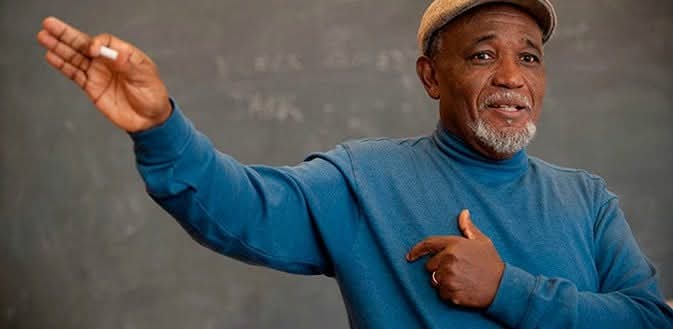
When the curtain finally fell on the life of Dr. Mohammed Ben Abdallah, Ghana lost not just a towering playwright and scholar, but a man whose vision helped shape the country’s cultural and intellectual landscape.
Losing a parent is one of life’s deepest heartbreaks. No matter how old we become, we are never quite prepared for that moment when the voice that guided us falls silent. My father was not just a father to me – he was a compass, a teacher, and a friend.
Though he had battled cardiovascular issues and lived with a pacemaker, he remained strong and in good spirits. Yes, we all know that life is finite, but I must confess – I didn’t see it coming. The news of his passing on 18 September 2025 left a void that words can barely fill.
For our family, his loss is immeasurable. My siblings – Farouk, Rameses, and Amina – live abroad, so it was my mother, my sister Pomaa, and I who were closest to him in his final years. Caring for “the old boy,” as we fondly called him, was both a duty and a privilege. His humour, wisdom, and unwavering faith in the power of art kept our home alive with energy and meaning.
To the nation, his passing is monumental. Ghana has lost a husband, a father, a grandfather, a brother, an uncle – and above all, a cultural icon. To his colleagues, students, and mentees, his departure feels like the closing of a golden chapter in our artistic history. Indeed, a legend has gone home.
A Life Steeped in Theatre and Vision
Born on 25 April 1944 in Kumasi, Dr. Abdallah’s life was defined by an unyielding belief that art could be both mirror and medicine for society. His academic journey began at the University of Ghana, where he earned a Bachelor of Arts in Drama and Theatre Arts in 1968. He later pursued postgraduate studies in the United States, obtaining an MFA from the University of Georgia (1976) and a PhD in Theatre Arts from the University of Texas at Austin (1980).
Returning to Ghana, he quickly rose through the ranks of academia. As a Senior Lecturer and Head of the Department of Theatre Arts at the University of Ghana, he modernized theatre training and research. His classroom was not just a space for performance, but a crucible for ideas on identity, justice, and the human spirit.
But Dr. Abdallah was not confined to the academic stage. His public service career saw him occupy several key roles under the Provisional National Defence Council (PNDC), including Deputy Secretary for Tourism, Secretary for Information, and later Secretary for Education. In each role, he brought creativity and clarity of purpose, linking education and culture to national consciousness.
A Cultural Architect
In 1989, Dr. Abdallah became the first Chairman of the National Commission on Culture (NCC) – an appointment that would mark one of the most significant chapters of his life. Under his leadership, Ghana’s first National Cultural Policy was drafted and implemented, establishing a framework that continues to guide the nation’s cultural development today.
He was also instrumental in the creation of the National Theatre of Ghana, collaborating with the Chinese government to see the vision realized. Within that theatre, he founded Abibigromma, a resident company dedicated to promoting Ghanaian theatre and storytelling – a living legacy of his philosophy that art must serve community and consciousness.
The Playwright and Philosopher
As a playwright, Dr. Abdallah’s pen cut deep into the heart of the African experience. His works – The Slaves (1972), The Trial of Mallam Ilya, Land of a Million Magicians, Winds of Kumbi, and Come Back Azaglo – are not mere scripts but philosophies rendered in dialogue. They explore questions of morality, freedom, and destiny, fusing myth, ritual, and politics into what he called the Abibigoro tradition – an Afrocentric theatre that is both spiritual and revolutionary.
For him, theatre was not entertainment alone. It was education, healing, and resistance. His characters spoke with the cadence of the ancestors, yet their struggles were unmistakably modern.
Mentorship and Legacy
Throughout his decades of teaching and directing, Dr. Abdallah mentored hundreds of students – many of whom now lead in academia, television, film, and cultural policy. His influence can be traced through the corridors of the University of Ghana’s School of Performing Arts, the National Theatre, and the creative industries that continue to draw inspiration from his philosophy.
As a consultant for cultural policy and theatre development, he worked with the Ma’at Foundation, the NCC, the NCCE, and various UNESCO-linked projects, dedicating his later years to the preservation of Ghana’s intangible heritage.
His life’s work now continues through the Ma’at Foundation’s Project to Restore and Promote Visual Artistic and Theatrical Collections, which safeguards his manuscripts, research, and archives for future generations of artists and scholars.
Honours and Recognition
Dr. Abdallah’s remarkable career earned him national and institutional recognition, including:
- National Award for Cultural Contribution (Republic of Ghana) – 1988
- University of Ghana Award for Excellence in Teaching and Research – 1995
- Lifetime Achievement Award, Ghana Association of Writers (GAW) – 2009
- Recognition by the National Theatre of Ghana – 2015
- Posthumous Honours (2025) – Tributes from the Ministry of Tourism, Arts and Culture, the University of Ghana, and the National Commission on Culture.
A Fitting Farewell
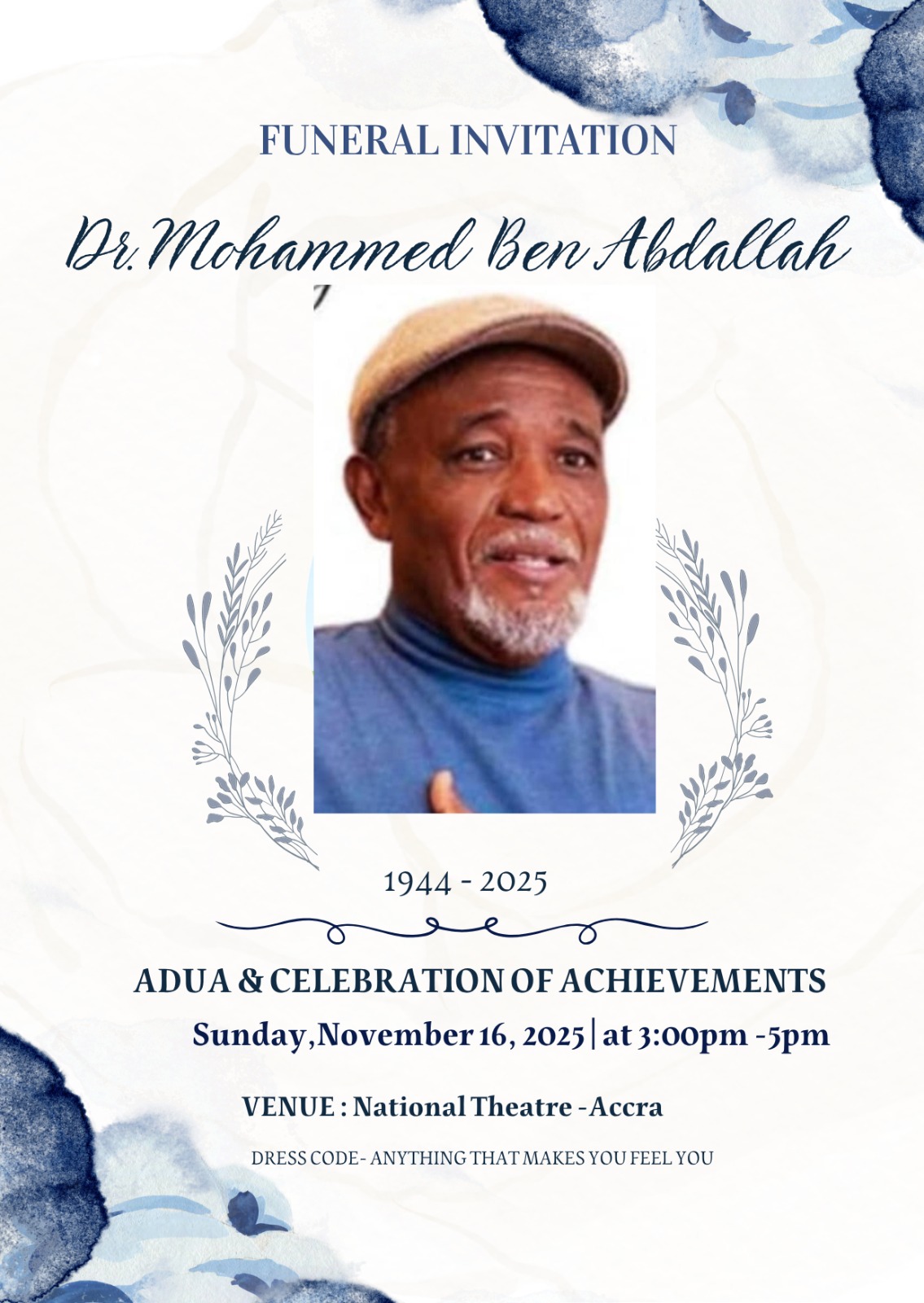
The Final Funeral Rites of Dr. Mohammed Ben Abdallah will be held on Sunday, 16th November, from 3:00 p.m. to 5:00 p.m. The celebration will feature music, dance, and excerpts from his most iconic plays – a fitting farewell to a man whose life was itself a performance of truth, discipline, and devotion to the arts.
An experience awaits – not of mourning alone, but of remembering, rejoicing, and renewing the spirit of a man who taught us that art is life, and that through creativity, the human story continues forever.
A Lasting Legacy
Dr. Mohammed Ben Abdallah’s story is not just that of a man, but of a movement – a reminder that the arts are not peripheral to national development, but central to the making of conscience and culture.
For all who knew him, he remains the same steady voice that urged us to see ourselves, to question power, and to believe in the transformative force of art.
Indeed, a legend has gone home, but his light will continue to illuminate Ghana’s cultural horizon for generations to come.