
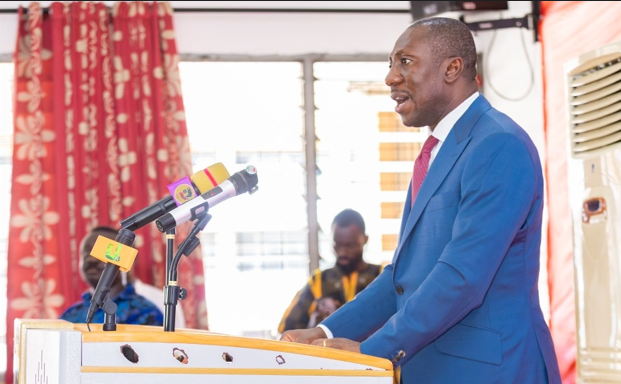
The Minority Leader in Ghana’s Parliament, Alexander Kwamena Afenyo-Markin, has delivered a forceful set of closing remarks at the end of the First Meeting of the Second Session of the Ninth Parliament of the Fourth Republic, emphasising accountability, transparency, and the duty of the opposition to speak truth to power.
Drawing on a quote by former U.S. President Harry S. Truman, Afenyo-Markin warned against any attempt by a government to silence dissent, arguing that such actions undermine democratic governance and erode public trust.
He stressed that the Minority remains committed to its constitutional role, insisting that although parliamentary numbers determine outcomes, they do not determine truth. According to him, the Minority has a responsibility to “guard, protect, and proclaim” the truth, regardless of its numerical strength in the House.
Afenyo-Markin declared that the Minority is not in Parliament to “observe pleasantries,” but to rigorously hold the government accountable. He reiterated that the Ghanaian people expect oversight, not silence, and vowed that the opposition would not be intimidated or subdued.
Concerns over governance and public accountability
The Minority Leader raised a series of concerns about governance, including allegations of opacity in state programmes, procurement irregularities, and questionable financial transactions.
He cited concerns over the Gold-for-Reserves (G4R) programme, describing it as lacking transparency and calling for full disclosure of financial details. He also referenced reported losses in the programme and questioned whether proper accountability mechanisms were in place.
Afenyo-Markin further called for scrutiny of transactions involving politically exposed persons, urging state institutions such as the Office of the Special Prosecutor and the Criminal Investigations Department to investigate alleged irregularities.
He also emphasized that transparency must extend to all levels of government, including matters involving individuals close to the President, insisting that public office demands strict accountability regardless of political affiliation.
Galamsey and environmental concerns
On illegal mining (galamsey), Afenyo-Markin expressed concern that despite public statements acknowledging the problem, government action has not been sufficient. He called for stronger enforcement, including the identification and prosecution of individuals involved, as well as stricter oversight of mining activities and gold sourcing systems.
He warned that continued environmental degradation threatens Ghana’s water bodies and ecosystems, stressing that failure to act decisively undermines national development.
Economic and agricultural challenges
The Minority Leader also addressed economic issues, particularly in agriculture. He criticised recent reductions in farmgate prices for cocoa and cashew, arguing that such decisions negatively impact farmers who depend on stable pricing for their livelihoods.
He urged the government to engage farmer cooperatives and establish a clear price stability framework to protect agricultural producers from sudden market shocks.
He further raised concerns about Ghana’s dependence on food imports, calling for stronger policies to support local production and reduce vulnerability to external supply disruptions.
Security and road safety
Touching on national security, Afenyo-Markin highlighted recurring communal conflicts in parts of the country, urging urgent and sustained interventions by security agencies and traditional authorities.
He also drew attention to road safety, referencing alarming statistics on road fatalities and calling for coordinated action by regulatory agencies to improve road conditions and enforcement.
He cited individual tragedies to underscore the human cost of inaction, urging Parliament to prioritise reports and investigations into such incidents.
Call for institutional accountability
Throughout his remarks, Afenyo-Markin underscored the need for Parliament to remain vigilant in its oversight role. He called for parliamentary committees to actively investigate national issues and ensure that public institutions are held accountable.
He also addressed internal parliamentary dynamics, acknowledging disagreements between the Minority and Majority but emphasising the importance of mutual respect and the national interest.
Closing remarks
In conclusion, the Minority Leader reaffirmed his commitment to representing the interests of Ghanaians, particularly vulnerable groups such as farmers, accident victims, and communities affected by conflict.
He urged all stakeholders to remain committed to the principles of accountability, transparency, and good governance, stating that the Minority will continue to advocate for justice and responsible leadership.
He closed by extending seasonal greetings to Members of Parliament and Ghanaians, expressing hope for national renewal and urging continued dedication to the work of Parliament.