
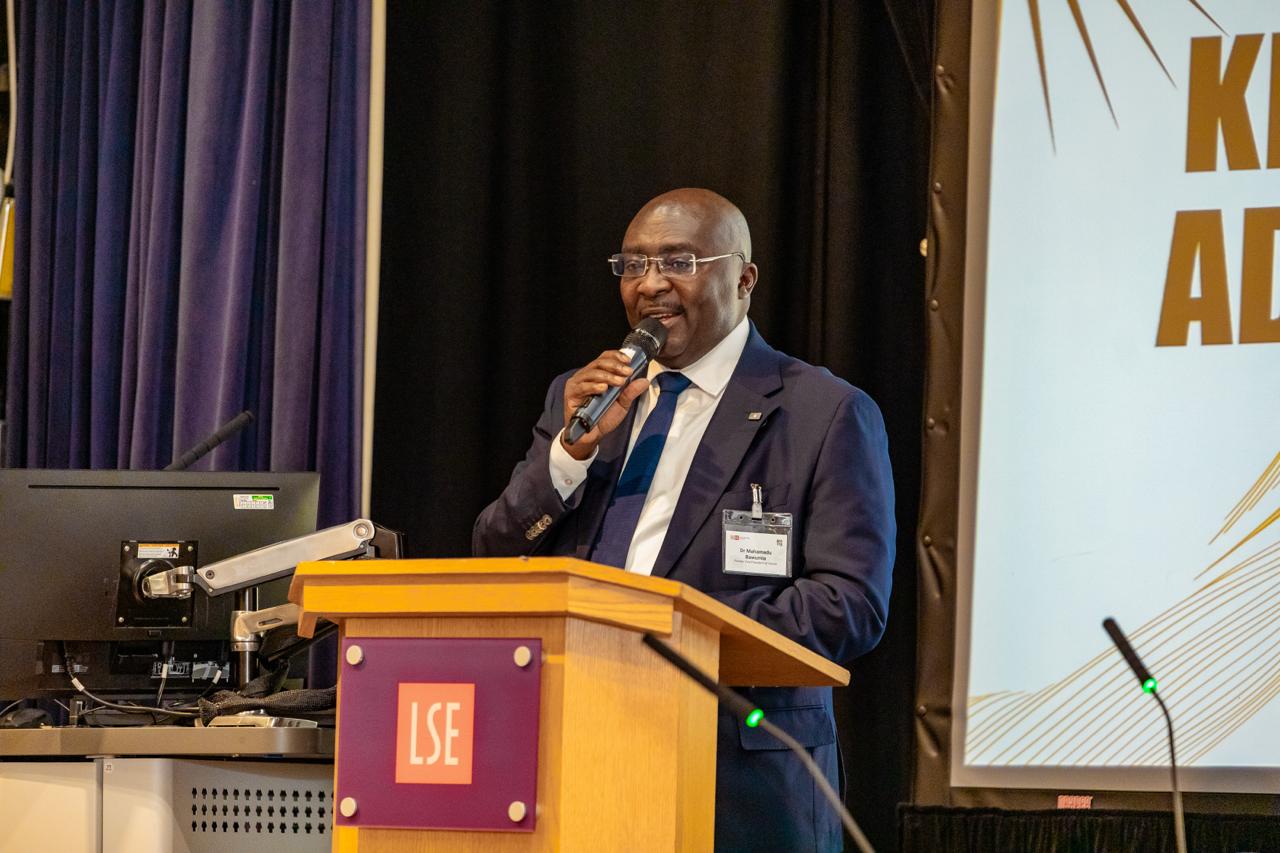
Former Vice President of Ghana and 2028 flagbearer of the New Patriotic Party (NPP), Dr Mahamudu Bawumia has outlined six key policy commitments he believes are essential for Africa to emerge as a global leader in Artificial Intelligence (AI).
He underscored the importance of robust digital infrastructure as the foundation for artificial intelligence development in Africa.
Giving a keynote address at the London School of Economics and Political Science (LSE) Africa Summit 2026, the former Ghanaian Vice President highlighted how Artificial Intelligence can break barriers, connect people, and drive a more united and prosperous Africa.
The six priorities for building Africa’s AI capacity, he mentioned, included, investing in reliable electricity and broadband infrastructure to support digital innovation, developing secure and trustworthy data systems that protect users and facilitate large-scale AI applications.
Others are creating large-scale talent development programmes to equip Africa’s workforce with critical AI skills and strengthening public sector procurement capacity to ensure governments can effectively adopt AI solutions.
The rest are integrating ethical standards into AI deployment, ensuring technologies are transparent, fair, and accountable as well as promoting cross-border collaboration to create interoperable digital markets that enhance innovation and scale.
Dr Bawumia highlighted significant disparities in internet connectivity and electricity access across African countries, arguing that without reliable electricity, broadband, and data systems, AI ambitions on the continent would remain unattainable.
“It is the case that we are in the midst of a global digital revolution. Artificial Intelligence, big data, cloud computing, the Internet of Things-they are not just buzzwords, they are reshaping our world. Digitalization is no longer at the periphery. It is front and center; it is a necessity for survival and prosperity in the 21st century.
“Africa missed the first industrial revolution, which saw the transition from manual to small-scale production to mechanized production in agriculture and goods like textiles, mostly powered by steam and coal energy.
“Then we missed the second industrial revolution where the widespread use of electricity powered mass production and assembly lines. The third industrial revolution, which was set off by the introduction of computers, also did not see Africa jump on and develop like others.
“We are now in the fourth industrial revolution where the technologies have come together in a global network to create the internet, which is the greatest machine ever created by mankind, and using that to also energize tools and equipment to make them ‘smart’ to create the internet of things (IOT) and Artificial Intelligence (AI), which have opened up amazing possibilities with no end in sight,” Dr Bawumia recounted.
While acknowledging progress, he stressed that the quality of access internet connectivity remains a critical issue.
“AI thrives on connectivity, electricity, and reliable digital infrastructure.
“Before we debate algorithms, we must be disciplined about the foundations that enable adoption at scale: networks, power, and trustworthy data systems.”
He reiterated that internet penetration and electricity access across Africa remain uneven, warning that such disparities could widen inequality if not addressed.
Dr Bawumia also referenced global data indicating that billions of people remain offline, with Africa mostly affected.
He called for urgent and coordinated investment in infrastructure, noting that Africa’s AI agenda must be treated as an infrastructure agenda to ensure inclusive and sustainable digital growth.
Dr. Bawumia emphasised that Africa must move beyond debate and take practical, measurable steps to establish a competitive AI ecosystem.
He stressed that success in the digital era requires deliberate planning, sustained investment, and strong institutional capacity across the continent.
“Technological revolutions reward those who build foundations: institutions, infrastructure, skills, and rules before they chase the latest applications.
“Africa must act boldly, but methodically to secure its place in the global digital economy,” he stated.
Dr Bawumia called on African leaders and institutions to seize the moment and shape the continent’s AI future.
“Africa should be poised to shape the global AI conversation not as a passive consumer, but as a builder of responsible systems.
“If we unite borders through infrastructure, skills, governance, and markets, then AI can become a force for shared prosperity.
“We cannot afford to be left behind this time. We should embrace technology and not be intimidated by it,” Dr Bawumia concluded.
By Kyei Boateng