
The Bank of Ghana (BoG) has said Ghana’s economy has made significant progress toward stability following a difficult period marked by high inflation, currency depreciation, and debt restructuring.
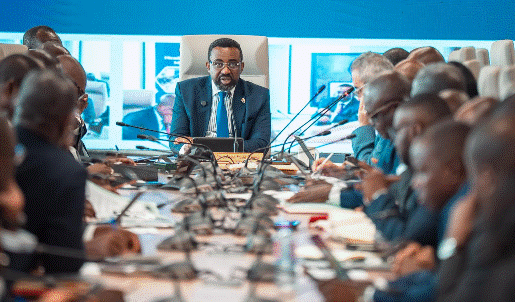
Addressing Parliament’s committee on the economy, Governor of the Central Bank, Dr Johnson Asiama said the central bank’s policy measures since early 2025 have helped restore confidence in the economy, stabilise the exchange rate and strengthen the financial sector.
The Governor told the committee that when he assumed office in February 2025, the economy was emerging from “one of the most challenging periods in recent history.”
Ghana had recently undergone a sovereign debt restructuring, inflation remained high, and the financial sector was still adjusting to the impact of the Domestic Debt Exchange Programme.
Inflation at the end of 2024 stood at 23.8 percent, far above the central bank’s target band of 8 ± 2 percent. At the same time, the Ghanaian cedi had depreciated by 24.8 percent during 2024, contributing to rising prices and weakening confidence in the economy.
The banking system was also facing pressure following the debt exchange programme, which affected financial institutions’ balance sheets and limited lending activity. Lending rates remained above 30 percent, while private sector credit growth was weak.
The central bank itself was not spared. The restructuring of government securities under the debt exchange programme imposed a 50 percent haircut on the Bank of Ghana’s holdings of government securities, weakening its financial position.
The situation was further complicated by excess liquidity in the banking system, which reduced the effectiveness of monetary policy.
Despite these challenges, the Bank of Ghana said it entered 2025 with a clear objective: to decisively reduce inflation, restore confidence in the exchange rate and rebuild the foundations for long-term macroeconomic stability.
Policy actions
To achieve these goals, the central bank implemented a series of policy measures.
First, the Monetary Policy Committee maintained a tight monetary policy stance aimed at bringing inflation under control and anchoring expectations.
The Bank also intensified open market operations to absorb excess liquidity in the banking system. This included increasing the frequency and volume of open market operations, sterilising foreign exchange intervention inflows, and coordinating closely with the Ministry of Finance on government cash management.
The central bank further prioritized strengthening Ghana’s external buffers. International reserves were boosted through improved export earnings, remittance inflows and the Domestic Gold Purchase Programme.
In November 2025, the Bank also introduced a new foreign exchange operations framework to improve transparency and predictability in the foreign exchange market.