
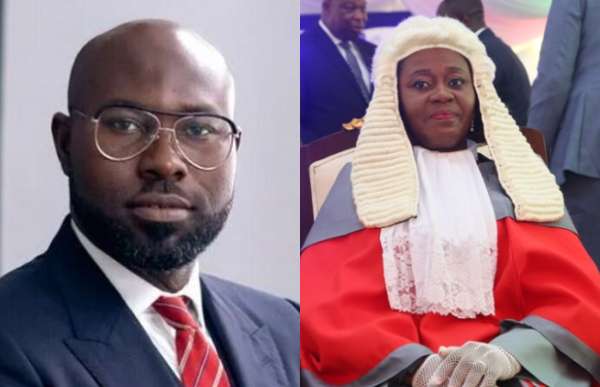
The removal of Chief Justice Gertrude Araba Esaaba Sackey Torkornoo from office by President John Dramani Mahama has been described as a ‘flagrant assault’ on Ghana’s democracy, warning that the development threatens the independence of the judiciary.
The Minority caucus in Parliament in a statement issued on Monday 1st September, 2025, said the president’s action amounted to nothing more than a judicial coup clothed in flawed constitutional procedures.
Mr John Darko, Member of Parliament (MP) for Suame and Legal Counsel to the Minority Caucus in the statement opined that Ghana’s judiciary is now under the control of the executive.
“1st September of every year must be commemorated as the day in which the judicial branch of Ghana’s political institutions was finally subjugated by the executive. It must live in infamy,” the Minority’s statement added.
President Mahama in warrant signed on 1st September, 2025, said “NOW THEREFORE, KNOW YE ALL MEN that I, JOHN DRAMANI MAHAMA, President of the Republic of Ghana, in pursuance of the said article 146(9), do hereby REMOVE the said Chief Justice, Justice Gertrude Araba Esaaba Sackey Torkornoo, from the office of Chief Justice and Justice of the Supreme Court, with effect from the date hereof.
“IN WITNESS WHEREOF, I have hereunto set my hand and caused the Presidential Seal to be affixed at Accra this 1st of September 2025.”
With this warrant, President Mahama is now the second Head of State in Ghana’s political history with the unenviable record of dismissing a Chief Justice, following that of President Kwame Nkrumah in 1963.
The Minority expressed shock at the president’s decision, even though the group said it had anticipated the administration’s machinations to oust the Chief Justice.
“Our caucus, even though aware of the administration’s intentions to remove the Chief Justice, still held the belief that the president would appeal to his better angels to act virtuously for the sake of the nation,” the Minority reiterated.
Separation of powers hindered
Recent events in Ghana have sparked a nationwide debate, leading many to question the health of the nation’s democracy and the traditional separation of powers.
With the swearing-in of President John Mahama, the National Democratic Congress (NDC) now holds a formidable position of power, controlling not only the executive but also a rare supermajority in Parliament.
This consolidation of power, culminating in the unprecedented removal of the Chief Justice, has led to a single, urgent question, is Ghana witnessing the emergence of a “Supreme Leader” who now controls all three arms of government?
Weakening institutions
The Minority group has argued that the removal aligns with what they describe as a grand agenda by the governing NDC to weaken state institutions for political gain.
“From the president’s address to NDC lawyers and the several claims by the NDC’s Chairman Johnson Asiedu Nketiah that Justice Torkornoo and the Chair of the Electoral Commission must be removed at all cost during the 2024 campaign, this removal forms part of that agenda to bastardize the institutions of state and run the country as a gangster town,” Counsel to the Minority caucus, Mr Darko added.
According to the Minority, the development has set Ghana back in its democratic journey and puts the nation in the unenviable company of countries like Pakistan, Bangladesh, and Sri Lanka, which have removed their chief justices for political reasons.
“All well-meaning Ghanaians, including our revered chiefs, the clergy and the media, must condemn this coup in no uncertain terms,” the statement added.
President’s extensive authority
As both the Head of State and Head of Government, President Mahama exercises extensive authority, ranging from serving as Commander-in-Chief of the armed forces to making key appointments across the public service.
This inherent power is a given in Ghana’s presidential system.
However, the real concern, according to political watchers, arises when the other branches of government, designed to serve as checks, appear to be in lockstep with the executive’s agenda.
NDC’s supermajority in Parliament
The results of the December 2024 general election have ushered in a new era of parliamentary dominance for the NDC.
After a period of an unprecedented “hung parliament” where the previous government had to negotiate and build consensus, the NDC now holds a supermajority with two-thirds of all seats in parliament.
This dramatic shift has a profound implication for Ghana’s democracy. Parliament’s role as a legislative check on the executive is severely diminished.
With a supermajority, the government can pass any bill it desires with minimal resistance.
More significantly, it now has the power to amend the non-entrenched constitutional provisions without needing bipartisan support from the opposition.
This effectively transforms Parliament from a body of checks and balances into a mere rubber stamp for the executive’s policies.
Effect of Chief Justice’s removal
The most potent symbol of this perceived consolidation of power is the recent, unprecedented removal of Chief Justice Gertrude Torkornoo.
Appointed by the previous NPP administration, the CJ’s dismissal came after a constitutional committee recommended her removal based on a petition alleging “stated misbehaviour.”
While the Presidency maintained that it was simply following the constitutional process, the timing and nature of the event have sent shockwaves through the legal and political communities.
For the first time in Ghana’s history, a sitting Chief Justice has been investigated and dismissed.
This act, regardless of its legal justification, is seen by many as a dangerous precedent.
It creates a chilling effect, where judges may now feel pressured to rule in favour of the government to avoid similar petitions and investigations.
Critics’ view
Critics argue that the dismissal of Chief Justice Torkornoo is a clear attempt to install a more compliant head of the judiciary, thus allowing the executive to extend its influence over the third and final branch of government.
Cumulative effect on democracy
When viewed in isolation, each of these events—a presidential election victory, a parliamentary majority, and a legal process for removing a judge, might seem like normal functions of a democratic state. However, political analysts believe their cumulative effect paints a concerning picture.
Ghana’s democracy is founded on the principle of the separation of powers, where the executive, legislature, and judiciary are distinct and independent.
When one political party and its leader control all three, the very foundation of this principle is threatened.
More questions raised
The current political landscape raises several urgent questions for the future.
Will the NDC’s supermajority enable it to make controversial constitutional amendments without public consensus?
Will judges feel secure enough to make rulings that challenge the government?
And, most importantly, has the era of democratic checks and balances given way to the undisputed reign of a single, all-powerful leader?
While supporters may argue that the NDC is simply exercising a clear mandate given by the Ghanaian people, the profound shift in the balance of power demands urgent national discourse.
The events of this year have thrust Ghana into a moment of truth, testing the resilience of its institutions and the strength of its democracy.