
It appears the idiomatic expression that ‘what goes around comes around’ has finally returned to President John Dramani Mahama over his unconventional views on the impact of external factors on the Ghanaian economy.
While in opposition, Mr Mahama argued that external factors such as the Russia-Ukraine conflict did not affect the country’s economy as the distance between Ghana and those two Eastern European countries were thousands of miles away.
“How does it concern us if Russia and Ukraine are in war? Travelling from Accra to Ukraine in a plane is about 7,000km and so how does it affect our economy if these two countries are fighting? What will Cote D’Ivoire also say because Russia and Ukraine are fighting?” Mr Mahama asked rhetorically, downplaying the effect of external shocks on Ghana’s economy during a campaign tour in the lead-up to the 2024 general election.
However, now in government, President Mahama has made a dramatic u-turn, strongly dismissing his own claim that the external factors do not have any impact on Ghana.
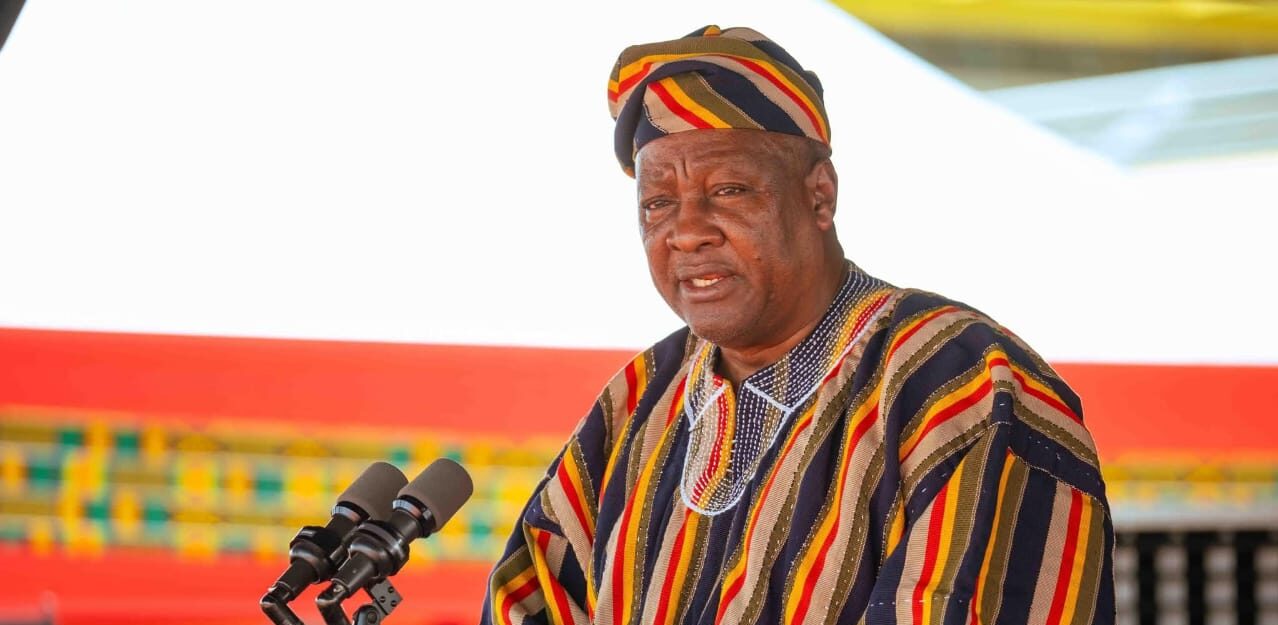
Speaking at Ghana’s 69th Independence Anniversary Celebration at the Jubilee House in Accra on Friday, 6th March, 2026, the President feared that the ongoing US-Israel and Iran war could lead to increases in petroleum prices with its negative consequences for the country’s economy.
“Ghana is not immune to the shocks of global events. Recent events in the Middle East, which involve an exchange of missiles between Israel and Iran, have started to escalate crude oil prices dramatically.
“I have asked our Minister of Finance and Minister of Energy to keep a close eye on the development and model the possible impacts on our petroleum prices,” President Mahama acknowledged.
Middle East tensions and economic impact
Earlier in Arusha, Tanzania, for the official opening of the 2026 Judicial Year of the African Court on Human and Peoples’ Rights on March 2, President Mahama expressed alarm over escalating attacks involving the United States, Israel and Iran, as well as counter-attacks on Gulf states, warning that Africa must brace for economic shocks.
He described the Middle East as the “epicentre of global oil supplies,” stressing that any sustained instability would inevitably trigger rising crude oil prices with direct negative consequences for African economies.
According to him, increases in global crude prices quickly translate into higher transport costs, inflationary pressures, and fiscal strain across the continent.
Contradictions in opposition
But in opposition, Mr Mahama downplayed the impact of COVID-19 on Ghana’s economy even though he acknowledged the pandemic significantly affected the whole of Africa.
Speaking at the Africa Business Conference of Harvard Business School in 2024, then former president Mahama painted a bleak picture of the negative impact that the COVID-19 pandemic and the two-month-old Russia-Ukraine war had on African countries.
He, however, argued that with better management, Ghana’s economy, though equally buffeted by global and geopolitical events, could have been more resilient.
On the impact of COVID-19 on Africa
Mr Mahama conceded that the entire African continent, based on “data from the Economic Commission of Africa”, showed that the COVID-19 pandemic created the “continent’s worst recession in 50 years, with real GDP shrinking by an average of 3% in 2020”, and that even “before the pandemic, poverty reduction was already a major challenge in Africa”.
“The pandemic is estimated to have dragged about 55 million more people into poverty in Africa and exposed another 46 million more to the risk of hunger and malnourishment. Indeed, 70% of hunger in Africa, which had already been on the rise since 2014, is directly attributed to this pandemic,” the former president said.
He further emphasised, “Like governments all over the world, it became necessary for African governments to take action to shield their population from the effects of the pandemic. This meant, in many cases, an increase in deficits due to unbudgeted expenditures.
“This has devasted many African economies and sunk them deeper into unsustainable debts and economic downturns. This pandemic has had a general deleterious effect on the economy of African nations,” Mahama said.
On Russia-Ukraine war
Another contradiction was that while Mr Mahama agreed that the Russia-Ukraine war had the negative impact on the African continent, he painted a picture that Ghana was only affected because of mismanagement of the economy.
“Even as COVID-19 still lingers and African countries attempt to reset their economies, yet another disruption, this time of a geopolitical nature, threatens to wreak more havoc on an already fragile continent.
“The Russia-Ukraine conflict is set to peg Africa’s growth back by an estimation of about 0.7%. Inflation is expected to rise by at least 2.2% in 2022, and as many as 43 countries that depend on energy and food imports will be confronted with fiscal and current account problems.
“Global increase in energy prices has escalated the cost of living and compounded hardships in many countries.
“In light of the above, the conversation is now about overcoming the twin problems of a pandemic and its aftermath and a geopolitically induced economic crisis, as opposed to one that focuses on just post-pandemic recovery,” he said.
According to him, Ghana was not able to deal with the effects of the pandemic and the Russia-Ukraine conflict because the country was not prudent in the use of its resource envelopes during these crises.
“In my country, Ghana, our economy has emerged in extremely poor shape from the COVID experience. A ballooning deficit, double-digit inflation, a nosediving currency, and increasing debt distress are some of the symptoms of a very ill economy.
“Ghana went into the pandemic without adequate buffers and has emerged with a terribly battered economy,” then NDC presidential candidate further claimed.