
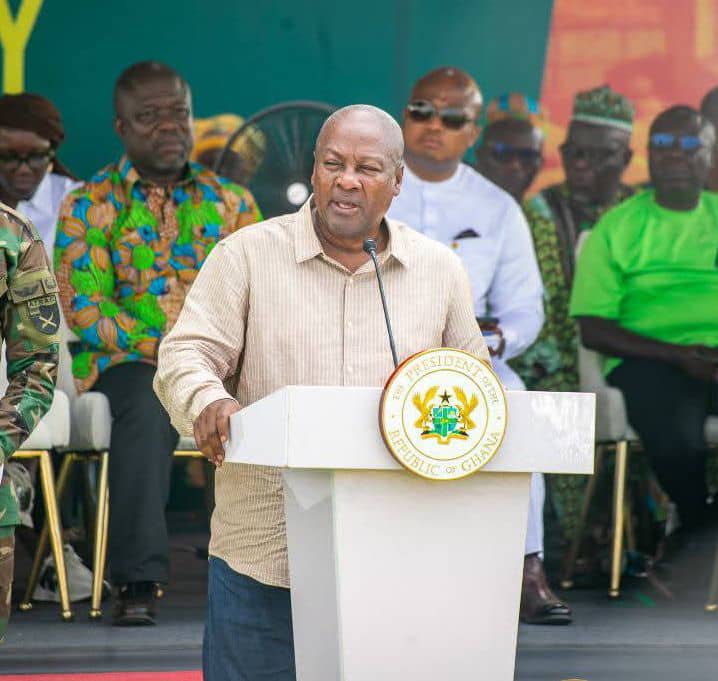
President John Dramani Mahama has announced that the government’s renewed agricultural policy is centred on modern irrigation, affordable credit, and guaranteed markets to ensure year-round production and strengthen national food security.
He said every nation that treasures food security must invest in systems that allow continuous production, not just seasonal farming.
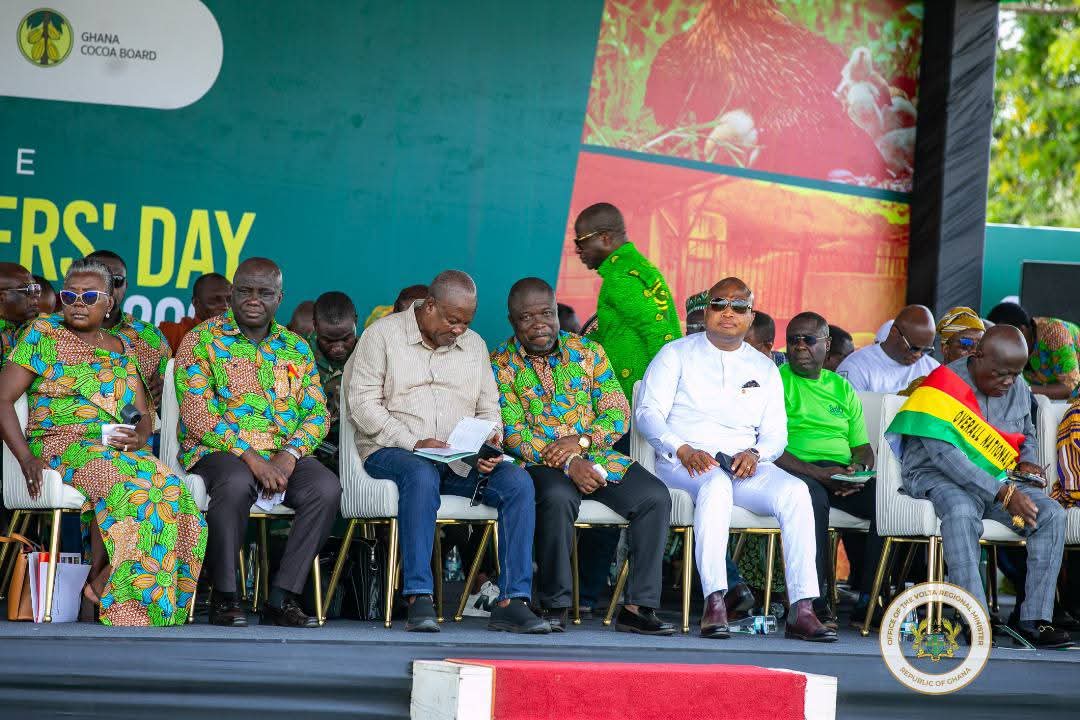
President Mahama said this during the 41st National Farmers Day celebration at Ho.
“We can only guarantee food security if we put in place mechanisms that support all-year-round agriculture,” he said.
“That is why we are taking irrigation seriously, both in areas close to water bodies and in areas where underground water can be accessed.”
He announced that the Ministry of Food and Agriculture would distribute solar-powered water pumps and drill boreholes for farmers, even on small 10-acre farms, to enable uninterrupted farming without reliance on the national grid.
“With year-round irrigation, a farmer can plant and harvest up to three times a year. Ten acres of irrigated land can produce the same yield as 40 acres of rain-fed land,” he noted.
President Mahama praised women farmers and fishers, including the Ghana Association of Female Agricultural and Fish Farming Award Winners (GAFAFAW) group, describing them as central to Ghana’s agricultural transformation.
He acknowledged that high interest rates continued to hinder productivity and affirmed the government’s commitment to delivering single-digit credit for farmers.
“Credit for agriculture must be below 10 per cent. At the current rates, farmers end up working for banks instead of themselves,” he said.
The President expressed concern about the continued importation of food for the School Feeding Programme (SFP), while Ghanaian farmers struggled with unsold produce.
“It is unacceptable that rice from Vietnam is being used to feed our schoolchildren when our farmers still have stock from last year,” he said.
He reiterated his directive that rice, maize, and poultry used under the SFP must be sourced locally.
President Mahama highlighted breakthroughs by local scientists, including a new weevil-resistant variety of cowpea (black-eyed beans), which allowed longer storage and reduced post-harvest losses.
He said the government would commercialise improved seed varieties and distribute them to farmers to enhance productivity and food preservation.
The President announced plans to launch a nationwide school agriculture programme requiring all secondary and tertiary institutions to operate school farms to produce livestock and vegetables for their own consumption.
A National School Agriculture Coordinator had already been appointed to lead the initiative, he said.
The government is distributing three million improved four-week-old chickens to registered farmers under the ‘Nkoko Nkitenkite’ initiative.
Beneficiaries also receive feed to raise the birds until they were ready for market within four to six weeks, stating that agriculture was profitable and could complement salaried jobs.
“Even as President, I am a farmer. Everyone can farm, including teachers, nurses, engineers, and civil servants. A 10 or 20-acre oil palm plantation can earn you more than your annual salary,” he said.
President Mahama also commended the U.S. government for removing tariffs on several Ghanaian agricultural products, including cocoa, avocado, pepper, oranges, onions, and yams.
He stated that with zero tariffs, Ghana’s agricultural exports to the U.S., currently around $100 million, could increase significantly, and encouraged farmers to tap into the expanded market.