
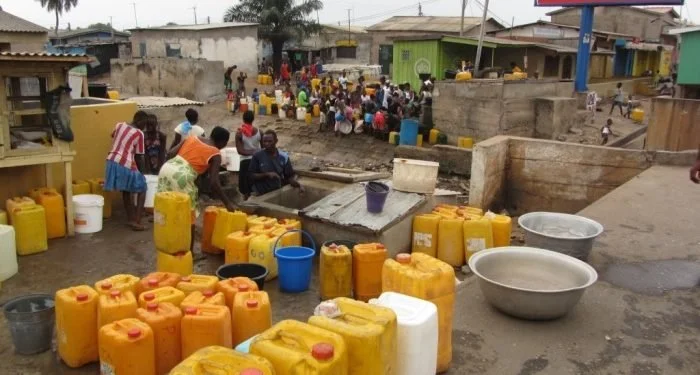
Residents across the Tema Metropolis and eastern parts of Accra are expected to face a major water supply interruption after a 42-inch transmission line burst, disrupting distribution to several communities.
Ghana Water Limited (GWL) announced in a statement on Tuesday, January 20, 2026, that a significant pipeline burst occurred on Monday, January 19, 2026. The incident has caused widespread supply challenges throughout the affected areas.
Efforts to fix the damage
According to GWL, engineers and technical teams were deployed immediately after the fault was detected and have been working continuously to repair the damaged line.
“Due to the size of the transmission main and the complexity of the repair, the restoration process requires careful handling to ensure safety, durability, and efficiency,” the statement said.
GWL emphasised that every effort is being made to accelerate repairs and restore normal supply:
“We sincerely regret the inconvenience caused and appreciate the patience and understanding of our cherished customers.”
Areas affected
The interruption is expected to impact customers across the entire Tema Metropolis and several parts of Accra, including:
-
Ashaiman
-
Gbetsele
-
Akatamanso
-
Klagon
-
Lashibi
-
Baatsonaa
-
Spintex
-
Parts of East Legon
-
Nungua
-
Teshie
-
And the surrounding communities
Support for essential services
GWL noted that essential institutions — particularly schools and hospitals — will receive special assistance to ensure access to clean water during the repair period.
The company assured the public that supply will be restored immediately upon completion of the work and reiterated its apology for the inconvenience caused.
About Ghana Water Limited (GWL)
Ghana Water Ltd. is the government-owned utility responsible for the production, transmission, and distribution of water in urban areas nationwide. As of June 2024, GWL manages eighty-four (84) water systems — sixty-one (61) surface water systems and twenty-three (23) groundwater systems — serving roughly 14 million people.
The company operates through 15 regional offices and 103 district offices, with an average production capacity of 950,995 m³/day against a national demand of 1,129,361 m³/day. Urban water access currently stands at 84.2%, serving over one million customers, 89% of whom are metered. GWL employs 5,755 staff.
Governance structure
The Ministry of Sanitation and Water Resources oversees national water supply policy, supervises GWL operations, and coordinates sector investment. Under this framework, GWL is governed by an 11-member Board of Directors responsible for setting sector policies and managing corporate programmes.
Day-to-day operations are led by a Managing Director and three General Managers in charge of Finance and Administration, Operations, and Special Duties.
They are supported by 16 Chief Managers heading various departments, including Human Resources, Legal Services, Corporate Planning, Finance, Water Quality Assurance, Operations and Maintenance, and others.
At the regional level, 15 Regional Chief Managers oversee operations, supported by line managers. District Managers lead operations at the district level across the country.