
By Ken Bediako
The unsolicited advocacy to restore the name of Ohene Djan as a legendary Ghanaian sports administrator continues unabated. In my capacity as a long-serving Ghanaian sports journalist spanning more than 60 years, I can modestly confirm with some amount of authority that Ohene Djan truly deserves to be in Ghana Sports Hall of Fame.
I can assure you the national honour done Ohene Djan in 2004 by naming Accra Sports Stadium after him was definitely a step in the right direction.I keep wondering why the Sports Ministry has turned a blind eye to the defacing of the Accra Stadium allegedly by a group of hired hooligans. What a shame. I seem like a broken gramophone record I have kept repeating the tall list of Ohene Djan’s achievements so much so that you may begin to get bored. I have opted to give special attention to The National Football League, which is a major legacy of Ohene Djan. As already enumerated in my previous articles Ohene Djan as FA executive secretary, subsequently doubling as Sports Director, the Aburi Royal competently run the National League from 1958 till 1966 when he was sacked from office when Osagyefo Kwame Nkrumah’s CPP government was changed in Military cum Police Coup d’etat.
We have already covered the 1958- 1960 league stories.
Here you are with the story of the 1961-62 league season.
THE CONTROVERSIAL FORMATION OF REPUBLIKANS
April 16, 1961-March 11, 1962.
To give the game more nationwide appeal, the size of the league doubled from 8 teams to 16, and new centres were also created.
The new clubs admitted into the league were Swedru All Blacks, and Real Republikans (Swedru); Denkyira United and Adansi United (Dunkwa/Obuasi); Great Ashanti and B. A. United (Sunyani); Accra Standfast and Kumasi United (Nkawkaw).
In the Central Region, the Cape Coast venue, which had been closed the previous season was re-opened, in addition to Agona Swedru. In Ashanti, the Dunkwa/Obuasi centre was created, as was Nkawkaw for the Eastern Region and Sunyani for Brong Ahafo.
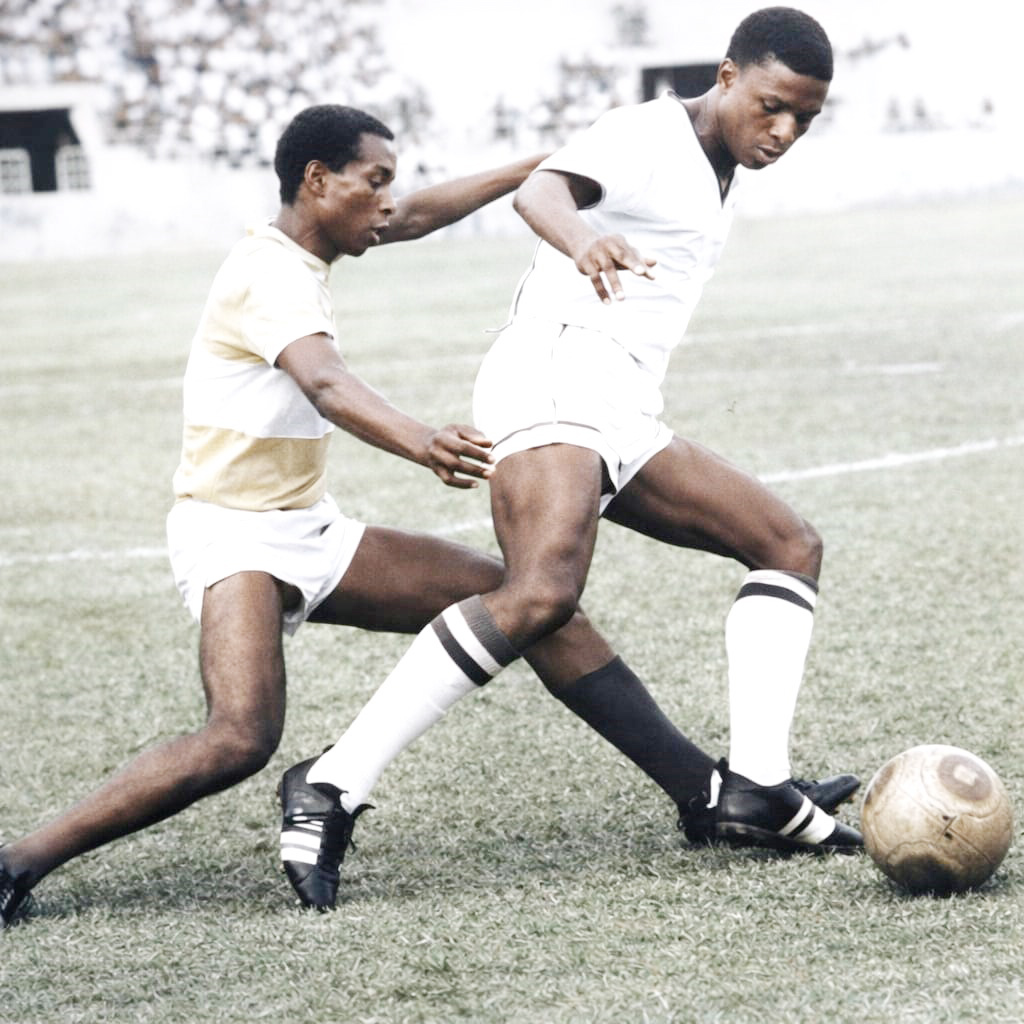
This was a season full of controversy. Sports Director Ohene Djan’s decision to form model club, Real Republikans, which was made up of the two top players of top league clubs raised a storm of protest from the sporting public. The poached players were Addo Odametey, Ofei Dodoo (Hearts); Dodoo Ankrah, E.O. Oblitey (Olympics); Dogo Moro, Baba Yara (Kotoko); Edward Acquah, Cromwell (Wise); Bob Neizer, George Appiah (Hasaacas); Joe Aikins, Kojo Appiah (Corners); Thompson Nunoo (Vipers); Edward Boateng (Standfast); Osei Kwasi (Great Ashanti); and Franklin Crentsil (Independence).
Ohene Djan’s vision was to have the top national stars play together regularly so Ghana could form a strong national team ready for continental assignments at the shortest notice.
Subsequent events proved Ohene Djan right as Ghana won the African Cup of Nations twice on the trot in 1963 and 1965. Ghana beat Sudan 3-0 in the 1963-Cup final in Accra and beat host nation Tunisia 3-2 in extra time in the 1965-Cup final in Tunis. The team was made up of mainly Republikans players.
Asante Kotoko was the most outspoken club against the formation of Republikans and threatened to boycott the league. To counter the threat, the Football Association in an unprecedented display of power, hurriedly formed Kumasi United Club as a replacement for the ‘Porcupine Warriors’ if they carried out their boycott threats.
After a series of tense secret negotiations, Kotoko agreed to play the league. However, for daring to rebel in the first place, they were forced to honour all their first round ‘home’ matches at Nkawkaw CYO Park. The situation changed in the second half and Kumasi United moved to Nkawkaw while Kotoko returned to their ‘natural habitat.’
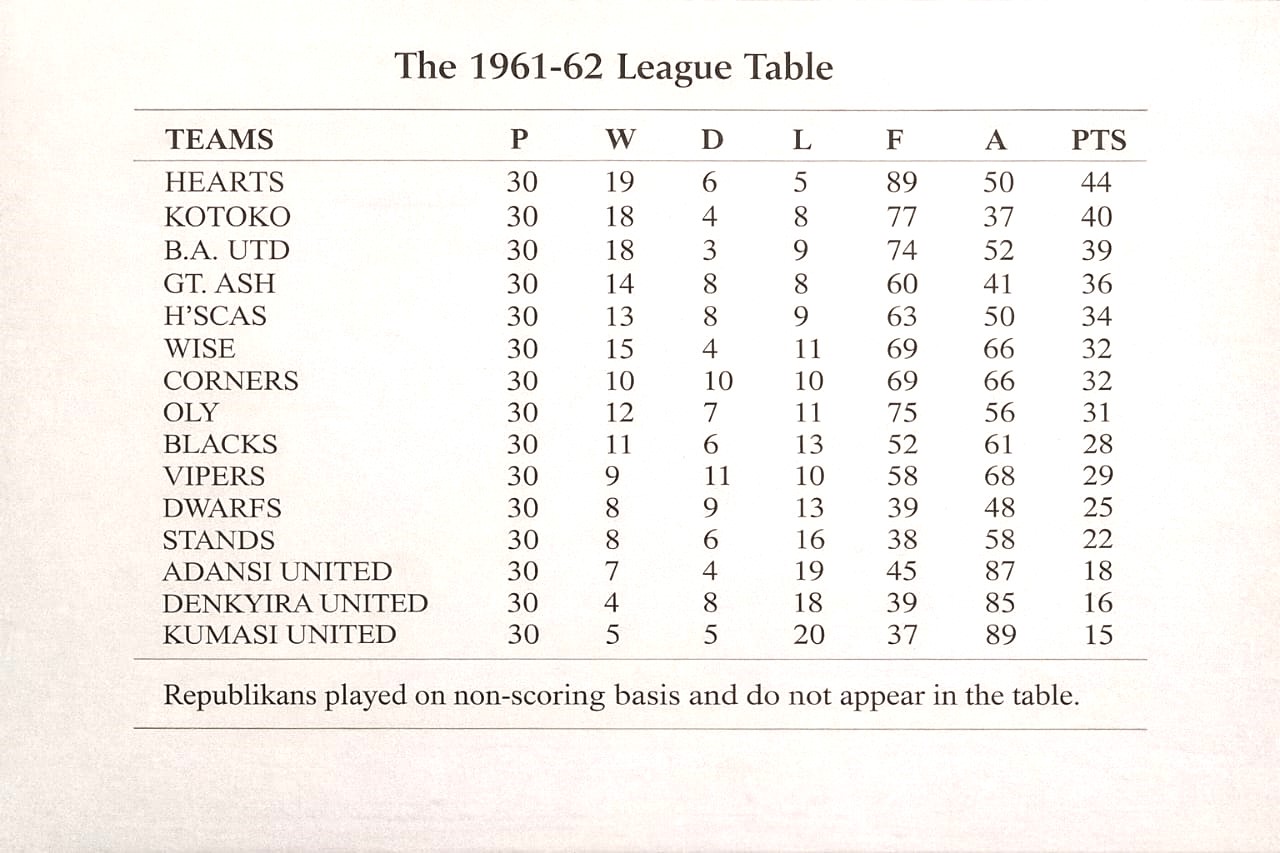 As if the formation of Real Republikans wasn’t controversial enough, more controversy was caused by the role they played in the league. The star-studded team played on a non-scoring basis, meaning it did not count if they won a match; however, if they were defeated, the winning team gained two points.
This arrangement became an important factor in a deciding match between Hearts of Oak and Republikans. The ‘Phobians’ needed a win to capture the league trophy and won 2-1. General consensus though didn’t believe it was a fair win, with Republikans being openly accused of deliberately making things easy so that Hearts could become the champions. This charge was understandable, for if Republikans had defeated Hearts, Kotoko would have been the team to raise the cup; it was common knowledge, after the controversy at the beginning of the league that Kotoko and Republikans were the bitterest of enemies.
Some football historians claim that the Hearts-Republikans match was the first match-fixing incident in Ghana, and it was officially sanctioned.
The star attraction of the season was once again Aggrey-Fynn, the schemer cum goal-getter.
For the first time, teams were relegated from the league for underachieving. Adansi United, Denkyira United and Kumasi United, languishing at the bottom of the league table were the first three teams to experience relegation in the Ghana League.
Cheers everybody and keep loving sports.