
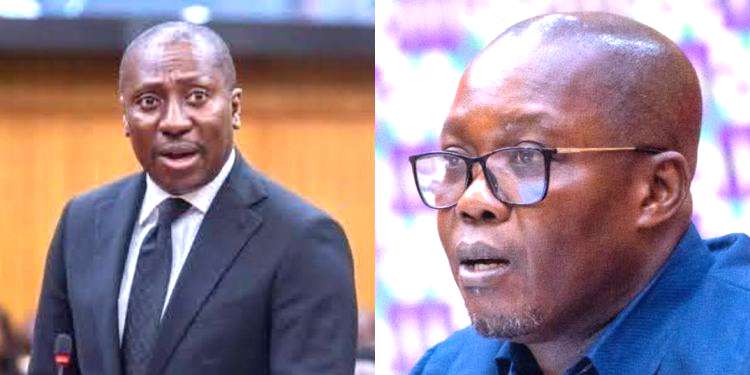
Ghana’s Minority Leader in Parliament, Osahen Alexander Afenyo-Markin, has officially challenged a ruling by the First Deputy Speaker, Mr Bernard Ahiafor that blocked parliamentary debate on a private member’s motion.
The motion was seeking review of a controversial directive issued by the Chief of Staff, Julius Debrah on mass dismissal of public sector workers by current the National Democratic Congress (NDC) government.
However, the motion was struck down by Mr Ahiafor on grounds of being subjudice.
Parliamentary scrutiny
The motion numbered 16, sought to invite parliamentary scrutiny of the directive, which has drawn national attention due to its sweeping nature and implications for continuity in public administration.
Accordingly, on Friday, June 13, 2025, Osahen Afenyo-Markin filed an application on the Floor of Parliament, urging the Speaker to set aside the earlier ruling.
He argued that the decision to sustain a preliminary objection based on ongoing litigation, “fundamentally misconceives the nature and application of the subjudice rule.”
The Minority Leader who is also the Member of Parliament (MP) for Effutu in the Central Region accused the First Deputy Speaker of subordinating Parliament’s constitutional role to the mere existence of a court case.
“This ruling establishes a dangerous precedent that threatens the very foundations of parliamentary democracy in Ghana,” Afenyo-Markin stated.
Parliament must not be muzzled
The Minority Leader maintained that Parliament’s deliberative and oversight powers cannot be neutralized simply because a citizen has filed a lawsuit involving the same or related matters.
He insisted that only an express court injunction backed by strong evidence of irreparable harm can justifiably bar a constitutional body from exercising its functions.
Citing the Supreme Court’s recent ruling in Vincent Ekow Assafuah vs. Attorney General, Osahen Afenyo-Markin noted that the country’s apex court held that the work of constitutional bodies cannot be frozen by the mere initiation of legal proceedings.
“The mere pendency of the action cannot, therefore, justify parliamentary inaction,” he emphasized.
According to him, the ruling by Mr. Ahiafor introduced what he called “a perverse incentive structure,” whereby any person could suppress parliamentary debate by filing lawsuits on national matters.
“Such a practice, if allowed to stand, would undermine Parliament’s constitutional independence and weaken its capacity for democratic oversight,” the Minority Leader warned.
Invoking Order 127 to reinstate agenda item
Osahen Afenyo-Markin has invoked Order 127 of the Standing Orders of Parliament, which grants the Speaker revisionary powers to set aside previous rulings under specific circumstances.
He called for the restoration of Motion No. 16 to the Order Paper to allow a full debate on the Chief of Staff’s directive and its national implications.
“Mr. Speaker, such action would reaffirm Parliament’s constitutional independence, protect the integrity of democratic accountability, and ensure that urgent matters of national importance receive the attention they deserve,” he urged.
Parliament is yet to issue an official response to the Minority Leader’s motion, and it remains to be seen whether Speaker Ahiafor will exercise his discretionary power to revisit the ruling.
Political observers and legal experts are already weighing in on the implications of the dispute, which pits parliamentary procedure against judicial prudence.
With both Parliament’s independence and the principle of subjudice now in tension, the outcome of this challenge could set an important precedent on the boundaries of legislative debate in Ghana’s constitutional democracy.