
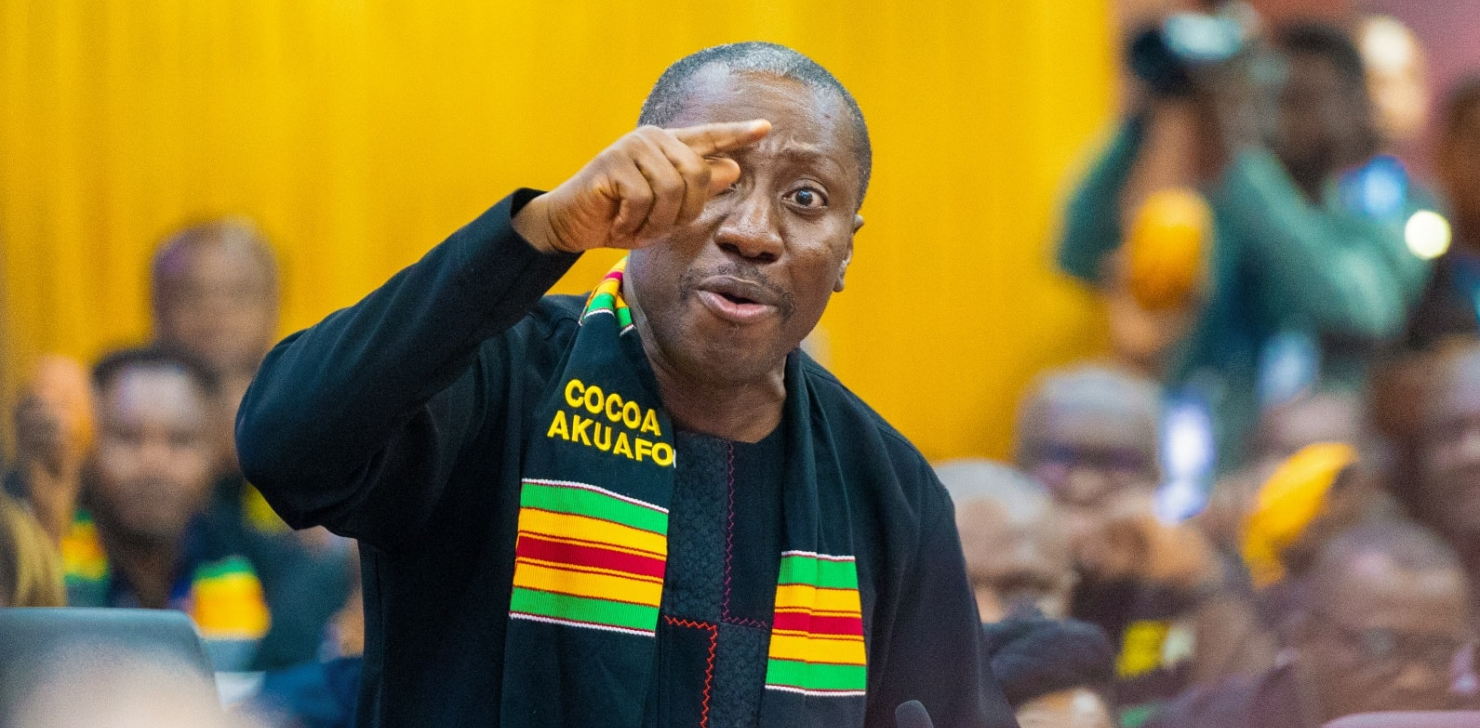
Minority Leader Osahene Alexander Afenyo-Markin has criticised the government’s poor handling of the agricultural sector, which has brought untold hardships to Ghanaian farmers.
Government, he pointed out, has failed to make the necessary investments to support local farmers and boost production in the country.
The Minority Leader, who is also the Member of Parliament (MP) for Effutu, said the lack of priority investment in agriculture has significantly increased the cost of local production, encouraging cheap imports.
Speaking in a recent interview with TV3 on a wide range of national issues, Osahen Afenyo-Markin entreated the government to check why, after paying taxes and duties, imported rice, frozen chicken, and other foreign agricultural products are still cheaper on the Ghanaian market.
According to him, this worrying phenomenon has made Ghanaian farmers poorer as they cannot sell their produce at competitive prices.
The Effutu MP suggested that government policies should provide incentives for local farmers to remain competitive and reduce Ghana’s dependence on imports.
Agric Minister’s poor performance
Osahen Afenyo-Markin said even though he respects the Minister for Food and Agriculture, Mr Eric Opoku as a knowledgeable politician and strong debater, he has not been impressed with the Minister’s performance.
“I respect Mr. Eric Opoku. He’s one strong debater, very knowledgeable, and I respect that. But I must say that as an Agric minister, he hasn’t impressed me,” he stated.
The Minority Leader argued that the government’s claims of supporting agriculture are not reflected in the national budget, insisting that there is no serious investment in the sector.
“If the government wants to tell me that it has taken agriculture seriously, I must see it in the budget. Go look at the 2025 budget. Go look at the 2026 budget. There is no serious investment in the agric sector,” he said.
Osahen Afenyo-Markin further raised concerns over the cost of locally produced rice, indicating it is currently cheaper to import rice into Ghana than to buy rice produced by local farmers. According to him, this points to what he described as “policy misalignment.”
He explained that suppliers under government programmes such as school feeding and Free SHS often prefer imported rice because it is less expensive than locally produced alternatives.
“These suppliers buy from importers instead of buying locally produced rice because it is cheaper. If local producers grow and nobody buys from them, they run at a loss. The next season, they won’t produce again,” he noted.
Poor investment in poultry production
The Minority Leader also criticised the government for failing to invest adequately in local poultry production, arguing that imported poultry products remain cheaper than locally produced ones even after duties are paid.
According to him, this trend discourages local production and places unnecessary pressure on the Ghanaian economy and currency.
“You don’t sustain your economy through high dependency on imports. It is when local production becomes cheaper that you can say you are sustaining your economy,” he stated.
Cocoa farmers disappointed
The Minority Leader also highlighted the serious disappointment of cocoa farmers with the government over farm gate prices.
The NDC, he recounted, promised to significantly increase cocoa prices before assuming office from GH¢3,100 to over over GH¢6,000.
However, the NDC after assuming office, only increased the price to GH¢3,625 and later cut the price below what it came to meet, ostensibly due to reduced global market price of the commodity.
On February 12, 2026, the government reduced the cocoa producer price for the 2025/2026 season by 28.6%, lowering it to GH¢2,587 per bag from GH¢3,625.
This decrease, according to the Minister for Finance, Dr Cassiel Ato Forson, was driven by a global price slump from over $7,000 to roughly $4,100 per ton.
He said the price reduction was aimed at managing liquidity issues and ensuring Licensed Buying Companies can continue payments.
However, Osahen Afenyo-Markin compared the situation to the administration of former President Nana Akufo-Addo, recalling that cocoa prices were maintained despite similar global market turbulence.
Minority engaging farmers
The Minority Leader said his side has been engaging farmers across the country to better understand their challenges, insisting that the concerns being raised go beyond partisan politics.
“Our focus has been to get to the grassroots, deal with ordinary people and engage them,” he said.
Osahen Afenyo-Markin concluded by accusing the government of failing to properly manage the economy over the past 15 months, reiterating that weak investment in agriculture and local industry continues to undermine production and economic stability in Ghana.