

By Ken Bediako
A belated happy birthday wish to Fabulous Kumasi Asante Kotoko who celebrated their 91st birthday last Monday August 31. There were no high sounding activities to mark the day for obvious reasons.
In fact. many admirers of arguably the nation’s best supported football club will tell you Kotoko are losing fast their tradenark magnetic attraction that filled the stadiums to their full capacity “in the good old days “. But hold it. The die hards however believe there is light at the end of the tunnel and last Friday’s “Democracy Cup” victory over Accra Hearts of Oak, their traditional rivals, should be a signal that a bright star looms in the seemingly dark horizon. As my humble contribution to the rather mute birthday celebration let me trace the birth of the Fabulous club of Africa as told by football historian Henry K/ Akyeampong in his 1964 publication.
THE BIRTH OF THE FABULOUS CLUB
Here we go:
“Kumasi Asante Kotoko has woven around itself a reputation which has earned the Club the tag “Fabulous Asante Kotoko.”
But in 1935—little did the pioneers think that one day the Club would become the first national knockout champions to receive the coveted title of “Champion of Champions”, the first to play in boots, the first to supply as many as seven players for the national team, the first to employ a full-time professional football Coach and last, but not the least, the first to play twenty-two matches in a row in a League competition without a defeat. What a unique achievement!
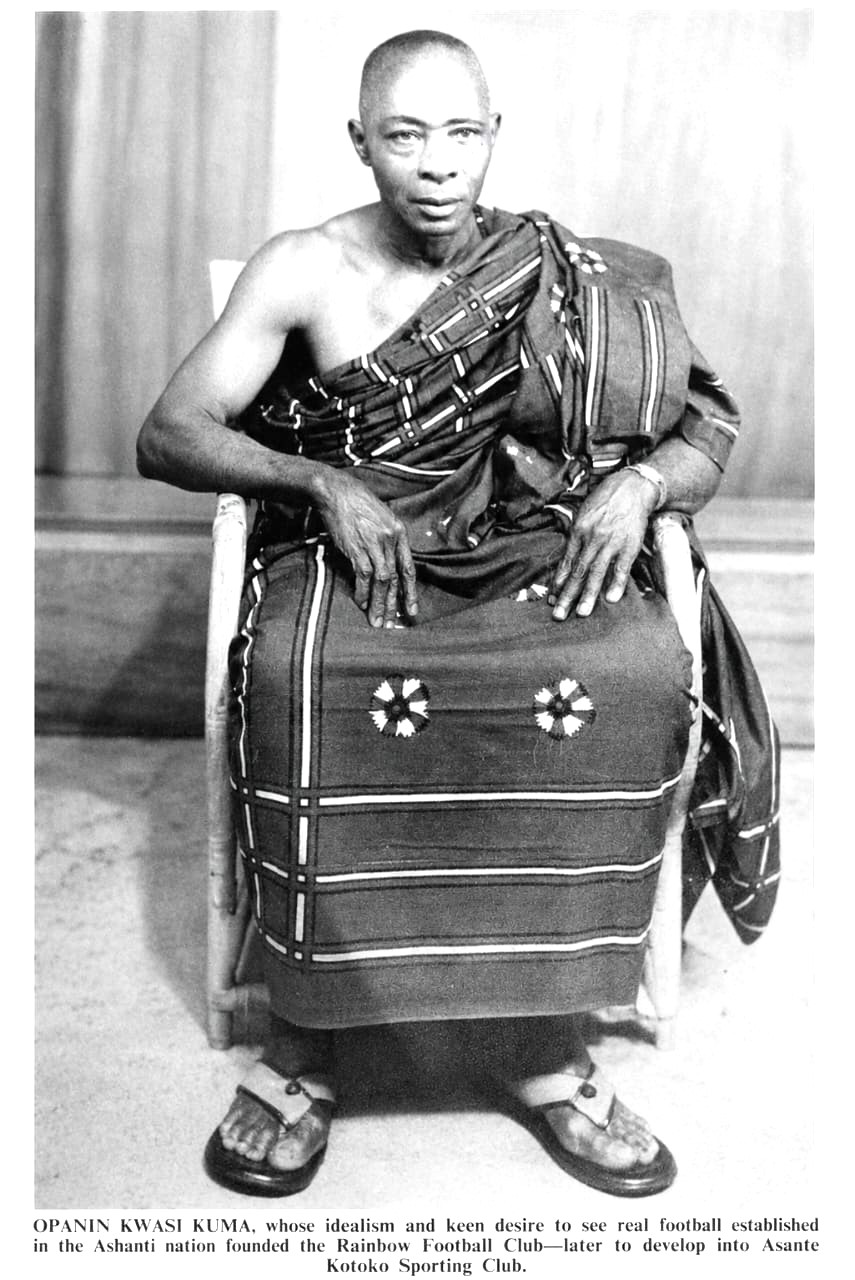
Great things have humble beginnings and so was the growth of the Asante Kotoko Sporting Club. To understand the end one must begin at the beginning. Kotoko began in 1924 as Rainbow Football Club. A football enthusiast, Kwasi Kuma (a driver employed by the Ghana Farmers’ Council Co-operatives, Kumasi, who also used to drive an Army Officer by name Colonel Ross after witnessing a football match between Accra Standfast and Accra Hearts of Oak at the Government Technical School Park, Accra, was so inspired that he decided to form a football club when he returned to live in Kumasi. In the said match Hearts beat Standfast 2-1 and Sir Gordon Frederick Guggisberg, the Governor of the Gold Coast presented Hearts of Oak with a set of jerseys.
Towards the end of the year, 1924, Colonel Ross left the country for good and so Kwasi Kuma had to return to Kumasi. Before he left Accra he had bought some jerseys and footballs. Immediately on arrival, he gathered a group of 13 young men and founded a Club, which he named “Kumasi Rainbow”.
Before 1924, there were only two football Clubs in the Garden City—Evertons and Royals. Evertons drew their strength from the Roman Catholic School, represented by Onsunyameye Amissah, Kwaku Renner, Sey, Bowma while Royals had such stalwarts as D. M. Forson, Adu-Gyamfi, Davies, Rockson and Amihere of Wesleyan School (now Methodist) among their foundation members.
Kwasi Kuma’s brain child “Rainbow” was no match for the established crack teams because of lack of experience. As a very progressive football enthusiast, Kuma went to the local Government School to recruit boys for his Club and met Mr Kanin and Mr Henry Prempeh, both being teachers. He discussed with them his intention of getting a first-class team in Kumasi and asked specifically for Ashanti boys who could play football. He recruited some few promising boys. There were also one or two hidden talents in E.C.M. (Anglican) and A.M.E. Zion Schools and with these and other boys from the town he formed the Ashanti United Football Club in 1926. Rainbow thus collapsed into the ashes of the past.
At the inauguration of Ashanti United which took place in his house at Ashanti New Town, Kwasi Kuma invited Mr J. S. Kankam who was then with Messrs Drewery and Company, late Quarshie, who later became Boamanhene and Mr J. K. Darkwa, who was then a U.A.C. Storekeeper (Swanzy). Kwasi Kuma provided two bottles of whisky which cost him 10 shillings each—quite a big sum in those days—and libation was poured by Mr Darkwa to invoke the spirits of the ancestors to heip the club to survive.
The first office bearers, who readily come to mind, are Mr L. Y. Asamoah, Electrical Contractor; Mr J. K. Darkwa and Mr J. S. Kankam. Kwasi Kuma became the first Chairman of the Club.
Ashanti United had such fine players as Kofi Gyato, George Nuamah, E. K. Nkansah, Kwame Adjei (Tommy), Adjei Kyem, Kwadwo Ansah and Paul Kuma.
Two years later, that is in 1928, the team was strengthened by the accession to its ranks by such young talents as Joshua Arthur (later Superintendent of Police, Winneba) Gabriel Arthur and late J. E. Opoku; and success was not long in coming.
This time interest in football had risen to a very high pitch. In 1929 a Police Magistrate by name Capt. W. Price-Jones had donated a silver cup for a knockout competition in Kumasi. Each team had to pay 10 shillings as entrance fee. The Clubs that entered the competition were: Royals, Evertons, Never Miss, Primrose, Railways, Prisons, Europeans, Army and Police.
Ashanti United first met Railways and knocked them out by 4-0; Prisons also suffered a 3-0 defeat. Primrose and the Kumasi European team drew seven times. In the end Primrose, after a hard struggle, beat the Europeans by 2-1. Sir Patrick Fitz-Gerald, who would be the Managing Director of the Ghana National Trading Corporation, took part in the match on the European side. He is said to have been a good player.
Ashanti United’s opponents for the finals were Primrose. The first match ended in a 2-2 draw. But United won the replay by 2-1 two weeks later. Capt. Price-Jones presented the Cup to United’s captain, Tommy, and so their name was the first to be inscribed on the Cup. The Cup was kept at the current C.O.S. Office in Kumasi together with other trophies donated by late Mallam Sallow, Zirinkin Zongo and Messrs. F. H. Rydan.
According to records, Kwasi Kuma brought great life and activity into football in Kumasi and the Ashanti United Club in particular.
The venue for all football matches in Kumasi was Fort Park in Stewart Avenue, where now stands a Government building. No gate fees were collected until in 1932 when the Ashanti Football Association was formed. And, in order to persuade fans into paying gate fees, all tickets were raffled.
The tickets ranged from one penny to one shilling, and a holder of a one shilling ticket got ten pounds. This continued for some time until the Jackson Park was opened in 1936 and the raffling of tickets was discontinued.
But the irony of it all was the 66⅓ per cent deduction from the gate fees by the Kumasi Public Health Board, now Kumasi City Council, which, according to the authorities were responsible for the maintenance of the field.
Imagine, therefore, the financial embarrassment which faced Clubs which used the Park. It was not until 1943 when the Ashanti Football Association was reorganised that Clubs took the opportunity, through their representatives, to protest against the deductions, which the Council imposed on the Clubs, by boycotting the use of Jackson Park for nearly four months. Incidentally, the chairman, Mr Sam Russell, an expatriate of U.A.C. Limited, J. D. Dadzie and J. S. Kankam—both of whom were Councillors—raised the issue at one of the Council’s meetings. The 66⅓ per cent deduction was substantially sliced to 25 per cent.
In the 1930s football supporters could be influenced by their weekly turnouts and Ashanti United were soon competing with the two clubs—Evertons and Royals—in this regard. The supporters of the Clubs wore the same kind of jerseys and hoses—conspicuously minus boots. Some of them wore canvas shoes during these turnouts. It was only to identify them with the Clubs to which they belonged.
Ashanti United began to attract the entire population of the Garden City. But notwithstanding its immense support and popularity, in 1931 it had its name changed to Titanics as a result of some internal troubles, mainly financial and leadership. The question of a good leader in those days was always a problem.
Travelling expenses were borne by the Clubs themselves because no gate fees were collected and, therefore, the Clubs had no other source of income. To accept, therefore, the responsibility of a chairman, one had to make big monetary sacrifices, in addition to finding employment for the players and so unless one ran a very lucrative business, it was very difficult to meet these commitments.
Yaw Asamoah bodly assumed leadership of the Titanics Football Club. The club was one of the most attractive teams in Kumasi and had a large following. Titanics were runners-up in the Asantehene’s Cup competition. As finalists, they held Prisons to a draw on four occasions until they finally succumbed.
In 1934 many of the players who worked with Prisons, Railways and other firms were transferred from Kumasi, and the Club could no longer stand on its own feet. In the words of Mr Gyimah, a sports-writer of the defunct “Ashanti Pioneer”, it was “a struggling lot”. They had to struggle to get substitutes which invariably did not help.
The name Titanics did not appear to bring good luck to the Club and remained so until 1935 when the J. S. K. Frimpong, popularly called Teacher Frimpong, then a teacher of the local Government School—now Asem Middle Boys School—drafted some boys from his school and changed the name Titanics to Asante Kotoko, after having obtained special permission from the Asantehene.
The name Asante Kotoko is just like the name “Real Madrid” of Spain. The prefix “Real”, meaning “Royal”, was added to the name of the club in 1920 by special grant of King Alfonso XIII of Spain.
The monumental change of name from Titanics to Asante Kotoko took place on August 31, 1935, before a great assembly of chiefs, clergymen, intelligentsia and hundreds of men, women and children, all in gala attire, Frimpong opened the inaugural meeting of the Asante Kotoko Club with a revitalising address in which he threw open the doors of the Kotoko Club to all Ashantis.
Among other things, Mr Frimpong said in his address: “Finally, our motto would be ‘Excelsior’—higher and higher at all times whether misunderstood or appreciated; as long as we understand ourselves, and our actions spring from pure motives we should go full steam ahead neither restraining the course of the Great Spirit within us, nor allowing ourselves to be dismayed by deed or word of anybody, and so to leave behind us ‘footprints on the sands of time’.”
“We are solidly behind you”, said Nana Boakye Yamoa Atipinhene of Kumasi, addressing the gathering. “The long-looked-for-day has come in the formation of this Asante Kotoko Football Club. That it may succeed will be our constant and earnest prayer and desire.”
The pioneer officers elected were Mr J. K. Darkwa, President; Mr John Darkwa, Treasurer; Mr J. K. Osei, Secretary; Mr Kwame Frimpong and Mr Opong, Trainers. The Otumfuo Asantehene, Nana Osei Agyeman Prempeh II, Nana Atipinhene and Nana Anantahene were appointed Patrons.
The Atipinhene completed the day’s events by pouring libation to invoke the Ashanti gods to guide, guard and “inspirit” the Club. After this colourful and monumental ceremony in 1935 what followed next is history.
Supporters of Kotoko will be too happy to tell you they were the first FA Cup holders to receive the title of champion of champions, the first to play in boots; the first to supply as many as seven players in the national team, the first to play 22 matches in a whole national league undefeated, 24 times league champions and the last but not the least the first to win the Africa Cup for champion clubs.
Cheers everybody and keep loving sports.