
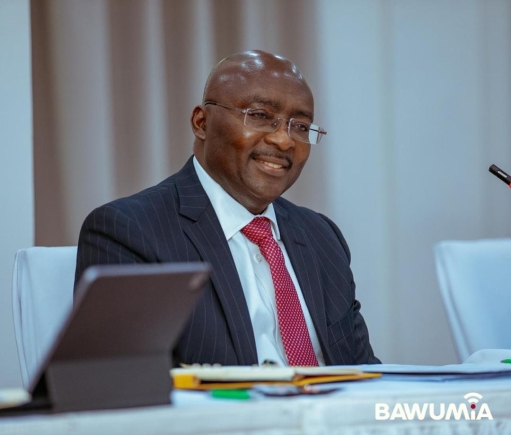
Former Vice President and New Patriotic Party flagbearer Dr Mahamudu Bawumia has given a detailed account of the thinking behind two of the previous administration’s most innovative economic interventions — the Gold-for-Oil programme and the Domestic Gold Purchase Programme.
Addressing members of the Ghana National Association of Small-Scale Miners in Accra, Dr Bawumia said the initiatives were born out of necessity during a period of severe external pressure on Ghana’s economy.
He identified two closely linked challenges that forced policymakers to seek unconventional solutions. The first was the abrupt drying up of external financing in the wake of the COVID-19 pandemic and the Russia-Ukraine war.
“That tap (external financing) was shut for Ghana and quite a few countries. And for us, it resulted in a balance of payments crisis,” he said.
The second constraint, he explained, came from the terms of Ghana’s International Monetary Fund programme. Under the programme, the Bank of Ghana was permitted to use only $80 million a month to support the foreign exchange market.
“You can imagine what the demand for foreign exchange for Ghana would be on a monthly basis. Significantly more than $80 million a month. And so, in that framework, there was only one result. Because when demand exceeds supply, prices would go up, isn’t it? The cedi started depreciating daily,” Dr Bawumia noted.
Faced with these restrictions, he said the Gold-for-Oil programme was conceived as a practical way around the dollar shortage. By using gold to pay for petroleum products, the country could secure fuel supplies without further depleting scarce foreign currency reserves and risking shortages at the pumps.
The second major idea — the Domestic Gold Purchase Programme — came to him during a routine exercise session. Reflecting on Ghana’s position as a significant gold producer, he questioned the logic of the existing system.
“Why does Ghana, which mines gold every day, have to export cocoa to get dollars for its forex reserves? Why not buy the gold we already produce with cedis?” he recalled asking himself.
Dr Bawumia described the approach as deliberate “out-of-the-box thinking.”
“It was not a textbook idea. There’s no textbook in economics that will tell you about the Gold-for-Reserves programme,” he said.
He later presented the concept to the Bank of Ghana. Because the proposal was highly unconventional, the central bank spent nearly a year conducting thorough due diligence. Officials were initially hesitant, worried they could face consequences for implementing a policy that had no clear international precedent.
“Finally, they agreed, and Ghana became the first country in Africa, and probably the world, to implement such a programme. Now, other countries are coming to learn from Ghana,” Dr Bawumia added.
The former Vice President’s remarks offer insight into the practical pressures and creative responses that shaped key economic policies during a particularly difficult period for the Ghanaian economy.