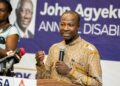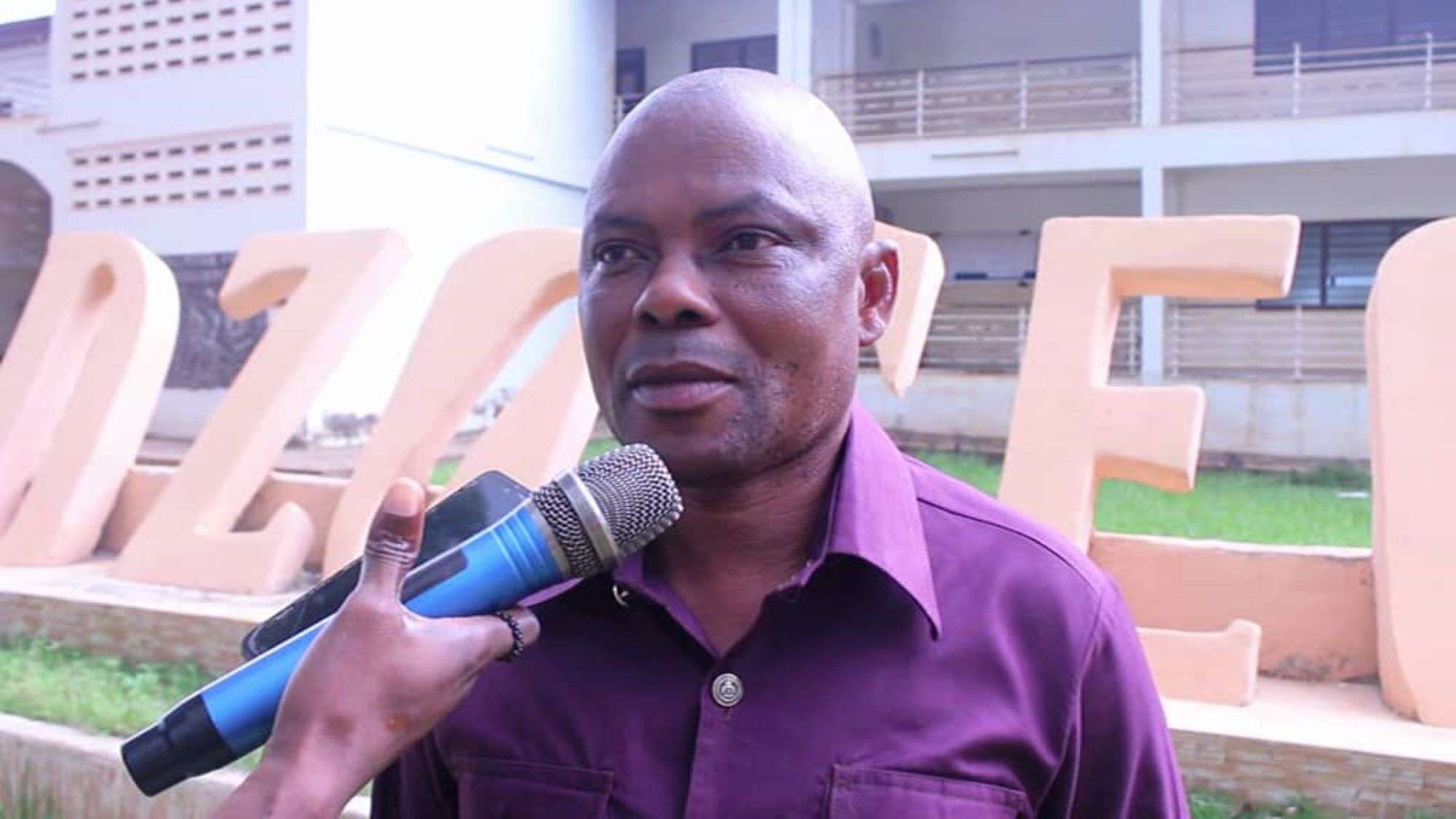


Disability advocate and researcher Dr James Kwabena Bomfeh Jnr. has called for a decisive shift from policy commitments to practical action to ensure persons with disabilities (PWDs) can fully participate in Ghana’s social, economic and political development.
Speaking as keynote speaker at The Inclusion Forum ’26, held at the Google Ghana AI Centre on Thursday, August 27, 2026, under the theme “Celebrating Strength in ThisAbility Diversity,” Dr Bomfeh argued that disability should not be viewed primarily through the lens of limitation.
Drawing on his 2022 framework, he described “ThisAbility” as the strength, resilience and capacity of persons with disabilities to confront and overcome the barriers that stand between them and leadership.
He challenged stakeholders to move beyond celebrating PWDs through conferences, policies and public statements and instead create measurable opportunities that enable them to lead and succeed.
From stigma to rights
Dr Bomfeh traced some of the historical roots of discrimination against persons with disabilities, noting that disability has, in many societies, been associated with curses, witchcraft and ancestral wrongdoing.
He contrasted these beliefs with evidence of indigenous systems that historically provided legal and social accommodations for persons with disabilities, including observations documented by R. S. Rattray in 1929.
He also drew on religious perspectives to challenge negative perceptions of disability, referencing Nancy Eiesland’s concept of the “Disabled God” and the Qur’anic account of Surah Abasa, which emerged from the Prophet Muhammad’s encounter with Abdullah ibn Umm Maktum, a blind man.
According to him, these perspectives demonstrate that disability and human dignity have never been incompatible.
Ghana’s progress, but implementation gap remains
Dr Bomfeh highlighted several milestones in Ghana’s disability-rights journey, including Article 29 of the 1992 Constitution, the passage of the Persons with Disability Act, 2006 (Act 715) after years of advocacy, and Ghana’s ratification of the UN Convention on the Rights of Persons with Disabilities in 2012.
He also cited the Inclusive Education Policy of 2015 and the Building Regulations, LI 2465, introduced in 2020, as important steps toward inclusion.
However, he questioned whether these measures have translated into meaningful improvements in the everyday lives of PWDs.
His central question was simple: Has Ghana moved from “papers to practice”?
He argued that the country continues to struggle with an implementation gap, where persons with disabilities are often invited to participate in discussions but remain excluded from the processes where budgets, programmes and policies are actually designed.
Statistics reveal scale of challenge
Dr Bomfeh pointed to statistics highlighting the challenges confronting PWDs.
Globally, the World Health Organisation and World Bank estimate that about 1.3 billion people live with significant disabilities and, on average, experience substantially shorter lifespans than people without disabilities.
In Ghana, the 2021 Population and Housing Census recorded 2,098,138 persons, representing about 8 per cent of the population, living with disability-related difficulties, compared with about 3 per cent recorded in 2010.
Women and rural residents were identified as disproportionately affected, with disability prevalence standing at 8.8 per cent among women and 9.5 per cent among rural residents.
Dr Bomfeh also highlighted educational and economic inequalities, noting that nearly 45 per cent of children with disabilities have never attended school, while 33.1 per cent live in multidimensional poverty.
He further cited the high proportion of PWDs who are self-employed without employees and raised concerns about inadequate investment in mental health.
Progress worth recognising
Despite the challenges, Dr Bomfeh acknowledged that Ghana has made progress in some areas.
He pointed to the increase in the District Assembly Common Fund allocation for PWDs from 2 per cent to 5 per cent, as well as the introduction of free tertiary education for persons with disabilities under the Mahama administration.
He also highlighted the emergence of successful Ghanaian professionals and leaders with disabilities, including Dr. Henry Seidu Daanna, Evelyn Appiah, Farida Bedwei and Ama Adwoa Buabeng.
Their achievements, he said, demonstrate that impairment does not determine a person’s ability to contribute meaningfully to society.
The location of the forum itself, at a Google AI facility, was also significant to him.
He argued that technology can become a powerful tool for dismantling barriers faced by PWDs, particularly in education, employment and entrepreneurship.
Five barriers to leadership
Dr Bomfeh identified five major forms of resistance that continue to prevent persons with disabilities from reaching their full leadership potential.
The first is persistent cultural stigma, which he said continues to contribute to children with disabilities being excluded from education.
The second is inaccessible infrastructure, despite legal requirements intended to improve accessibility.
He noted that the ten-year moratorium associated with Act 715 expired in 2016, yet many public and private facilities remain difficult or impossible for PWDs to access.
The third is the lack of adequate accessibility within healthcare facilities, including the absence of Braille materials and sign-language interpretation in many clinics.
The fourth is inadequate special-school infrastructure, particularly in regions where such facilities remain unavailable.
The fifth concerns the administration of the Common Fund for persons with disabilities, which he described as politicised, delayed and inadequately resourced.
He argued that these challenges reflect a broader problem of patronage replacing genuine provisioning.
Call for technology-driven inclusion
Dr Bomfeh called for stronger investment in technology and digital skills as part of Ghana’s disability-inclusion agenda.
He specifically challenged Google Ghana to train 1,000 persons with disabilities within the following year and urged the development of artificial intelligence tools capable of improving sign-language translation.
He also called for enterprise support to be redirected towards PWD-owned businesses, proposing that portions of programmes such as YouStart and Ghana Enterprises Agency resources be deliberately targeted at entrepreneurs with disabilities.
According to him, inclusion should not end with access to welfare support but must extend to opportunities for people to build businesses, create jobs and accumulate wealth.
He further urged greater investment in para-sports and the arts as avenues for talent development and economic empowerment.
From participation to leadership
Internally, Dr Bomfeh urged persons with disabilities to cultivate what he described as “indwelt spirit, drive and perseverance.”
But he stressed that personal determination alone cannot eliminate structural barriers.
Society, he said, must provide the enabling environment required for individuals to translate their abilities into achievement.
Among his recommendations were stronger enforcement of disability-related laws by the Executive, Parliament and Judiciary, backed by meaningful penalties for non-compliance.
He also called for mandatory disability-disaggregated data across all Ministries to ensure that government policies and budgets properly account for PWDs.
He proposed reserved positions for qualified persons with disabilities on public boards and District Assemblies to increase their representation in decision-making.
He further urged that any future amendment to Act 715 should focus on correcting implementation failures rather than merely changing the language of the law.
A measurable promise for 2027
Referencing the International Classification of Functioning, Disability and Health (ICF), Dr Bomfeh argued that disability inclusion should ultimately be measured by whether restrictions on participation have been removed.
He urged participants not to leave the forum with only photographs and speeches, but with measurable commitments.
“Disability is not inability. ThisAbility is strength,” he declared.
He challenged stakeholders to make the next year’s forum a point of accountability.
By Inclusion Forum ’27, he said, Ghana should not only be counting the approximately 2.1 million persons with disabilities identified in the census, but also measuring how many have become coders, chief executive officers, entrepreneurs, artists, athletes and Members of Parliament.
For Dr Bomfeh, the real test of inclusion is therefore not how many policies Ghana has written, but how many barriers it has deliberately removed—and how many people have been empowered to rise because of it.