
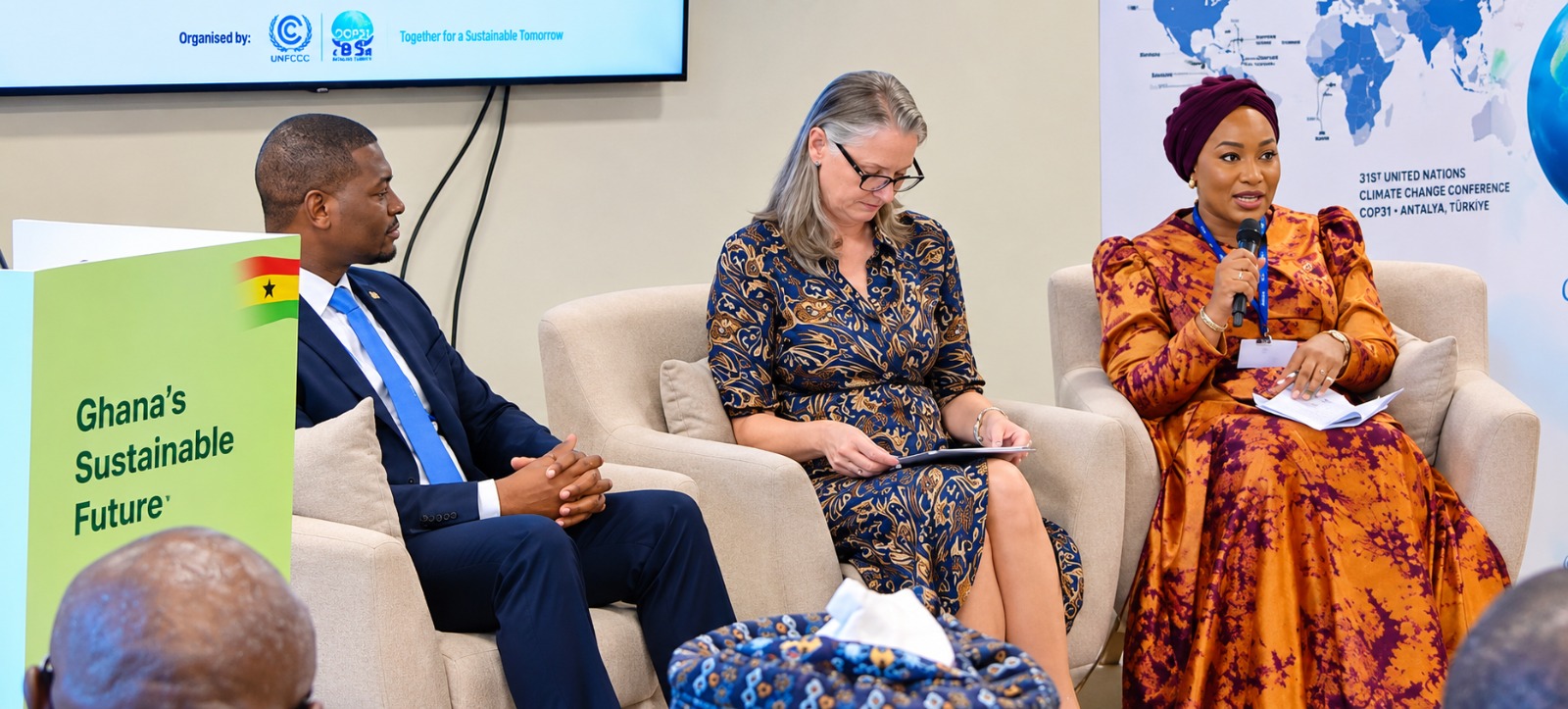
Global Ambassador and Global Champion of the Clean Cooking Alliance and former Second Lady of Ghana, Hajia Samira Bawumia, has called for increased investment in clean cooking solutions, warning that reliance on traditional cooking methods is worsening health risks, environmental degradation and gender inequalities across Africa.
She said the effects of traditional cooking practices went beyond household energy consumption, with women and girls bearing a disproportionate burden through exposure to harmful smoke, time spent collecting firewood and the demands of preparing meals.
Speaking as a panellist at the 31st United Nations Climate Change Conference (COP31) in Antalya, Türkiye, she said clean cooking should be treated as a major development priority rather than an isolated environmental intervention.
According to her, women in Africa spend an estimated 80 hours a week cooking, time that could otherwise be devoted to education, economic activities and other productive pursuits.
“The time it takes to collect firewood, to travel and to prepare meals takes a toll on girls and women. It affects their education,” she said.
She noted that the disproportionate responsibility women bear for household cooking made the transition to cleaner cooking technologies an important gender equality and empowerment issue.
Madam Samira said clean cooking was also closely connected to several development priorities, including food security, public health, energy transition and the achievement of the Sustainable Development Goals (SDGs).
She argued that cooking should be integrated into broader food systems and energy policies because access to nutritious food and sustainable energy depended partly on how food was prepared.
“Anytime you talk about food systems, you have to talk about cooking. Anytime you talk about energy transition, you have to talk about clean cooking. Anytime you talk about women empowerment, you have to talk about clean cooking,” she stressed.
On the environmental implications, she said the continued use of firewood and other traditional fuels was contributing to deforestation, particularly where economic trees were being felled to meet household energy needs.
She observed that in Ghana and other African countries, a significant proportion of wood used for cooking was sourced unsustainably, creating additional pressure on forest resources and undermining environmental protection efforts.
She also highlighted emissions from traditional cooking methods, particularly black carbon, describing clean cooking as an important component of the global response to climate change.
“This is a climate issue. In Ghana, for instance, and other African countries, most of the wood that is used for cooking is not sustainable. We are felling economic trees for firewood,” she lamented.
Madam Samira called for stronger political commitment and increased financing to accelerate the adoption of clean cooking technologies across the continent.
Citing estimates by the International Energy Agency (IEA), she said Africa would require about US$4 billion annually to transition to clean cooking solutions by 2030.
Madam Samira
She urged governments, development partners and private-sector institutions to prioritise investments in technologies that could address the health, environmental and economic consequences of traditional cooking practices.
She also commended Ghana for making progress in advancing its clean cooking agenda, noting that the country had adopted national standards for clean cookstoves and solutions and was developing a National Clean Cooking Strategy and Investment Prospectus.
Among the initiatives she highlighted was the distribution of three million improved cookstoves, alongside efforts to promote sustainable woodlots as an interim measure while households gradually transition to cleaner fuels.
She further cited the Woodlots for Households programme being implemented by the Council for Scientific and Industrial Research (CSIR), which she said had reached about 1,000 households, with plans to extend its coverage.
Other interventions include collaboration between the Energy Commission and the Ghana Education Service to incorporate energy technologies and clean cooking solutions into the educational curriculum.
She said educating children and young people about alternative cooking technologies was necessary to change long-established household practices and encourage the adoption of cleaner methods.
Madam Samira also highlighted the establishment of two testing laboratories at the institution she identified as her alma mater, the Columbia Institute of Science and Technology, to support research and testing of clean cooking technologies.
She said Ghana had demonstrated political commitment to the transition but needed sustained collaboration among government agencies and development partners to achieve meaningful results.
Samira called for a coordinated national approach, explaining that clean cooking required the involvement of several institutions, including the ministries responsible for health, environment, education and lands.
“The challenge is how to go about it and who owns it, because it is a multi-sectoral issue. You cannot leave it to just one sector,” she said.
She expressed optimism that stronger partnerships, improved financing and wider public awareness would help accelerate the transition and ensure that clean cooking became accessible to more households across Africa.
COP31 is bringing together governments, international institutions, businesses and civil society organisations in Antalya, Türkiye, to advance global climate action and strengthen commitments towards a more sustainable future.