
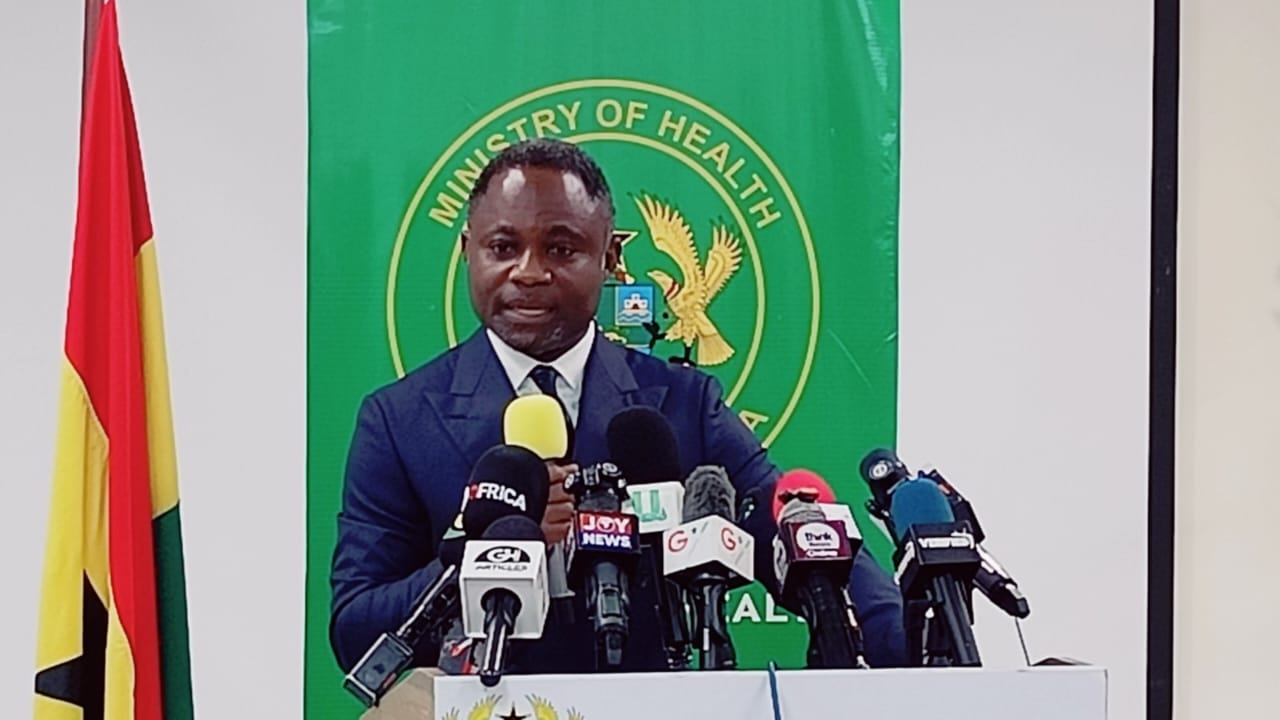
The Minister for Health, Mr. Kwabena Mintah Akandoh, has announced the Free Primary Healthcare Programme, one of the flagship health sector reforms of President John Dramani Mahama, has officially commenced operations in 135 districts across all 16 regions of the country.
The programme covers three main categories of services: curative, preventive, and promotive.
Curative services include treatment for common conditions such as malaria, respiratory diseases, and diarrhoea while preventive services cover screening for blood pressure, blood sugar, body mass index, selected cancers, mental health conditions, as well as maternal and child reproductive health services.
The promotive services encompass nutrition counselling, physical activity guidance, hygiene and sanitation education, and healthy lifestyle counselling.
Speaking at a media engagement in Accra on Monday, September 7, 2026, Mr Akandoh said the rollout marks a major shift in Ghana’s approach to healthcare delivery—moving from a hospital-centred, sickness-driven model to a community-based system focused on prevention and early detection.
“We are changing the paradigm. We are changing the health architecture. Under normal circumstances, somebody will wait until they are forced to go to the hospital. In some cases, it gets worse. What we are saying today is that we are now paying for prevention whilst we are paying for treatment,” he declared.
4,574 Facilities Participate
The Minister disclosed that 4,574 primary healthcare facilities are currently providing services under the programme, comprising 3,708 CHPS compounds, 746 health centres, and 48 polyclinics.
Facilities operated by the Christian Health Association of Ghana (CHAG) and the Ahmadiyya Muslim Mission are also participating to ensure no community is left behind.
The government’s initial target is to implement the programme in 150 deprived districts, with the remaining 15 expected to be added by the end of this year.
The broader goal is for every part of the country to benefit from free primary healthcare by the end of 2027.
Focus on deprived areas
The implementation of the policy has been prioritised underserved districts, particularly communities in northern Ghana where access to healthcare has historically been limited.
The 135 implementing districts are spread across all regions, with the highest numbers in the Upper East (15 districts), Upper West (11), Northern (14), Oti (nine) and Western North (nine).
“We started with the most deprived regions—the Upper West, the Upper East, Oti, Western North—because that is where the need is greatest,” Mr Akandoh explained.
Equipment and logistics
Since the programme was launched in April 2026, the government has undertaken extensive preparations, including training health workers and retooling primary healthcare facilities.
More than 24,500 pieces of hospital equipment have been distributed to CHPS compounds, health centres, and polyclinics across the country.
The Ministry has also taken delivery of 5,000 health worker bags containing basic equipment for house-to-house services, with additional supplies expected in the coming weeks.
To facilitate the movement of health professionals into communities, the government is providing not less than 7,000 motorbikes and tricycles.
Motorised health posts
The Health Minister announced the introduction of motorised health posts strategically placed where Ghanaians spend most of their time—lorry stations, market areas, and other busy locations. Thirty such health posts have already been deployed, with an additional 270 expected to be added across regions and districts.
Payment systems established
The Minister clarified that while the service is free to the ordinary Ghanaian, it is not free to the government. Two main payment systems have been established to ensure sustainability: population-based payments for preventive and promotive services, and Ghana Diagnosis-Related Group (G-DRG) payments for curative services.
The government has committed approximately GH¢79.6 million to the programme as of September 5, including GH¢35.1 million in Population-Based Payments.
No NHIS card required
Mr Akandoh stressed that residents in implementing districts do not need to possess a National Health Insurance Scheme (NHIS) card to access services. Beneficiaries can walk into any participating facility, register, and receive care. A one-time access code generation system has also been established, with clients able to dial *929# to register.
“Whether you have any form of card or not, that will not prevent you from getting access to quality healthcare,” the Minister assured.
Clarification on scope
The Minister cautioned that the programme is not free universal hospital care, explaining that services are covered only at the primary healthcare level—CHPS compounds, health centres, and polyclinics. Patients requiring referral to higher levels of care would need active NHIS membership.
He also clarified that the initiative is not a replacement for the NHIS but is intended to complement it by reducing the burden of preventable conditions on the scheme.
Three-pillar healthcare protection
Mr Akandoh outlined the government’s three-pillar healthcare protection framework: Free Primary Healthcare at the primary level, the National Health Insurance Scheme for secondary care, and MahamaCare for non-communicable diseases such as cancer, cardiovascular diseases, and chronic kidney failure.
Early impact stories
The Minister shared early success stories emerging from communities, citing the Mother Charles Walker Catholic Clinic in Atebubu-Amantin, where health workers are collaborating with the Ghana Private Road Transport Union to screen commercial drivers.
“One driver was found to have a systolic blood pressure reading above 200mmHg and was prevented from driving that day with the support of GPRTU officials,” Mr Akandoh recounted. “What it means is that a person did not wait to collapse. What it means is that the health service went to the person instead of the person going to the health service. A tragedy has been averted.”
Warning against illegal charges
The Minister cautioned health workers against demanding illegal payments from beneficiaries for services covered under the programme, stating that the Ministry would investigate reports of such payments and take appropriate disciplinary action where necessary.
Dedicated hotlines have been announced for the public to report complaints and concerns.
Call to action
Mr Akandoh urged Ghanaians in participating districts to take advantage of the programme by seeking preventive care and regular screening rather than waiting until illnesses become severe.
“Don’t wait till the condition is worse because you don’t require any money to go to the hospital,” he appealed.
“A healthy nation is a wealthy one. The health of the people has a direct correlation on the productivity of the country. We are not only investing in our health; we are also investing in the economy to have a strong, healthy workforce,” he added.
The Minister concluded with a firm assurance that, “Free primary healthcare has come to stay.”
The programme is currently live in: Ashanti (8 districts), Bono (5), Bono East (6), Eastern (8), Greater Accra (7), Volta (11), Western (7), Central (11), Ahafo (2), Northern (14), North East (6), Savannah (6), Upper East (15), Upper West (11), Oti (9), and Western North (9).
The Free Primary Healthcare Programme was launched by President John Dramani Mahama on April 15, 2026, at the Shai-Osudoku District Hospital in Dodowa.
By Kingsley Asiedu