
A proposal by President John Dramani Mahama calling for renewed international commitment to slave reparations has sparked strong opposition from Israel, Argentina, and the United States, igniting fresh diplomatic and historical debate.
Mahama’s motion, which seeks recognition and compensation for the enduring legacy of the transatlantic slave trade, was presented as part of broader efforts by African leaders and diaspora advocates to push for justice and economic redress.
The initiative highlighted the long-term social and economic consequences of slavery on African nations and people of African descent worldwide.
However, officials from the United States, Israel, and Argentina rejected the proposal, citing concerns ranging from legal complexity to questions about historical accountability and present-day responsibility.
Diplomatic representatives from these countries argued that assigning financial liability across generations and borders presents significant challenges and risks, potentially setting precedents with far-reaching implications.
Speaking at the UN High-Level Special Event on Reparatory Justice at the United Nations Headquarters in New York yesterday, President Mahama opened his eight-page address with a striking declaration: “There is no such thing as a slave.”
He described the transatlantic slave trade as a system “designed to deny African people their humanity,” built on a racial hierarchy “with no basis in fact or science.”
He concluded with a call to place humanity at the centre of the discussion: “When discussing slavery and its resulting institutions and practices, we must always start by reclaiming racial equality, the dignity of Africans, the humanity of our ancestors who were enslaved and, as a matter of course, our own humanity.”
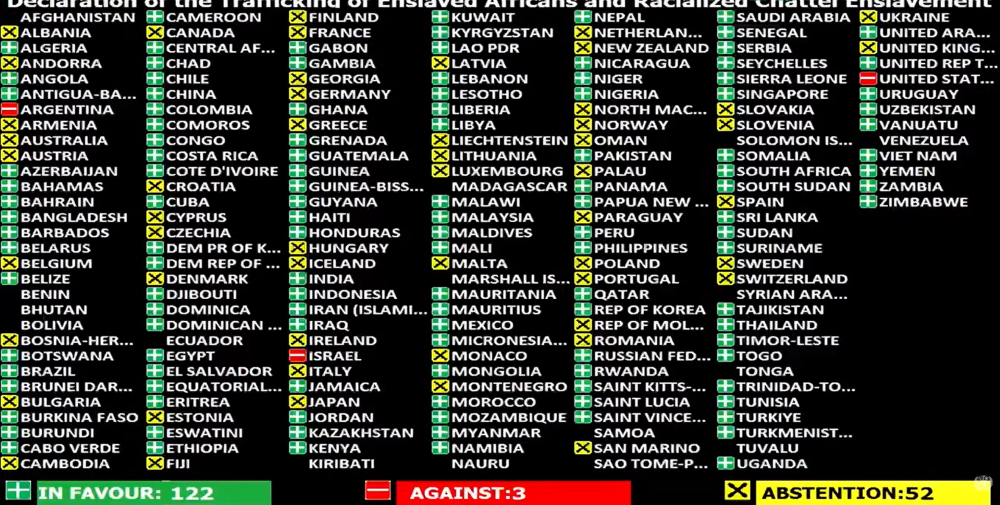
The UN General Assembly subsequently adopted the slavery reparations motion tabled by President Mahama, with 123 countries voting in favour. The resolution called on the UN to recognise the transatlantic slave trade as the gravest crime ever committed against humanity.
After extensive debate, the motion was approved with 123 votes in support, three countries — the United States, Argentina, and Israel — voting against it, and 52 nations abstaining.