

A recent social-media post on the high cost of domestic air travel has touched a genuine public concern. Many consumers now see domestic flying as beyond the reach of ordinary workers and families. The post deserves attention. Public anger, though, is a starting point for inquiry, not proof of exploitation. We need to move away from emotion and examine the forces pushing prices up.
Domestic airfares sit inside a broader Ghanaian cost problem which I have termed “the Ghanaian pricing culture.” Hotel rooms, residential accommodation, office rent, car rentals, imported equipment, professional services and many everyday business inputs often feel expensive relative to income levels. Some real estate developers’ houses are expensive compared with the same specification in North America and Europe. Airlines buy many of those same inputs. They also face aviation-specific costs, many priced in dollars. Expensive tickets therefore reflect both the structure of aviation and the wider cost of doing business in Ghana.
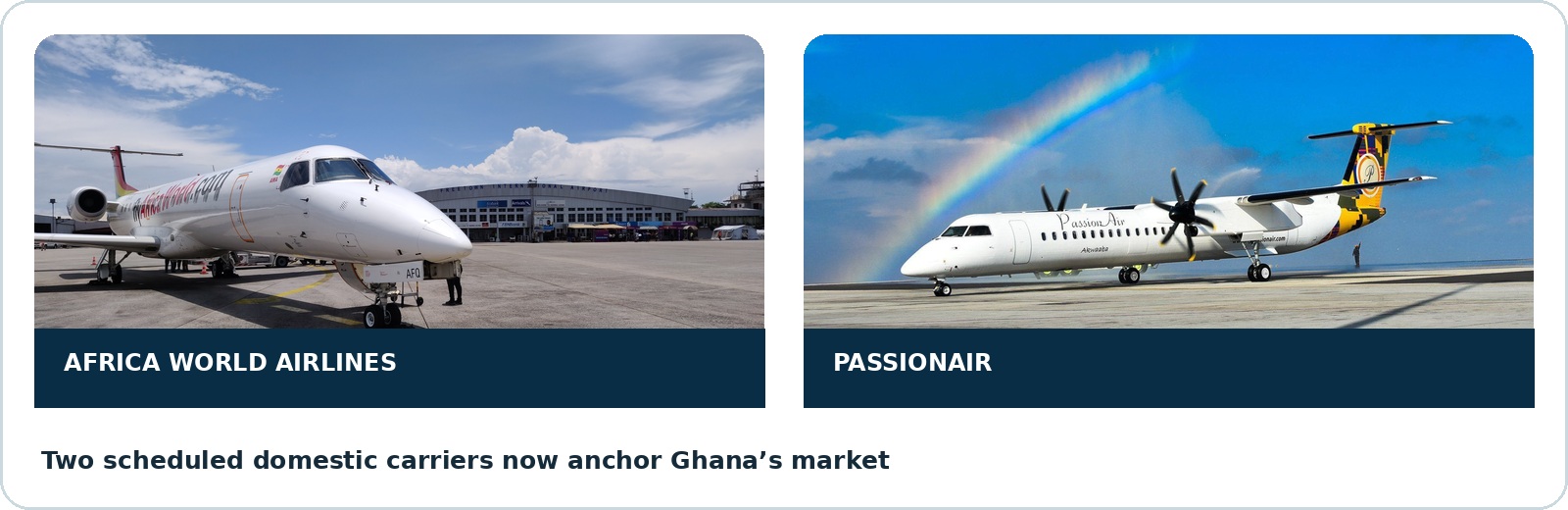
Africa World Airlines and PassionAir aircraft. Image sources: Wikimedia Commons and TW Radio.
The structure of the market can impact the cost of flight. In November 2012, I paid about US$36 for a return Fly540 ticket between Accra and Kumasi. The market had four players namely: Starbow, AWA, Citylink and Fly540. The prices began to increase when we moved from a market of four players in 2013 to one player in 2017. Passion Airlines entered the market in 2018. Today, Africa World Airlines and PassionAir are the two main scheduled domestic operators.
2. What the fare survey shows
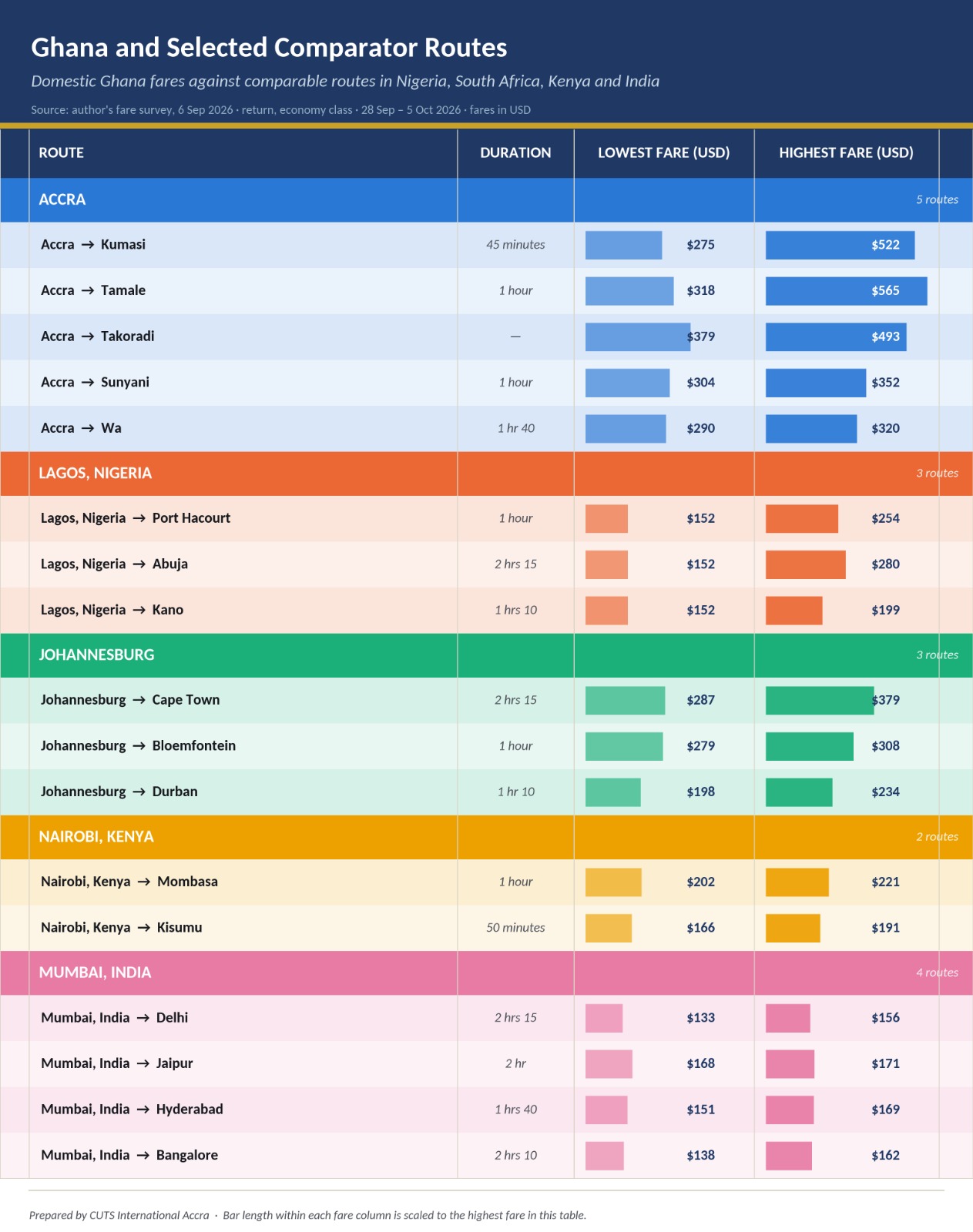
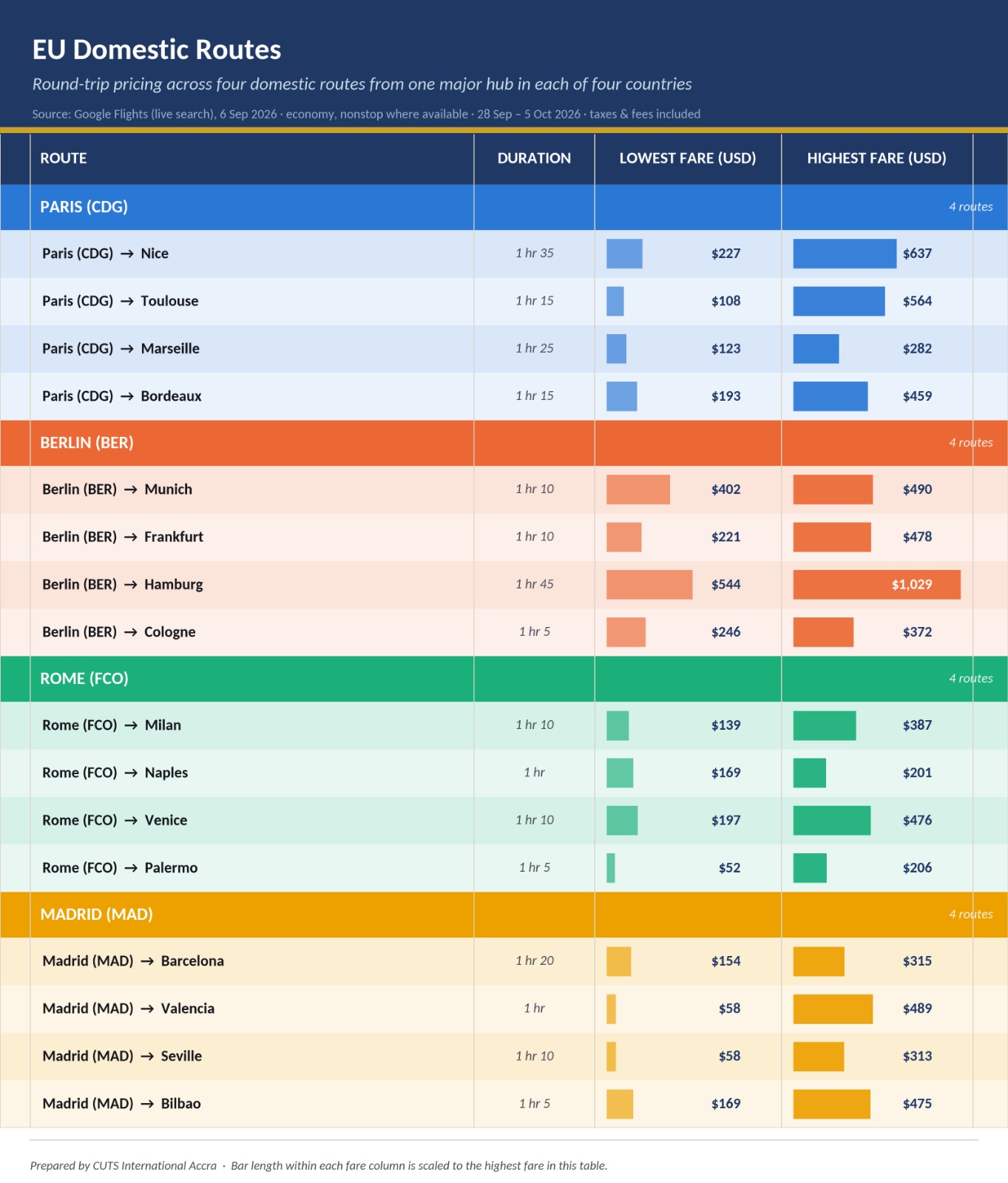
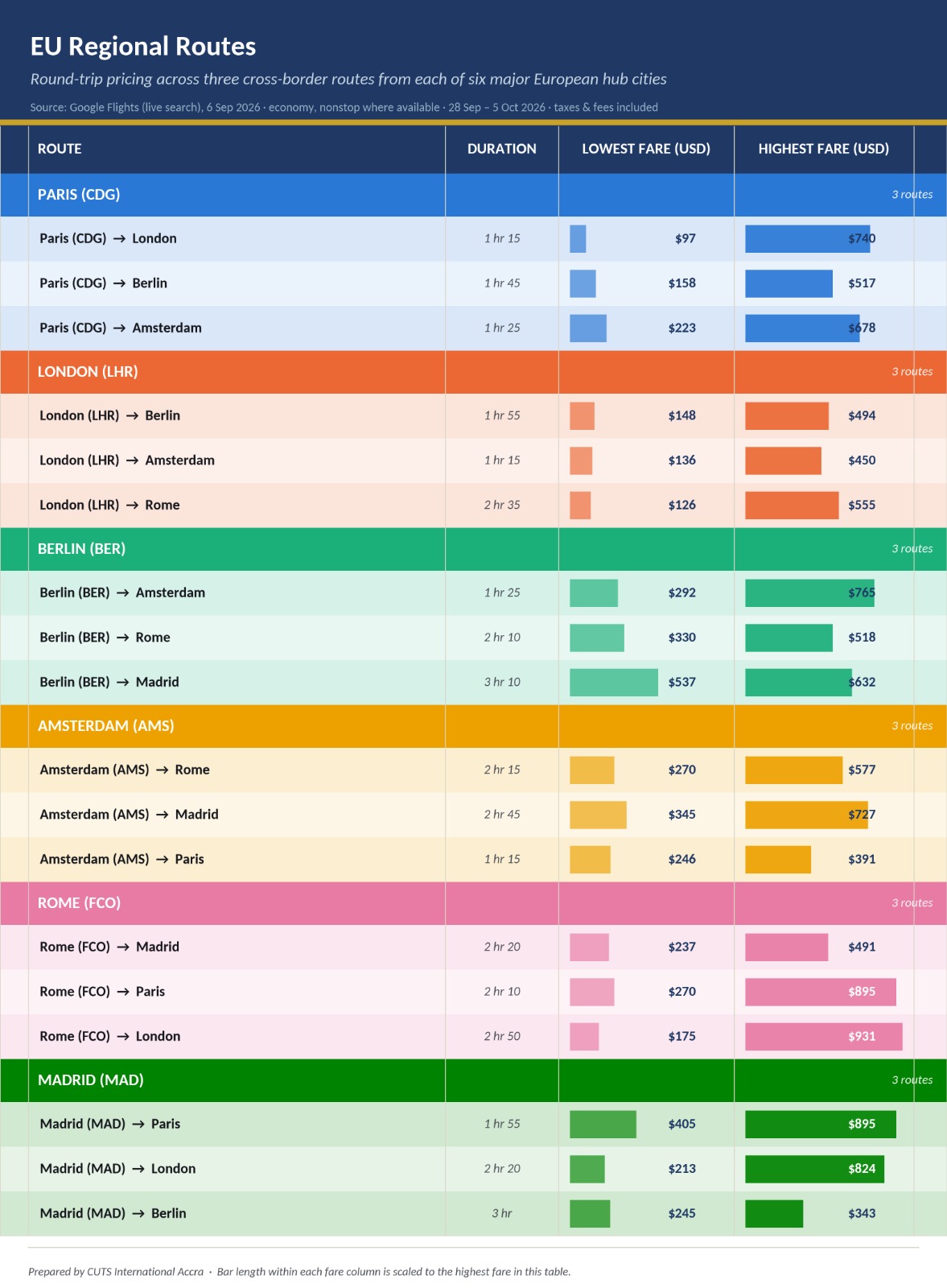
On 6 September 2026, I searched return fares for travel from 28 September to 5 October 2026. Ghanaian fares came from airline websites. Selected African and Indian fares came through Expedia, while European fares came from Google Flights. The exercise is a snapshot, not a controlled econometric study. It still provides a useful indication of the consumer prices on offer.
Figure 1 Average lowest and highest return fares in the surveyed markets
Across five Ghanaian routes, the average lowest return fare was US$313.06 and the average highest was US$450.48. Across 12 routes in Nigeria, South Africa, Kenya and India, the averages were US$181.50 and US$227.00. Ghana’s average lowest fare was about 72 percent higher, while its average highest fare was close to twice the comparator average.
The European evidence adds balance as the average lowest fare across 16 domestic routes was US$191.25, about 39 percent below Ghana’s average. Yet the average highest European domestic fare was US$448.31, almost the same as Ghana’s US$450.48. European regional routes had still higher maximum fares. Ghana therefore looks especially expensive at the bottom of the fare range. The data do not support the claim that every foreign flight is cheaper.
3. Why domestic fares are high
A high ticket price is not the same as a high profit. Proving excessive pricing would require airline-level evidence on load factors, passenger yields, aircraft use, leases, financing, fuel, maintenance, insurance, airport charges, route profitability and return on capital. Those data are not publicly available.
First, aviation carries large fixed costs. Aircraft leases or financing, insurance, staff training, certification, reservation systems and administration continue whether a flight is full or half empty. A short flight is not proportionately cheap. An eleven-hour flight from London Heathrow to Los Angeles LAX is fair cheaper than a six hour flight from Accra to London Heathrow by the same carrier.
Second, Ghana has limited scale. The Ghana Civil Aviation Authority recorded 903,227 domestic passenger movements in 2025. A return traveller counts twice. Kumasi accounted for about 54 percent of movements, Tamale 24 percent and Takoradi 15 percent. Thin routes and uneven demand make frequent service harder to sustain. If an illustrative 50-seat flight costs GH¢40,000, the cost is GH¢889 per passenger with 45 passengers and GH¢1,333 with 30, before profit.
Third, airlines face currency and input-cost pressure. Revenue is largely earned in cedis, while leases, engines, spare parts, insurance and some maintenance are paid in foreign currency. Fuel is also a major operating expense. IATA data show that African airlines face high unit costs compared with carriers elsewhere. Depreciation or a fuel-price shock passes quickly into the cost base.
Fourth, competition is limited. Two airlines do not prove collusion or abuse, but fewer independent rivals reduce the pressure to discount, innovate and pursue marginal passengers. International evidence links low-cost entry and contestable routes with lower fares. Destinations served by multiple operators normally see price competition this explains why trans-Atlantic flights between Europe and America are cheaper compared to flights from Europe/America to African destinations. The market is the best and the most efficient means of determining prices.
Fifth, government charges form part of the fare. Since 1 April 2026, the Airport Infrastructure Development Charge has added GH¢100 to each one-way domestic journey, or GH¢200 to a return trip. GACL also publishes landing, parking and specified lighting charges. Infrastructure needs funding, but a fixed charge weighs more heavily on a short domestic journey and raises the lowest viable ticket price.
Lastly, the Russian-Ukraine and the Middle East wars have pushed fuel prices above the roof. Airlines are allowed to charge for fuel surcharge whenever fuel prices go up. Currently, AWA charges GHC 440 and Passion Airlines GHC 150 for fuel surcharge on a return trip. Airlines must recover cost and make profit to make their business more sustainable.
4.0 What government should do
The Government’s ambition to make Accra an aviation hub for West Africa will require deliberate action to address the factors driving up domestic airfares. The Ministry of Transport, the Ghana Civil Aviation Authority and Ghana Airports Company Limited should consider the following measures:
- Undertake comparative cost studies
The Government should study selected developing and emerging economies where domestic airfares are lower. The study should compare the full cost structure of operating domestic airlines in those countries with the cost structure in Ghana.
Where the analysis identifies taxes, charges or regulatory costs that place Ghanaian airlines at a disadvantage, the Government should take steps to reduce them. Lower operating costs should support lower airfares. Lower fares should stimulate passenger demand, improve aircraft capacity utilisation and strengthen airline profitability, all other factors remaining equal. Stronger airline performance would also increase corporate tax revenue for the State.
- Remove or reduce the airport infrastructure charge
The Government should consider removing or reducing the GH¢100 airport infrastructure charge. This charge increases the final ticket price paid by passengers and places an additional burden on domestic air travel.
- Encourage new entrants into the domestic market
The Government should create conditions that attract new airlines into the domestic market, with particular attention to low-cost carriers. Additional entry would expand consumer choice, increase capacity and strengthen price competition.
- Strengthen competition oversight
The GCAA should continue monitoring the domestic aviation market to support fair competition, encourage market entry and identify practices that might restrict consumer choice or market growth.
Market concentration does not necessarily indicate improper conduct. Given the limited number of domestic operators, regular market reviews and constructive engagement with industry stakeholders would support competition, service quality and consumer welfare.
By Appiah Kusi Adomako, Esq
NB: The writer is a lawyer and a competition economist, and a consumer protection advocate. He is the Director, West Africa Regional Centre of CUTS International. He can be contacted via email: apa@cuts.org or www.cuts-accra.org or 0302-254-5652.