
By Ken Bediako
CRISIS GALORE: March 13 1988- Feb 26 1989
For the first time in the history of the league, Accra based Manchester United entered the premier division, along with Brong Ahafo United and Mysterious Dwarfs.
This was another controversial league season plagued with court cases, management crises in some top clubs, mass exodus of players and fixed matches.
Right from the kick-off there was confusion over the choice of home venue for newly-promoted Manchester United (re-named Man U) and Standfast. The GFA had ruled that the two Accra clubs should use Agona Swedru as home ground, but while Standfast complied, Man U opted for the Kaneshie Sports Complex, obviously for economic reasons. Man U under pressure had no option but to agree to the GFA decision and both teams were based at Swedru.
Just as the league was gathering momentum, an injunction was placed on Standfast resulting in a dramatic court case in which the GFA chairman, Sam Okyere, was fined. Mr. Kojo Mensah, a supporter of Cape Coast Venomous
Vipers went to court in Cape Coast challenging the eligibility of Standfast in the league. His argument was that Standfast should have been demoted at the end of the 1987 league season and should not, therefore, compete in 1988.
Kojo Mensah’s objection was upheld and an injunction was issued against Standfast’s continued participation in the league. But this was ignored by the GFA as Standfast played a couple of matches.
Then, suddenly, on May 5, the top hierarchy of the National Sports Council, Major John Addai, Chief Executive, A. K. Abotsi; Chief Administrative Officer, G.B. Dasoberi; GFA
Secretary and GFA Chairman, Sam Okyere, were arraigned before a Cape Coast High Court for contempt.
Mr. Justice F. K. Kpegah, presiding, cautioned and discharged Major Addai, Abotsi and Dasoberi. GFA boss Sam Okyere was fined ¢10,000 (about GHC1000) and bonded to be of good behaviour for six months or serve a three-month jail term.
The High Court judge’s explanation was that while Major Addai and officials of the NSC showed sincere remorse for their conduct, the GFA, especially, its Chairman, only indulged in polemics.
Obviously shaken, the GFA suspended the league at the eighth week on May 8 ‘to straighten up one or two things.’
After several weeks of inactivity, the GFA was able to establish to the Appeal Court that the High Court decision was disrupting the national football programme and by extension international fixtures. The Appeal Court therefore set aside the Cape Coast High Court’s injunction for the league to resume on June 19.
Interest in the competition was revived as Asante Kotoko and Okwawu United scored several important victories in their quest for the championship diadem.
Meanwhile, a simmering, internal leadership crisis in Accra Hearts of Oak nearly got out of hand. To curtail a crisis that might have disrupted the national football programme, the Ministry of Sports had to step in with the appointment of Lt. Col. Akai Nettey, for many years a GFA member, as the sole administrator.
There had been a protracted case in court with the directors of Hearts claiming that according to the constitution, the running of the club was reposed in the directors and since there was then a vacuum in the administration they
should be allowed to run the club.
Judgment was given in favour of the directors and this sparked off trouble as a large section of the players revolted against them. The directors, taking advantage of a GFA dispensation on registration of players, quickly recruited new players in addition to the few remaining ‘loyal’ ones, and struck off the names of other players. The new team shifted their grounds to El Wak Stadium. The directors even formed their own management committee.
In a league match against Corners in Kumasi, the directors, then in charge of the team, could assemble only 14 players. Hearts lost 0-1.
The following week, a home league match against RTU was called off 24 hours before kick off, apparently to avoid an explosive situation at Accra Stadium, where the two factions in Hearts could clash.
In another league match against Hasaacas in Sekondi, two Hearts teams showed up: the directors’ so-called ‘Gallant 14’, and a team representing the regular playing body, led by Santrofie Acquah, the prolific dribbler.
There was pandemonium at the Gyandu Park and play was delayed for nearly one hour before security men physically bundled out the ‘regular’ squad from the park. Poor visibility disrupted the match which ended in a goalless draw. A replay was later ordered and Hearts lost 2-3.
Just before the Accra High Court was to give judgment on the substantive court case between the directors and patrons over who should control the club, the ruling PNDC government stepped in with the appointment of sole administrator, Lt Col Akai Nettey, an ardent supporter of Hearts.
Meanwhile, the patrons and directors were still battling in court and, in what appeared to be the final judgment, an Accra High Court, presided over by Justice Georgina Lutterodt, dismissed the suit filed by the directors against the patrons as to who was qualified to run the club.
From that moment there appeared to be some peace in the Hearts camp and the club finished really hard in the league to place a respectable fourth.
With all the controversy and court actions throughout the season, it came as no surprise that the league ended in a bizarre manner. A fitting end, some might say. The final fixtures saw perhaps the greatest scandal in the history of the competition with two relegation-threatened teams, Hasaacas and B. A. United, scoring a total of 39 goals without reply from their opponents.
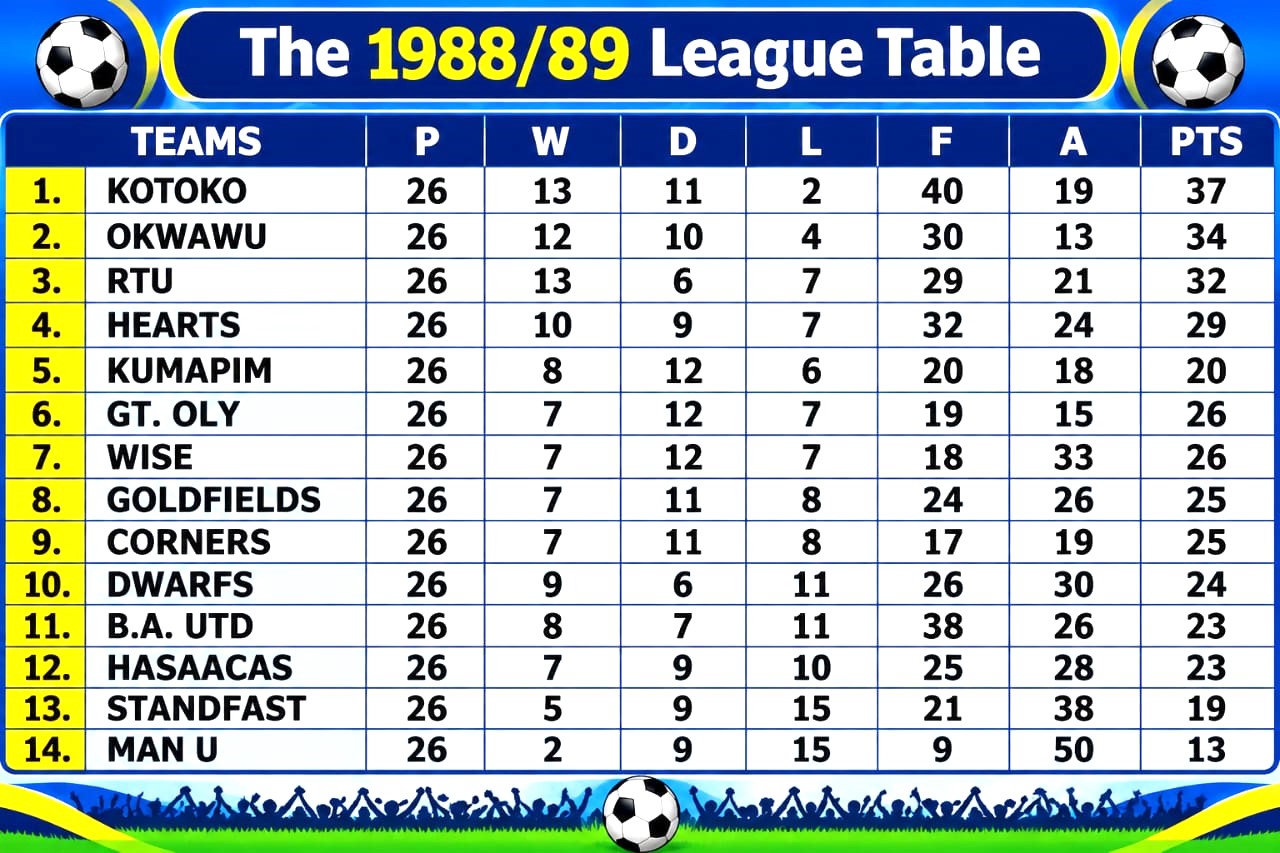 Hasaacas trounced rivals Eleven Wise 19-0 in Sekondi and B. A. United thrashed bottom of the table Man U 20-0 at Sunyani. Before these last fixtures Hasaacas and B. A. United had tied with 21 points apiece on the relegation border-line but United had a superior goal difference of three. It meant, therefore, that the Sekondi boys needed to score at least four goals without reply to oust B. A. United.
There had been wild speculation that these matches were going to be ‘fixed’, and the incredibly high goal tally, no doubt confirmed these rumours.
There was public outrage at the result of the two matches and the media had a field day. The Ghanaian Times, referred to Hasaacas, Wise, B. A. United and Man U as ‘gangsters’ and called on the Ministry of Youth and Sports to punish them.
A popular sports weekly, Graphic Sports, called for a play-off between Hasaacas and B. A. United to determine who stays in the first division.
In the furore, the GFA declared the results null and void; all the four clubs lost their share of gate proceeds and were suspended for six months from all competitions organised by the GFA. In addition, each club was fined ¢250,000 to be paid within ten days.
- A United, Hasaacas and Eleven Wise paid the fines within the stipulated time. Man U, who failed to beat the deadline were banned for two years by the GFA.
In a later development, all players and officials connected with the ‘fixed matches’ on that day were banned for one year.
The sanctions imposed on the clubs and their officials were however lifted on June 6 by the Ministry of Sports. Kwame Saarah-Mensah, Secretary for Sports, said the action had been taken following serious considerations of the numerous appeals by the public and the clubs’ own remorse at the episode.
On May 1, at the Kumasi Sports Stadium, in a match that ended 2-2 between Kotoko and Hearts of Oak, Kotoko fans rioted at the end of the first round match. The fans were protesting against a 47th minute penalty given to Hearts by FIFA Ref G. M. Affizie that gave Hearts the equalizer when Kotoko were leading 2-1. Some installations at the stadium were destroyed and the windscreens of some vehicles smashed.
As punishment, the GFA slammed a six-match home ban on Kotoko. The sentence was later reduced to three after Kotoko had rendered a public apology.
This was a historic season by all standards. It was the season that saw Asante Kotoko hit by the exodus of fifteen key players who left to seek greener pastures elsewhere, together with coach, Malik Jabir. Yet they still managed to remain on top of the league.
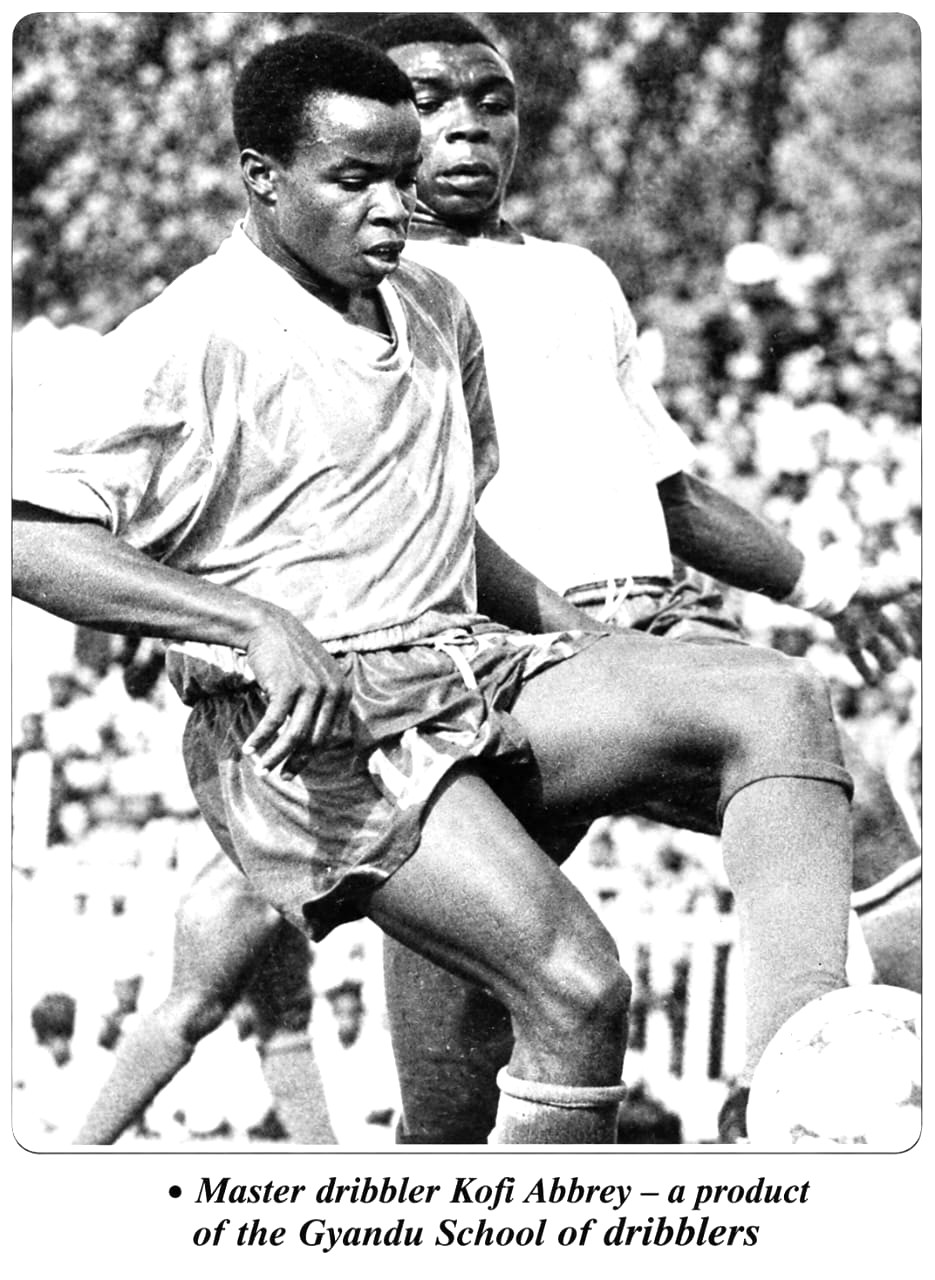
Those who left the club were Opoku Sampene, Naana Eshun, Kofi Abbrey, Asare Boateng, Rauf Iddi, Ebo Mends, Salifu Ansah, Opoku Nti, Abdul Razak, Saarah Mensah, Sam Ayipey, Alhaji Bello, Prince Opoku, Ibrahim Mohammed, and Abdulai Rahim Sunkule.
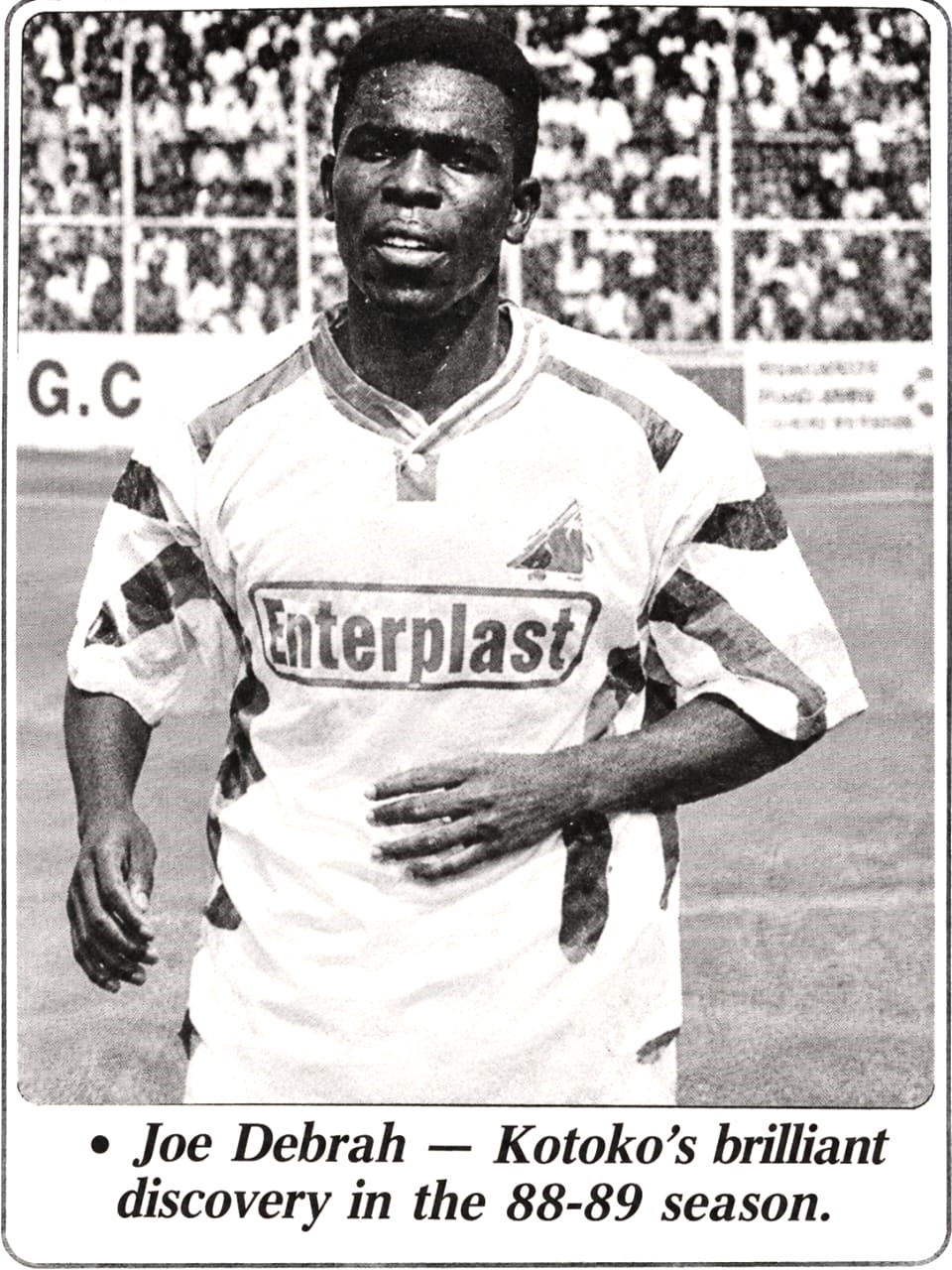
The brightest discovery of the season was Asante Kotoko’s midfielder Joe Debrah, affectionately called Abdul Razak Jnr., who played for both the Black Stars and the junior team, Black Satellites.
Okwawu United’s second position on the table depicted their consistent form over the past three seasons.
At the GFA’s annual Congress held at the Hotel Continental in Accra, the Ministry of Sports announced that Vipers had been granted automatic entry into the first division and would compete in the 1989-90 tournament. No official reasons were given for this action but it was an open secret that Vipers were promoted on the strength of their court case against the GFA.
Standfast and Man U were relegated. What a season.
Cheers everybody and keep loving sports.