
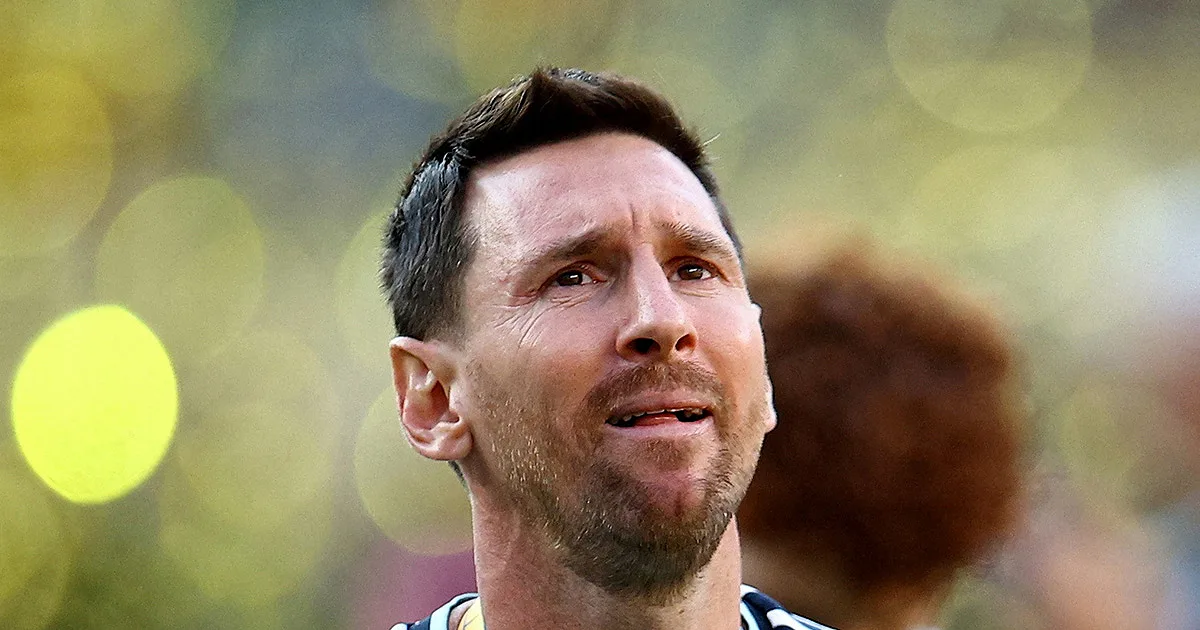
Lionel Messi, the greatest player of his generation and one of the finest in football history, has announced his retirement from international football.
The Argentina captain confirmed the decision on Monday in an emotional Instagram statement, drawing the curtain on a 21-year national team career that included a long-awaited World Cup triumph and a near-repeat in 2026.
“After the time that has passed since the final, and after giving it a lot of thought, I want to let everyone know that I am retiring from the National Team,” Messi wrote. “It was a decision that hurt – and still hurts deep down – but I understand that the time has come. I swear to you that I always gave it my all – not just in these last few years when we won everything, but before that too; I always fought and left everything on the field for this jersey, to bring you joy and make you feel proud to be Argentine through football.”
The 39-year-old added that time is running short and chapters are closing. “This is one that hurts me deeply. I love, have loved, and will always love being part of the national team. I’ve given everything I had; I have nothing left to give, and besides, some great young players are coming up who deserve to be here.”
Messi revealed he first wrote the message on July 21, two days after Argentina’s 1-0 extra-time defeat to Spain in the 2026 World Cup final in New Jersey. The loss denied him a second consecutive world title and a fairytale farewell on the biggest stage.
The subsequent death of his father and longtime agent, Jorge Messi, on August 8 at the age of 68, strengthened his resolve. “Today, after what happened with my dad, I’m even more convinced than before,” he said.
Messi’s international career spanned 207 appearances and 125 goals, making him Argentina’s most-capped player and all-time leading scorer.
He leaves as a World Cup winner (2022), two-time Copa América champion (2021 and 2024), Finalissima winner, and Olympic gold medallist from Beijing 2008.
He appeared in a record-tying six World Cups, reached three finals (2014, 2022, and 2026), and collected multiple Golden Ball awards as the best player at major tournaments.
His path was rarely smooth. A red card on his debut as an 18-year-old substitute against Hungary in 2005 set an early tone of turbulence. For years, Messi carried the burden of expectation in a country still haunted by the shadow of Diego Maradona.
Finals losses in the 2014 World Cup and successive Copa América tournaments in 2015 and 2016 fueled criticism and even prompted a brief retirement announcement in 2016 that he later reversed.
The turning point came under coach Lionel Scaloni. Victory at the 2021 Copa América in Brazil ended a 28-year major trophy drought for Argentina. The following year, Messi captained the side to World Cup glory in Qatar, scoring in the final against France and converting his penalty in the shootout.
That triumph, followed by another Copa América title in 2024, completed a remarkable redemption arc and elevated him, in the eyes of many, beyond debate as the greatest of all time.
In the 2026 tournament, hosted across the United States, Mexico and Canada, Messi once again led from the front. He featured in all of Argentina’s matches and scored eight goals, finishing just one behind tournament top scorer Kylian Mbappé. Reaching a third World Cup final at 39 was itself extraordinary, yet the extra-time defeat to Spain proved the final chapter.
While his international career ends, Messi’s club career continues. He remains contracted to Inter Miami in Major League Soccer until the end of 2028 and has shown no immediate signs of slowing down at club level. Only days before the announcement, he scored four goals in a 7-1 victory over CF Montréal.
The retirement marks the end of an era for Argentine football. Messi leaves a legacy defined not only by individual brilliance and record-breaking statistics but by the collective joy he ultimately delivered to a nation.
From the early struggles and public scrutiny to the pure elation of lifting the World Cup in Lusail, his journey with the Albiceleste became a story of perseverance, leadership and eventual fulfilment.
Young talents now step forward into the space he occupied for two decades. Messi departs with the peace of having given everything and the pride of having shared unforgettable moments with teammates and supporters.
“I leave with the peace of mind and pride of having given you—alongside my teammates—moments we once only dreamed of,” he wrote. “It was an incredible experience to live this with you all. I love you!”
Football will continue, but the sight of Messi in the light blue and white of Argentina is now consigned to history. The game’s most luminous talent of the modern age has closed one of its most significant chapters.