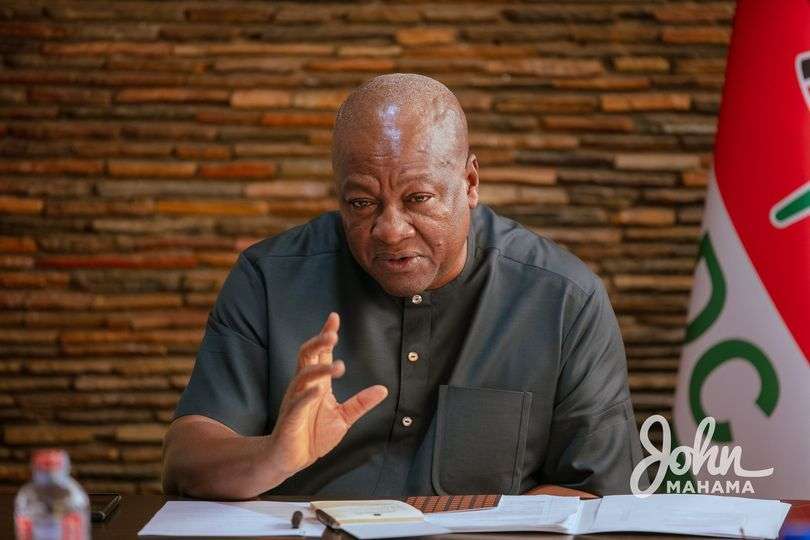


The President of the Republic, John Dramani Mahama, and the Finance Minister, Cassiel Ato Forson, have both been hauled before the Right To Information (RTI) Commission for failing to respond to an RTI request submitted to their offices on 7 October 2025 by a Ghanaian journalist seeking information on ex-gratia payments.
The RTI request submitted to the President and the Finance Minister sought information on the current status of the determination of Article 71 emoluments for the period 2021 to 2025 (the second term of the erstwhile Akufo-Addo administration).
Contention of Applicant
Even though a public institution under section 23 (1) of the Right To Information Act, 2019, (Act 989) is required to determine such an application and communicate its decision within 14 days after receiving the application, the presidency and the finance ministry have failed to do so after nearly 60 days of receipt of the application.
The applicant, after the expiry of the allowed 14 days, followed up on Friday, 24 October 2025, with an application for internal review of the refusal under section 32 of the RTI Act. As of Thursday, 4 December 2025, there has been no response to the main RTI request, and the application for internal review submitted to the presidency and the finance ministry.
The applicant, in his application, brought under section 65(1) of the Right To Information Act, 2019 (Act 989), which provides that: “A person who is dissatisfied with a decision of a public institution… may apply to the Commission for a review of the decision,” and Section 65(2) which further provides that “An application to the Commission may be made orally or in writing,” notes that the failure of the President and the Finance Minister to respond to his request constitutes a refusal.
“The Applicant respectfully submits this written application seeking review of the failure, refusal, neglect, or omission of two key public institutions, the Office of the President and the Ministry of Finance, to determine or respond to valid Right to Information (RTI) requests submitted on 7 October 2025, as well as subsequent applications for internal review submitted on 24 October 2025.
“Both institutions have failed to comply with their mandatory statutory obligations under Act 989, resulting in deemed refusals under section 23(5),” the application read in part.
Reliefs Sought
To this end, the applicant is seeking the following reliefs from the RTI Commission.
- Compel Disclosure
- Order the Chief of Staff, Office of the President, to determine and respond to the Applicant’s RTI request dated 7 October 2025 and provide all requested information.
- Order the Minister for Finance to determine and respond to the Applicant’s RTI request dated 7 October 2025, providing all requested information regarding Article 71 payments.
- Declarations
- Declare that both institutions have breached sections 23, 31, 32, and 33 of Act 989 and Article 21(1)(f) of the Constitution.
- Administrative Penalties (Section 71)
- Pursuant to section 71 of Act 989, impose administrative penalties on the Chief of Staff and the Minister for Finance for willful and unjustifiable disregard of their statutory obligations.
- Time-bound Order
- Direct that all requested information be provided within seven (7) days of the Commission’s ruling.
Assert Full Authority
In concluding his application to the Commission, the applicant submitted that “the persistent refusal by two of the most significant public institutions, namely, the Office of the President and the Ministry of Finance, to comply with the RTI Act constitutes a serious breach of statutory duty, undermines the constitutional right to information, and erodes public confidence in governance.
“In a democratic state, transparency, accountability, and openness are not optional virtues; they are binding constitutional obligations. The Office of the President and the Ministry of Finance, more than any others, must set the national standard for compliance with these principles.
“The Applicant therefore calls upon the Right to Information Commission, as the constitutionally mandated guardian of information rights, to assert its full authority to protect the constitutional right to information, ensure that the rule of law prevails, and reinforce the foundational governance values of transparency and accountability,” the application read.