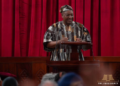

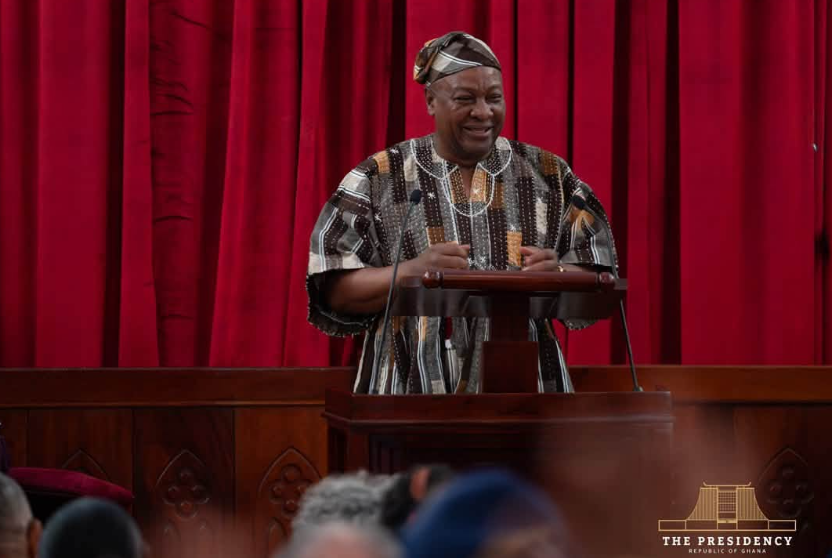
President John Dramani Mahama brought a touch of reggae music and Pan-African solidarity to the Parliament of Barbados when he sang lines from Jamaican reggae legend Peter Tosh’s iconic song African during an address to lawmakers.
The moment occurred on Friday, November 27, 2026, when Mahama addressed a joint sitting of the Barbadian Parliament as part of his state visit to the Caribbean nation.
Drawing on Tosh’s 1977 classic, the President highlighted the shared ancestry, identity and cultural heritage of Africans and people of African descent, emphasising that geographical boundaries and nationality could not erase their common roots.
“We are all Africans,” he declared, reinforcing the song’s central message that people of African descent remain connected by a shared identity, regardless of where they were born or live.
Mahama said the historical relationship between Ghana and Barbados was deeply rooted in the transatlantic slave trade, which forcibly displaced millions of Africans to the Caribbean and other parts of the world.
He noted that the Atlantic Ocean, which once separated Africans from their ancestral homes, should now serve as a bridge for renewed relationships, cooperation and shared prosperity between Africa and the Caribbean.
The President also highlighted cultural similarities between Ghana and Barbados, citing food, music, language, communal savings traditions and respect for elders as evidence of their enduring connections.
He mentioned Ghanaian staples such as kenkey and banku, which he said shared similarities with Barbados’ traditional dish, cou-cou. He also referenced the susu savings system, noting its roots in African traditions.
Beyond the cultural connections, Mahama renewed calls for reparatory justice for Africans and their descendants over the historical injustices of slavery, colonialism and the exploitation of African resources.
He paid tribute to the millions of Africans who endured enslavement, noting that their labour and suffering contributed significantly to the economic prosperity of Europe and North America.
The President criticised the unequal treatment that followed the abolition of slavery, pointing out that formerly enslaved Africans received no compensation for their suffering and stolen labour, while slave owners were compensated by imperial governments.
He stressed that the pursuit of reparatory justice was not about revenge but about historical recognition, accountability, reconciliation and the restoration of human dignity.
Mahama also referenced a United Nations General Assembly resolution on the trafficking and enslavement of Africans, describing its adoption as an important milestone in the global campaign for reparatory justice.
He called on Africans and people of African descent to work together to preserve their shared history and shape their collective future.
The President further urged Ghana and Barbados to strengthen practical cooperation through increased trade, direct air connectivity, educational exchanges and closer economic ties between Africa and the Caribbean.
He reaffirmed Ghana’s commitment to making the African diaspora’s designation as the African Union’s Sixth Region operational when the country assumes the AU chairmanship in 2027.
Mahama’s address came as Barbados marked 60 years of independence and five years as a republic. He congratulated the country on these milestones and commended its governance and development achievements.
He was the second Ghanaian President to address the Barbadian Parliament, an occasion he described as a reflection of the longstanding friendship and historical bonds between the two countries.