
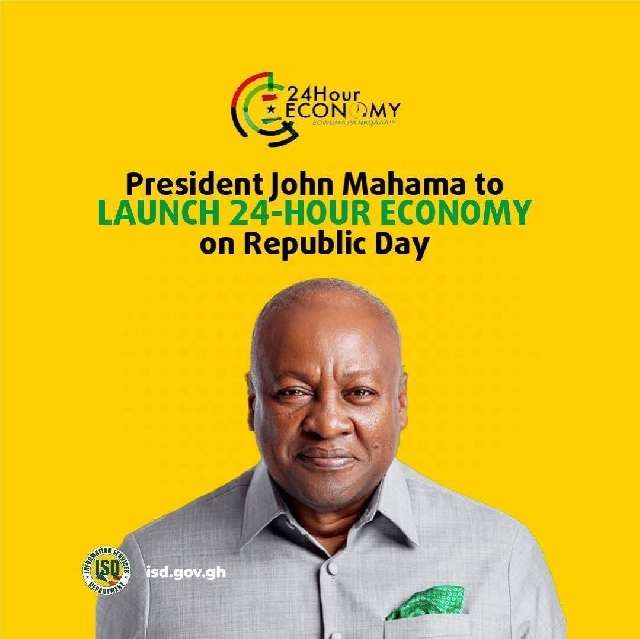
President John Dramani Mahama is set to officially launch the much-anticipated 24-Hour Economy policy on Republic Day, July 1, 2025.
The launch will mark a significant step toward the implementation of a key campaign promise aimed at transforming Ghana’s economy by encouraging continuous productivity across key sectors, day and night.
The initiative seeks to generate more jobs, improve efficiency, and boost national output through shift-based systems in both public and private enterprises.
The 24-Hour Economy is expected to impact industries such as manufacturing, healthcare, retail, transport, hospitality, and essential services.
According to the Information Services Department (ISD), which confirmed the launch, the policy is centred on innovation, technology, and investment in energy and security infrastructure to support round-the-clock economic activity.
President Mahama has consistently touted the policy as a game-changer for job creation and national development, emphasising its potential to significantly reduce unemployment and modernise Ghana’s economy.
Details of the launch event are expected to be communicated in the coming days.
The initiative was part of the NDC’s broader vision for economic revitalisation and inclusive growth ahead of the 2024 general elections.
However, many Ghanaians are wondering if this policy can be sustained in the midst of unstable electricity supply in the country.
President Mahama and Energy Minister John Jinapor claim there is over $2 billion debt in the energy sector left be the previous New Patriotic Party (NPP) government.
This, according to them, has placed significant constraints on the current administration’s ability to implement sustainable solutions.
This financial burden, President argued, has the potential of deepening the sector’s challenges and undermining efforts to stabilize power supply for Ghanaians.
However, the president assured Ghanaians that his government will work diligently to address these issues, restore stability, and improve transparency within the energy sector.