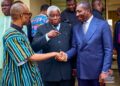


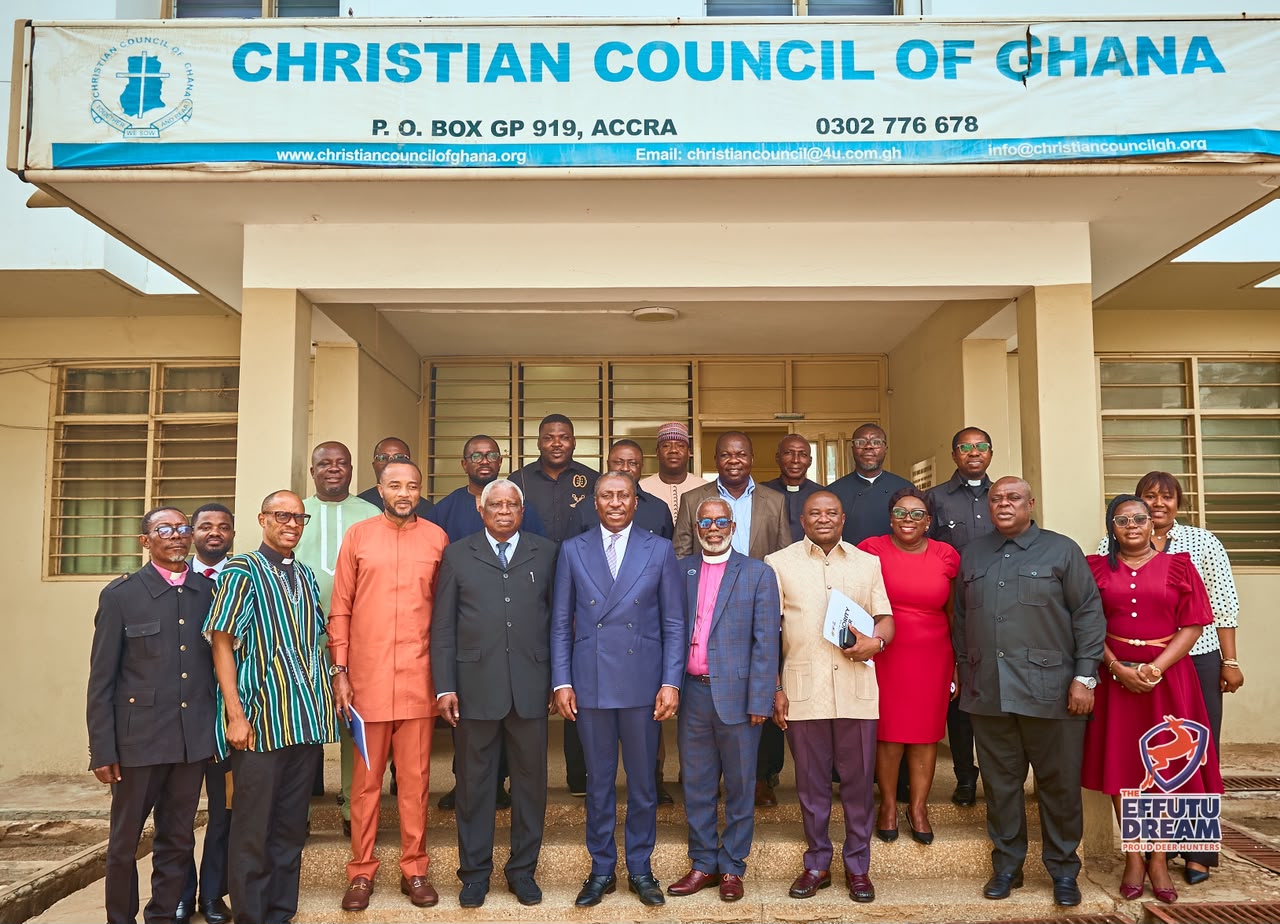
The New Patriotic Party (NPP) Minority Caucus in Parliament has met with the leadership of the Christian Council of Ghana (CCG) for a national conversation on Ghana’s economy, democracy and the future of the country.
The group called on the Christian Council to leverage its moral authority as a national voice to confront what it described as growing governance failures, rising illegal mining activities, wanton arrests, suppression of free speech and losses associated with the operations of the Ghana Gold Board (GoldBod) under the Domestic Gold Purchase Programme (GDPP).
The meeting held in Accra on October 6, 2026, was at the invitation of the Christian Council following public debate on numerous issues of national importance.
The Council explained that the meeting formed part of its engagement with key institutional stakeholders in Ghana’s democracy.
It indicated that issues raised during the meeting would, where appropriate, be referred to relevant bodies within the Church for consideration and possible action.
Addressing the meeting, the Minority Leader, Osahen Alexander Afenyo-Markin urged the Christian Council to play a more active role in holding the government accountable and speaking out on matters that threaten Ghana’s democratic and socio-economic development.
“We have come here in good faith and in response to your invitation. Our purpose is not obstruction. Our duty is to scrutinize government and provide oversight in the interest of the Ghanaian people,” he said.
The Minority Leader, who is also the Member of Parliament (MP) for Effutu, said institutions such as the Christian Council command enormous respect and credibility among Ghanaians and must therefore become a leading voice in mobilizing national action against what he termed policy failures and governance excesses.
He argued that the issues being raised by the Minority were not partisan concerns but matters affecting the future of the country.
According to him, the Council’s intervention would help elevate public discourse and ensure that critical national challenges receive the necessary attention from policymakers.
Domestic Gold Purchase Programme losses
A major focus of the engagement was the Minority’s concerns over losses linked to the Domestic Gold Purchase Programme (DGPP).
This was after the Christian Council wanted to understand the Minority’s position on the financial performance and governance of the GoldBod, among other issues.
Osahen Afenyo-Markin raised issues about the International Monetary Fund (IMF)-reported US$1.7 billion loss associated with the DGPP.
The Minority Leader said this figure had implications for the Bank of Ghana’s balance sheet and could potentially create a recapitalisation burden for taxpayers.
Such losses, he stated, were unacceptable at a time when government continued to cite fiscal constraints as a reason for delaying the posting of nurses and teachers and slowing critical development projects.
“If implementation mechanisms are not strengthened, the country will continue to incur huge losses,” he warned.
Calling for an independent and transparent reconciliation of the figures and the transactions behind the losses, Osahen Afenyo-Markin disclosed that the Minority will pursue a parliamentary motion seeking a public hearing into the matter.
Economic hardships
Osahen Afenyo-Markin also used the meeting to highlight the economic difficulties facing many Ghanaians, particularly young people.
He said economic recovery should not only be reflected in macroeconomic indicators but must translate into jobs, better living conditions and opportunities for the youth.
According to him, continued economic exclusion could undermine social cohesion and national stability.
Afenyo-Markin defends Minority’s role
The Minority Leader thanked the Christian Council for its longstanding contribution to national development and its willingness to engage different stakeholders on issues of national importance.
He said credible institutions were needed to enrich public debate and hold both the Government and Opposition accountable.
Osahen Afenyo-Markin maintained that the Minority would continue to discharge its constitutional responsibility despite its numbers in Parliament.
“We seek no immunity from lawful investigation and will never defend impunity,” he said.
However, he stressed that investigations and accountability must be pursued according to the law and that the powers of State institutions must not be used to intimidate political opponents.
Baffour-Awuah’s arrest
The Minority Leader also raised concerns about the recent attempted arrest of Manhyia South MP, Nana Agyei Baffour Awuah, within the premises of the High Court in Accra.
According to him, the attempted arrest did not respect the applicable constitutional and parliamentary procedures.
He further expressed concern about the subsequent warrant obtained by the Economic and Organised Crime Office (EOCO) and the circumstances surrounding the MP’s detention after he voluntarily presented himself to the agency.
The Minority Leader said the Caucus would remain peaceful and law-abiding but would not abandon its responsibility to hold the Government accountable.
Constitutional reforms
Constitutional reform was another major issue discussed during the meeting.
The NPP, Osahen Afenyo-Markin reiterated, supported reforms that were necessary to improve Ghana’s constitutional governance.
However, he expressed reservations about the Government’s current approach, particularly the scale of the proposed amendments and what he described as significant departures from the recommendations of its own Constitution Review Committee.
The Minority Leader argued that the major constitutional changes should have broad national support rather than being perceived as the agenda of one political party or government.
Osahen Afenyo-Markin also touched on pending Supreme Court cases concerning presidential term limits.
While acknowledging the independence of the judiciary and avoiding any attempt to prejudge the cases, he stressed the need to maintain constitutional safeguards against excessive concentration of executive power.
Social media, galamsey and AI
The discussions extended beyond politics and the economy.
The two sides discussed the need to protect children from harmful social media content while preserving constitutional freedoms.
They also considered the regulation of artificial intelligence, narcotics trafficking, illegal mining, water security, religious freedom, mission schools and long-term national development planning.
Osahen Afenyo-Markin said these issues required sustained national dialogue rather than short-term political responses.
National Cathedral financing
The National Cathedral project also featured in the discussions with the Minority Leader noting that the Government’s renewed engagement with the project, which the National Democratic Congress (NDC) had strongly criticised while in opposition.
He encouraged the Christian Council to explore a transparent, Christian-led private financing model that could provide a sustainable way forward without placing additional construction costs on taxpayers.
Narcotic Drug busts
The Minority Leader expressed disappointment over Parliament’s inability to debate a motion filed by the Minority on recent drug-related incidents, insisting that the issue poses a serious threat to Ghana’s international reputation and national security.
He said concerns first raised by Assin South MP Rev. John Ntim Fordjour deserved careful examination instead of intimidation.
On illegal mining, the Minority warned that the situation has reached alarming levels and requires urgent intervention from all stakeholders, including faith-based organizations.
Osahen Afenyo-Markin said organized labour, environmental groups and communities continue to raise concerns about the devastating impact of galamsey on water bodies and forest reserves.
Christian Council commends Minority
The Christian Council commended the Minority for what it described as the courage with which the Caucus continues to perform its constitutional role despite being in the minority in Parliament.
The Council also acknowledged Osahen Afenyo-Markin’s leadership and efforts to keep the Caucus focused on its parliamentary responsibilities.
Osahen Afenyo-Markin said the engagement had strengthened his conviction that credible national institutions must remain willing to listen, speak and act in the national interest.
He stressed that political differences should not overshadow the broader interests of the country.
“Whatever our differences on public questions, Ghana must always stand above all of us,” he said.
Delegation
The Minority Leader was accompanied by Jerry Ahmed Shaib, MP for Weija-Gbawe and Second Deputy Minority Whip; Mr. Daniel Nana Addo-Kenneth, MP for Okere; Mr. Frank Asiedu Bekoe, MP for Suhum; Mr. Emmanuel Tobbin, MP for Anyaa-Sowutuom; Mr. Kennedy Osei Nyarko, MP for Akim Swedru; and Mr. Fred Kyei Asamoah, MP for Offinso North.
The rest were Mr. Francis Kwabena Owusu-Akyaw, MP for Juaben; Mr. Alexander Akwasi Acquah, MP for Akim Oda; and former Yendi MP, Dr. Farouk Aliu Mahama.
They were received by a Council delegation chaired by Bishop Dr Lawson Adjei, former Vice-Chairman and Executive Member of the CCG, together with Dr Joyce Lako Steiner, Acting General Secretary; Rev. Godwin Amuzu, Director of Interfaith and Ecumenical Relations; Mr Samuel Koku Anyidoho, Communications Advisor; Rev. Felix Kadjahlo; Rev. Christian Tsikata; and Rev. Mark Quaye.