

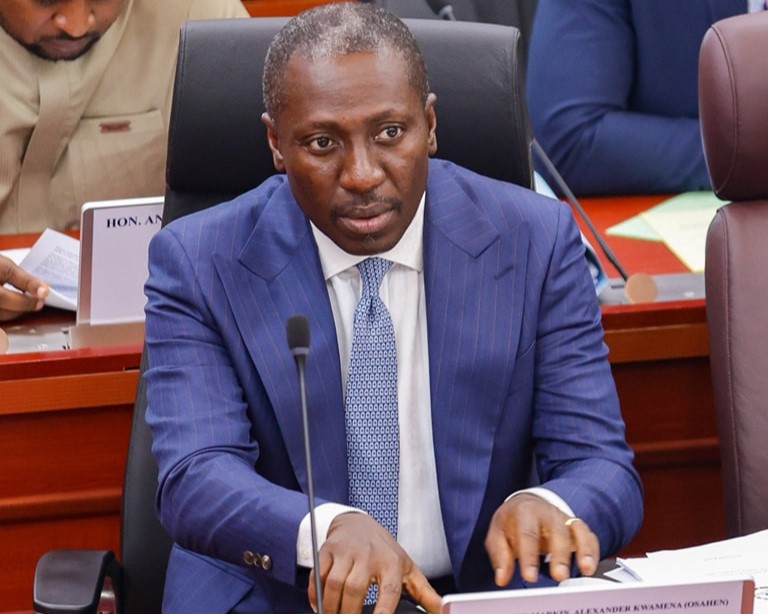
The New Patriotic Party (NPP) Minority in Parliament has revived its call for a full-scale parliamentary inquiry into major cocaine and drug busts linked to Ghana under the administration of President John Dramani Mahama.
The Minority had pointed out that drug seizures linked to Ghana under the current administration had a combined value of well over $2 billion in less than two years, calling for the probe.
Consequently, the Minority led by Osahen Alexander Kwamena Afenyo-Markin has filed an application seeking a review of Speaker Alban Bagbin’s ruling rejecting its private members’ motion for the parliamentary inquiry.
The Minority Leader who is also the Member of Parliament (MP) for Effutu disclosed that the application was filed through the First Deputy Whip, Habib Iddrisu, under Standing Order 127 of Parliament’s Standing Orders.
The application is challenging Mr Bagbin’s September 29, 2026, decision to reject the proposed inquiry into the narcotics seizures and possible institutional, regulatory and security failures that may have facilitated them.
Speaking to journalists at a ‘Leaders’ Media Briefing” on Tuesday November 3, 2026, ahead of Parliament’s resumption, Osahen Afenyo-Markin said the application was not intended to undermine the Speaker’s authority but to protect Parliament’s constitutional responsibility to hold public institutions accountable.
“We respect the office of the Speaker and recognise the constitutional responsibility entrusted to its occupant.
“However, the respect for the office does not require silence when a ruling raises a serious question about the constitutional powers of Parliament and the ability of elected representatives to demand accountability from public institutions,” he said.
Speaker Bagbin rejected the proposed inquiry on September 29, arguing that it could interfere with ongoing criminal proceedings relating to the narcotics seizures.
He held that the proposed parliamentary investigation would traverse factual matters directly connected with cases before the criminal justice system, raising concerns about the application of the subjudice principle.
The motion
The motion sets the stage for a fresh parliamentary dispute over the limits of the Speaker’s authority, the constitutional oversight responsibilities of Parliament and whether ongoing criminal prosecutions can be used as grounds to prevent lawmakers from investigating possible institutional failures in the fight against international drug trafficking.
Speaker Bagbin had ruled against the proposed investigation on the grounds that proceeding with it could prejudice ongoing criminal proceedings involving approximately 21 persons in four separate narcotics-related cases.
However, the Minority is now challenging the basis of that decision, arguing that Parliament cannot abandon its constitutional responsibility to examine the performance of public institutions simply because criminal cases are before the courts.
Osahen Afenyo-Markin insisted that the motion should not be interpreted as an attack on the Speaker or an attempt to undermine the authority of his office.
He reiterated that respect for the Speaker did not mean lawmakers should remain silent when a ruling raises questions about the constitutional powers of Parliament.
According to the Minority Leader, the proposed inquiry is intended to investigate the institutional and regulatory circumstances surrounding the movement of illicit drugs through Ghana, rather than determine the guilt or innocence of persons facing criminal prosecution.
Reasons for September 29 ruling
The Speaker’s September 29 ruling was based on the risk that a parliamentary inquiry could prejudice proceedings involving the accused persons.
However, Osahen Afenyo-Markin maintained that criminal prosecution and parliamentary oversight are separate constitutional responsibilities and should not automatically be treated as mutually exclusive.
He explained that criminal courts are responsible for determining whether accused persons have committed offences, while Parliament is expected to examine whether public institutions have performed their duties, whether existing laws and regulatory frameworks are adequate and whether failures in public administration require corrective action.
The Minority Leader warned that allowing ongoing prosecutions to become a blanket justification for preventing parliamentary scrutiny could leave possible institutional weaknesses unresolved.
He argued that prosecuting individuals, regardless of the outcome of their cases, does not remove the government’s responsibility to explain how public institutions performed their duties and whether any administrative or regulatory failures contributed to the incidents.
Drug seizures
Osahen Afenyo-Markin argued that the increasing number of international cocaine interceptions involving consignments linked to Ghana demands a broader examination of the country’s port security arrangements.
Among the incidents cited by the Minority Leader was the interception of approximately 3.9 tonnes of cocaine at the Port of Dunkirk in France on September 7, 2026.
The consignment, reportedly concealed in a shipment of plastic waste originating from Ghana, was estimated to be worth about €225 million.
The seizure has raised questions about how such a large quantity of suspected narcotics could allegedly move through the international shipping chain and reach a European port without being detected earlier by the relevant authorities.
Osahen Afenyo-Markin also referred to other reported cocaine seizures in Amsterdam, Antwerp and Sydney, as well as suspected interceptions within Ghana, including incidents around the Tema Harbour enclave and Pedu Junction.
Individual arrests not full solution
For the Minority, these incidents point to concerns that go beyond the individuals arrested or charged.
The opposition argued that the country must establish whether weaknesses in its border protection systems, intelligence-sharing arrangements and institutional supervision have created opportunities for international drug trafficking networks.
The latest development also revives broader concerns about Ghana’s vulnerability to transnational organised crime and the effectiveness of the agencies responsible for monitoring the movement of goods through the country’s ports, airports and other entry points.
At the centre of the parliamentary disagreement is whether an investigation by the legislature can proceed without interfering with criminal cases being handled by the courts.
The controversy is particularly significant because the proposed inquiry was intended to be bipartisan, suggesting that the opposition wanted the matter treated as a national security and institutional accountability issue rather than merely a partisan dispute.
However, the Speaker’s ruling has placed the immediate question of whether Parliament can proceed with such an inquiry before the House itself.
Possibilities
The filing of the motion now brings Standing Order 127 into focus, as the Minority seeks to use the parliamentary procedure to challenge the ruling and reopen the debate over the admissibility of its proposed investigation.
The outcome could have implications for how Parliament handles future inquiries involving matters that are simultaneously under criminal investigation or prosecution.
If the Minority succeeds, lawmakers could have another opportunity to examine the institutional arrangements surrounding the reported cocaine seizures, subject to the limits required to protect ongoing judicial proceedings.
If the ruling remains in place, the opposition’s proposed inquiry may face further procedural obstacles.
Beyond the parliamentary contest, the larger issue remains Ghana’s ability to prevent its ports and other entry points from being exploited by international narcotics trafficking networks.
Renewed focus on Ghana
The reported seizures across Europe, Australia and Ghana have placed renewed attention on the effectiveness of the country’s security and regulatory institutions.
The questions being raised include whether cargo inspection systems are sufficiently effective, whether intelligence is shared promptly among agencies and whether existing oversight mechanisms can identify and correct institutional weaknesses.
The Minority insisted that criminal proceedings must not become a shield against institutional accountability, while the Speaker’s earlier ruling reflects concern about protecting ongoing court cases from possible prejudice.
The motion filed by Habib Iddrisu will therefore test the boundaries between Parliament’s oversight mandate and the need to safeguard the independence and integrity of the criminal justice process.