
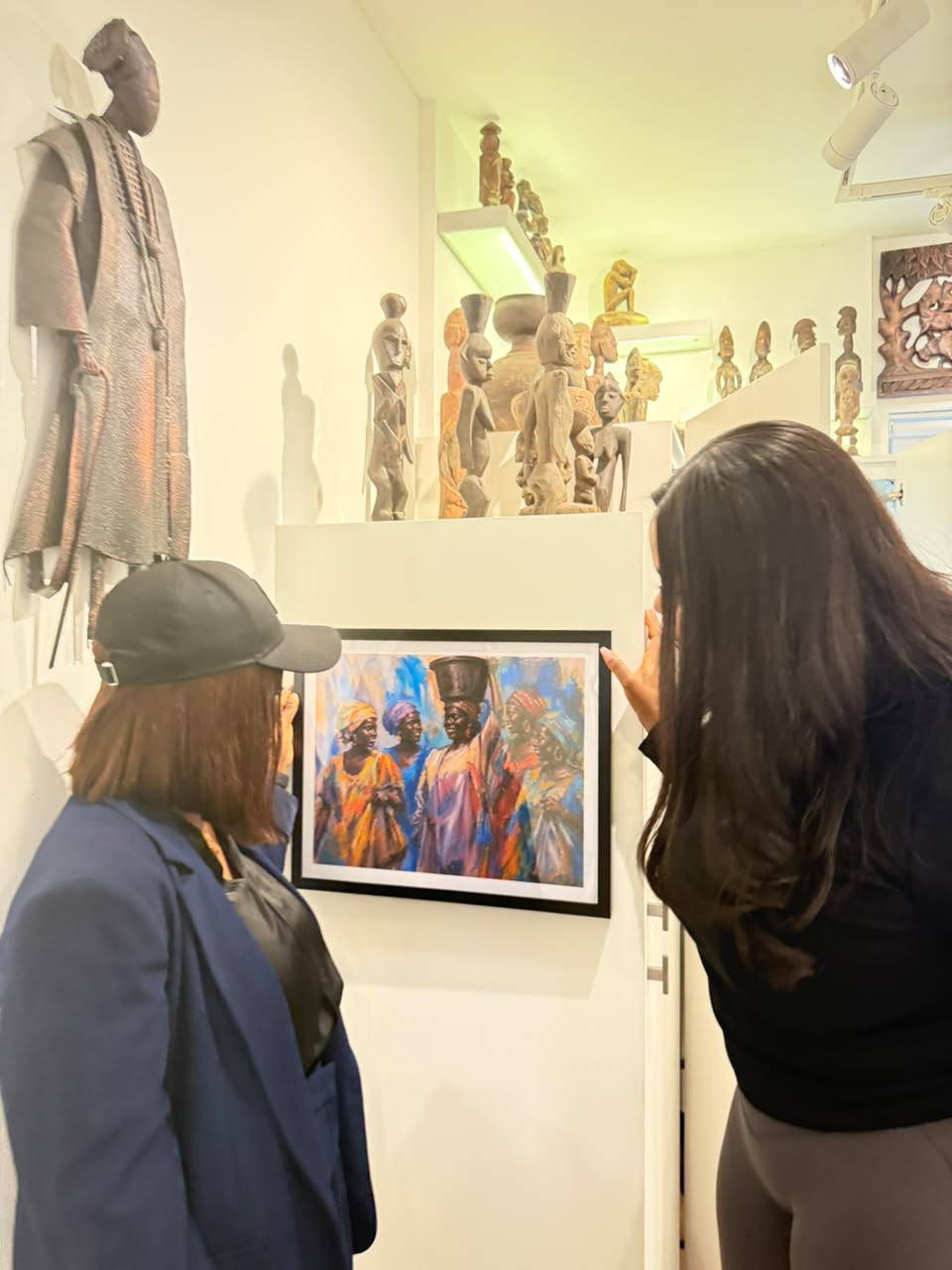
London became the setting for a vibrant celebration of African identity and everyday human connection as artist Ololade Oletubo presented his solo exhibition, Mixed Reality, at Afrahouse Gallery on 1 September 2026.
The exhibition brought together a striking collection of figurative paintings in which colour, movement, and human interaction took centre stage. Through richly textured surfaces and expressive brushwork, Oletubo presented scenes that felt at once intimate and communal, drawing attention to the relationships, traditions, and shared experiences that shape people’s lives.
Rather than focusing solely on individual portraiture, Mixed Reality placed people in relation to one another. Men appeared engaged in animated conversation, their gestures suggesting familiarity and exchange. Women stood together carrying children, while other figures appeared in scenes evocative of work, movement, and everyday community life.
These moments gave the exhibition its emotional character. The paintings did not rely on dramatic events to communicate their ideas. Instead, Oletubo found significance in ordinary encounters: a conversation between friends, the closeness between mother and child, the companionship of women moving through daily life and the simple act of people occupying a shared space.
Colour was central to that storytelling.
Electric blues, deep purples, brilliant oranges, yellows, greens, and turquoise swept across the canvases in thick, energetic strokes. Traditional garments and headwraps became fields of colour in their own right, while backgrounds appeared to merge with the figures themselves. The paintings shifted between representation and abstraction, allowing recognisable faces and bodies to emerge from vigorous layers of paint.
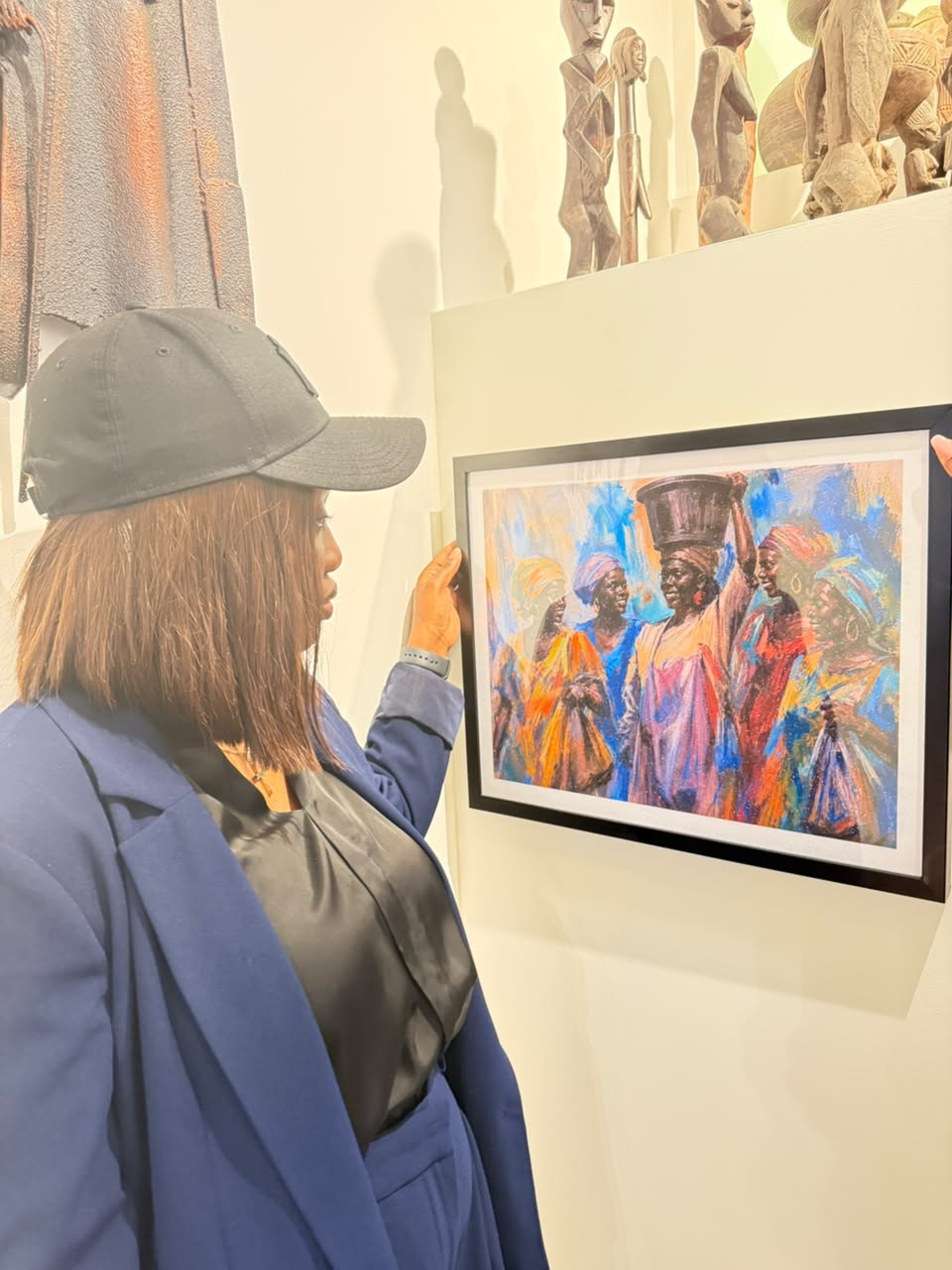
That visual tension gave Mixed Reality an intriguing sense of movement. Seen from a distance, the works offered confident scenes of people and community. Up close, those same images revealed themselves as collections of marks, textures, and overlapping colours.
The title Mixed Reality therefore seemed especially fitting. Reality in Oletubo’s paintings was not presented as something fixed or purely literal. It appeared instead as something shaped by experience, memory, heritage, and perception.
The cultural presence of the figures was equally important. Clothing, headwear, jewellery, and the rhythms of communal gathering referenced African traditions without reducing the subjects to cultural symbols. They remained individuals with expressions, relationships, and personalities.
There was also a strong sense of dignity running through the exhibition. Oletubo’s subjects frequently occupied substantial areas of the canvas, giving everyday people a commanding visual presence. Mothers, friends, workers, and community members became worthy of the scale and attention historically associated with more formal portraiture.
Presenting these images in London added another dimension to the exhibition. In a city where cultures, generations, and diasporic experiences constantly intersect, Mixed Reality offered a visual reflection on what it means to carry cultural identity while participating in a wider contemporary world.
Yet the exhibition did not require viewers to share the precise cultural experiences represented to connect with them. Its deeper themes—family, friendship, care, conversation, work, and belonging—were immediately recognisable.
Perhaps this was the achievement at the heart of Mixed Reality: the paintings remained culturally distinctive while speaking to experiences that extend beyond geography.
Oletubo’s expressive approach also prevented the exhibition from feeling nostalgic. Although heritage and tradition were clearly present, the works possessed a distinctly contemporary energy. Loose brushwork, intense colour combinations, and partially abstract backgrounds created images that felt active rather than preserved.
The people depicted were not presented as figures belonging to a distant past. They appeared alive within an evolving cultural story.
By the end, Mixed Reality emerged as more than an exhibition of colourful figurative paintings. It became an exploration of how people see themselves through family, community, and culture—and how individual identity is continually shaped by the people around us.
Through scenes of conversation, motherhood, friendship and everyday life, Ololade Oletubo turned familiar experiences into powerful visual statements about connection and belonging.
At Afrahouse Gallery, those moments came together in a body of work filled with movement, warmth, and unmistakable human presence a reminder that reality is rarely experienced alone, but continually created and recreated through the communities we share.