
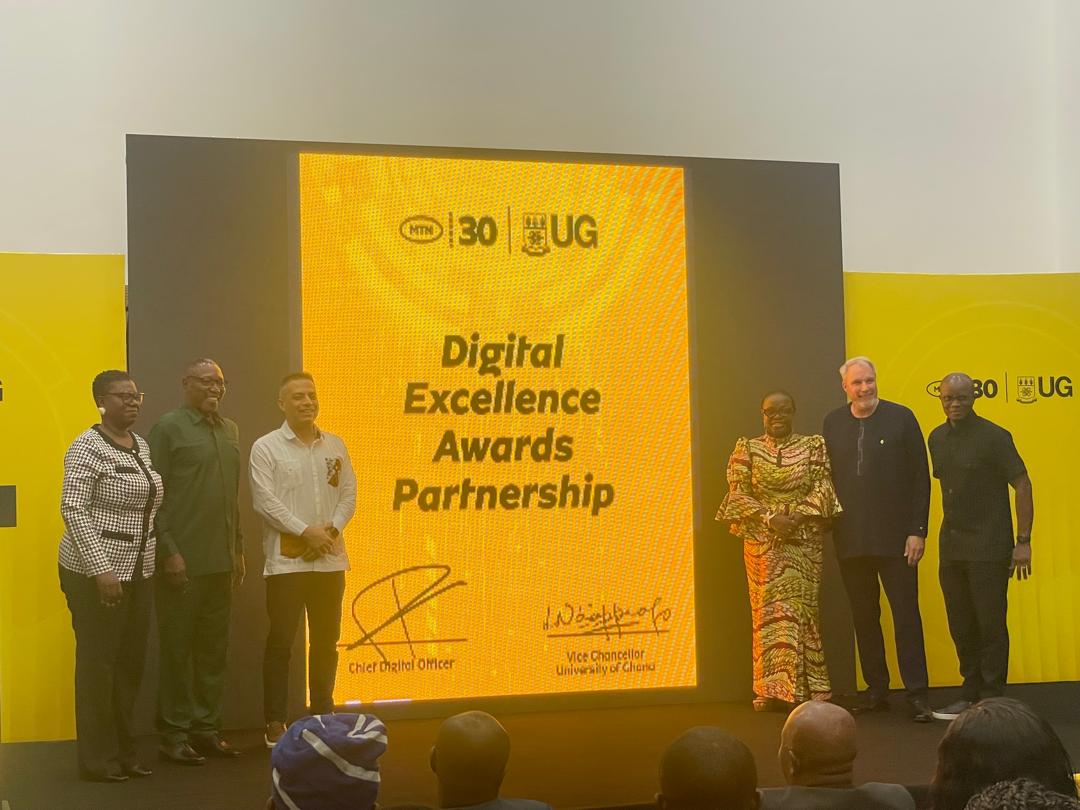
MTN Ghana and the University of Ghana have signed a Memorandum of Understanding (MoU) to deepen collaboration in digital innovation, with a focus on the MTN Digital Excellence Awards and Hackathon.
The partnership is aimed at equipping young people with practical digital skills and creating solutions to real-world societal and business challenges using emerging technologies, particularly artificial intelligence (AI).
Speaking at the ceremony, the Chief Executive Officer (CEO) of MTN Ghana, Stephen Blewett said the partnership reflected the company’s commitment to building Ghana’s digital talent pipeline and positioning the country as a hub for innovation.
He said the hackathon was particularly important because it would enable participants to move from theoretical knowledge to practical solutions.
“Hackathons bring theory to practice. We have a problem, we need to find a solution,” he said.
He said the initiative should not end with participants developing interesting ideas, but must provide a pathway for promising solutions to become viable products and services.
“It’s not about just coming up with great ideas, but it’s about identifying promising ideas, and then, very importantly, support, mentorship, then create a pathway for incubation and pilots, and then potential real-world developments,” he said.
According to him, mentorship was critical to helping young innovators transform good concepts into solutions that could be deployed locally and eventually taken to global markets.
He said MTN believed strongly in Ghanaian talent and the capacity of local innovators to contribute to the country’s digital transformation.
“We believe in the people of Ghana. We believe in strengthening digital talent and the digital talent pipeline. We believe that innovation will set us apart for the future,” he said.
Industry-academia collaboration
The Vice-Chancellor of UG, Professor Nana Aba Appiah Amfo, described the partnership as an example of the kind of relationship the university wanted to build with industry.
She said the collaboration went beyond the signing of an MoU, stressing that academia and industry had complementary roles to play in preparing young people for the future.
“These two worlds cannot co-create separately,” she said.
Prof. Amfo said the rapid development of AI, data analytics, cloud technologies and digital platforms was transforming businesses, jobs and the skills required by employers.
She said UG was consequently reviewing its curriculum to ensure graduates were better prepared for the changing world of work.
“As part of the review of our University of Ghana required courses, what we call UGRCs, we are introducing compulsory modules in digital literacy and applied artificial intelligence,” she said.
She added that the university wanted graduates who were not only technologically competent but also understood the social implications of technology.
“We want graduates who understand technology, who are technologically capable. But we also want graduates who understand the society in which technology operates,” she said.
From classroom to workplace
Prof. Amfo said the partnership would provide opportunities for internships, national service placements, industry visits, masterclasses and direct engagement between students and practitioners.
Such exposure, she said, would enable students to connect academic knowledge with practical workplace demands.
“We need real industry problems becoming student projects and research projects,” she said.
She added that industry, in turn, could benefit from the university’s research expertise and the creativity of its students.
“This MOU creates precisely that bridge,” she said.
The Vice-Chancellor cited an existing university initiative, Tekyerema Pa , to wit , good tongue as an example of how technology, research and inclusion could come together to address practical challenges.
She said the project sought to use AI and speech-recognition technologies to reduce communication barriers for persons with speech impairments while incorporating Ghanaian languages into digital solutions.
She stressed that innovation should take account of the needs of the people for whom the technology was being developed.
“The challenge to our students is not simply to produce technically impressive prototypes. It is to develop solutions that are useful, accessible, and grounded in the realities of the people they are intended to serve,” she said.
“Don’t innovate for applause, but innovate for work.”
AI for local problems
The Chief Digital Officer of MTN , Ibrahim Misto said technology created value only when it generated meaningful impact.
He said AI was already transforming economies, businesses, education and public services, adding that Ghana had to determine whether it would merely consume technologies developed elsewhere or build solutions tailored to its own needs.
“Will we wait for AI solutions to be built elsewhere, or will we use AI broadly, responsibly, and locally to solve local problems that matter to our people?” he asked.
He said the partnership would give participants practical exposure to AI and enable them to work across disciplines on real-world challenges.
The objective, he said, was to move beyond ideas and develop prototypes that could be tested, improved and scaled beyond the university environment.
He said the initiative was part of MTN’s broader commitment to investing in young people and supporting innovation as the company marked 30 years of operations.
“Our ambition is simple but important: Create a generation of young innovators who do not wait for solutions to be important, but who build solutions that are relevant to Ghana, scalable across Africa, and competitive to the world,” he said.
Addressing participants in the hackathon, the CDO challenged them to focus on solving problems rather than seeking recognition.
He urged the young innovators to develop solutions that improved lives, strengthened businesses and supported communities while demonstrating the ability of Ghanaian talent to compete globally.