

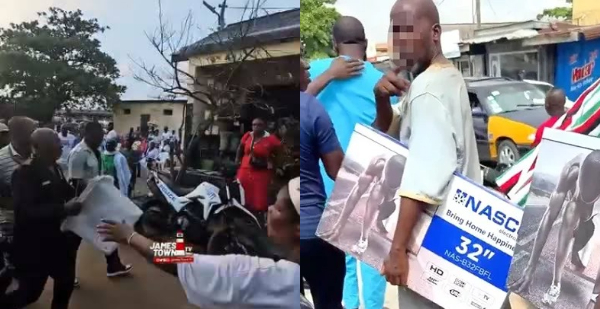
Cash, television sets, mobile phones, washing machines, clothes, table-top refrigerators, cooking stoves and other household appliances were openly distributed in several parts of the country to buy votes of the delegates in the governing National Democratic Congress (NDC) constituency primaries on Saturday October 24, 2026.
Scenes of violence and disorder also marred the primaries in some constituencies, raising questions about the credibility of NDC’s candidate-selection process and the standards expected of the governing party ahead of the 2028 general election.
From Odododiodioo and Teshie constituencies in the Greater Accra Region, Kintampo North in the Bono East Region to Sefwi Akontombra in the Western North Region, the internal elections were characterised by confusion at several polling centres, completely disrupting the voting process.
Video footages from some constituencies showed angry delegates confronting one another, security personnel struggling to contain disturbances, and ballot boxes becoming the centre of tense confrontations.
The footages further showed delegates displaying or receiving gifts visibly distributed by aspirants seeking their votes and support.
The incidents painted a troubling picture of contests in which the struggle for constituency leadership appeared, in some places, to extend beyond persuasion and the presentation of ideas to the distribution of material benefits and outright physical confrontation.
The disturbances are particularly concerning because the NDC is the governing party, making the conduct of its internal elections a test of its commitment to democratic standards and accountability.
The allegations of vote buying and scenes of violence overshadowed the constituency primaries, with some voting and counting processes disrupted and, in some constituencies, the election suspended despite reports of gifts being distributed.
Ballot boxes as flashpoints
In the Odododiodioo constituency in the Greater Accra Region, disturbances erupted after polls closed, forcing officials of the Electoral Commission (EC) to suspend the sorting and counting of ballot papers.
Videos showed a police officer running from the scene with a ballot box as several people pursued him.
Some appeared to be attempting to seize the box, while the officer tried to prevent it from being taken amid the unfolding chaos.
The officer eventually managed to leave the area with the ballot box and reportedly took it to a police station for safekeeping.
The dramatic scenes raised concerns about the security of election materials and the ability of officials to complete the process peacefully.
Other parts of Accra
At Tema East, also in the Greater Accra Region, confusion broke out over the procedure for counting ballots.
Tension emerged after aspirant Kempes Papa Nii Ofosu Ware reportedly suggested that all ballots be brought together and counted collectively instead of being counted according to individual polling stations.
Some aspirants resisted the proposal, triggering disagreement at the venue as the constituency attempted to elect new leaders.
The dispute over the counting method disrupted proceedings and highlighted the importance of clear, agreed procedures for resolving electoral disagreements before they develop into confrontations.
Sefwi Akontombra
In Sefwi Akontombra in the Western North Region, the situation reportedly turned violent after suspected machomen seized ballot boxes.
Police officers fired warning shots in an attempt to restore order, but the intervention reportedly failed to immediately calm the situation.
The reported seizure of ballot boxes represented one of the most serious threats to the credibility of the process, given that the integrity of election results depends on the safe custody of ballots and the ability of officials to count them without intimidation.
Kintampo North
Kintampo North in the Bono East Region also experienced scenes of pandemonium, with gunshots reportedly heard as tensions mounted.
Police struggled to calm tempers as disorder engulfed the constituency.
Ledzokuku
In the Ledzokuku constituency in Teshie in the Greater Accra Region, footage showed police officers scrambling to restrain angry delegates amid chaotic scenes.
The disturbances added to a growing list of constituencies where the elections were overshadowed by confrontation rather than an orderly contest for leadership.
Although the incidents differed from one constituency to another, their common feature was the strain placed on the electoral process when disagreements, anger and competing interests threatened to overwhelm the procedures governing the polls.
Fomena constituency
In the Fomena constituency in the Ashanti Region, delegates reportedly alleged that a contestant had shared money and Huawei mobile phones.
The claims added to the list of allegations that material benefits were being used to win support in the party’s internal elections.
Suhum constituency
In Suhum in the Eastern Region, footage showed delegates openly receiving blenders, table-top refrigerators and cash, while in Amasaman in the Greater Accra Region, videos showed the sharing of standing fans, cooking stoves and other items.
Amenfi East
Amenfi East in the Western Region presented another troubling scene.
Some delegates reportedly received televisions, clothing and cash, with the gifts being displayed as the election proceeded.
Despite the reported distribution, the election was suspended.
The range of items allegedly handed to delegates suggested that the inducements were not limited to small tokens.
The scenes also risked normalising a transactional approach to internal party democracy, in which candidates compete not only through their ideas and organisational ability but through their capacity to offer material benefits.
Legal loophole raises accountability questions
The allegations have renewed questions about the legal framework governing vote buying in Ghana, particularly the extent to which existing electoral laws apply to internal party primaries.
Section 33 of the Representation of the People Law, 1992, prohibits vote buying in general elections but, according to the information available, does not explicitly address the practice in internal party primaries.
The immediate challenge is whether the reported incidents will be investigated and whether any aspirants, delegates or other individuals found to have engaged in wrongdoing will face consequences.
Identifying culprits
The police and other relevant investigative bodies face questions about whether they will examine reports of ballot-box seizures, gunfire, violence and alleged inducements, establish what happened and identify those responsible.
The NDC also faces pressure to demonstrate that its internal disciplinary processes can deal credibly with misconduct, regardless of the status or influence of those involved.
A test of internal party democracy
The primaries were expected to provide delegates with an opportunity to choose constituency leaders through an orderly and competitive process.
Regrettably, the reported incidents of violence, disputes over ballot counting and allegations of inducements threatened to undermine confidence in that exercise.
The scenes also raise broader concerns about the cost and character of political competition.
When contestants are alleged to be distributing expensive household appliances, electronic gadgets and cash, questions arise about the resources being deployed to secure delegates’ votes and the expectations that may follow when those contestants assume office.
Material inducements can weaken the principle that delegates should select leaders on the basis of merit, competence, accountability and commitment to the party’s objectives.
Violence and intimidation pose an even more immediate threat by preventing delegates from exercising their choices freely and by placing election officials and security personnel at risk.
The NDC now faces the task of establishing the facts surrounding the incidents, resolving disputes through transparent procedures and determining whether its internal rules were breached.
Ultimately, the test will not be whether the party condemns violence and vote buying in general terms, but whether it is prepared to investigate specific allegations and impose consequences where wrongdoing is proven.
The public will be watching to see whether the reported distribution of gifts and the scenes of disorder lead to meaningful accountability or whether the incidents fade without any clear determination of responsibility.