

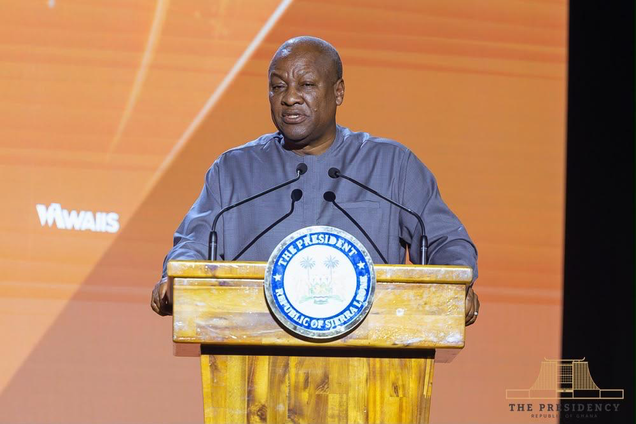
President John Dramani Mahama says the newly commissioned National Human Identification Laboratory will help families resolve long-standing disputes over paternity, inheritance and other biological relationships through scientific DNA testing.
The laboratory, located at the Noguchi Memorial Institute for Medical Research (NMIMR), is expected to provide a reliable way to establish biological links and settle questions of parentage that often lead to family disagreements.
Speaking at the facility’s commissioning ceremony on Wednesday, November 18, President Mahama said one of its major functions would be to resolve cases involving disputed paternity.
He explained that while maternity was generally established through childbirth, questions about the biological identity of a father could sometimes become contentious.
“It will also determine paternity. Maternity, we all know, the woman gives birth to the child, so we know the mother. But sometimes the paternity of the father is in dispute, and the laboratory will settle once and for all the questions of who owns the child,” he said.
According to him, the facility would also help families dealing with inheritance disagreements by providing scientific evidence to establish biological relationships and determine rightful successors.
He added that DNA testing could be useful in international travel situations, particularly where authorities or families need to establish whether children accompanying adults abroad are their biological offspring.
“I am sure that families will also come for analysis to find out, in case of inheritance, who the right successor is, and in case of travel abroad, whether the children you are going with are your real children or they are some strangers from somewhere. And so this laboratory will also help us settle those issues,” he said.
Meanwhile, President Mahama urged government regulators to reconsider their approach to business licensing and permit processes, warning that unnecessary bureaucratic procedures could undermine entrepreneurship and discourage investment.
He called on public institutions to adopt a more business-friendly approach and recognise the difficulties entrepreneurs face when navigating regulatory requirements.
“Regulators must see themselves in the eyes of the businessman,” he said.