
The Minerals Commission has defended its decision to terminate the mineral rights of Northern Ashanti Mines Limited, formerly Owere Mines. It said the move followed years of persistent default on statutory fees, and that the Company must pursue its grievances in court and not in the media.
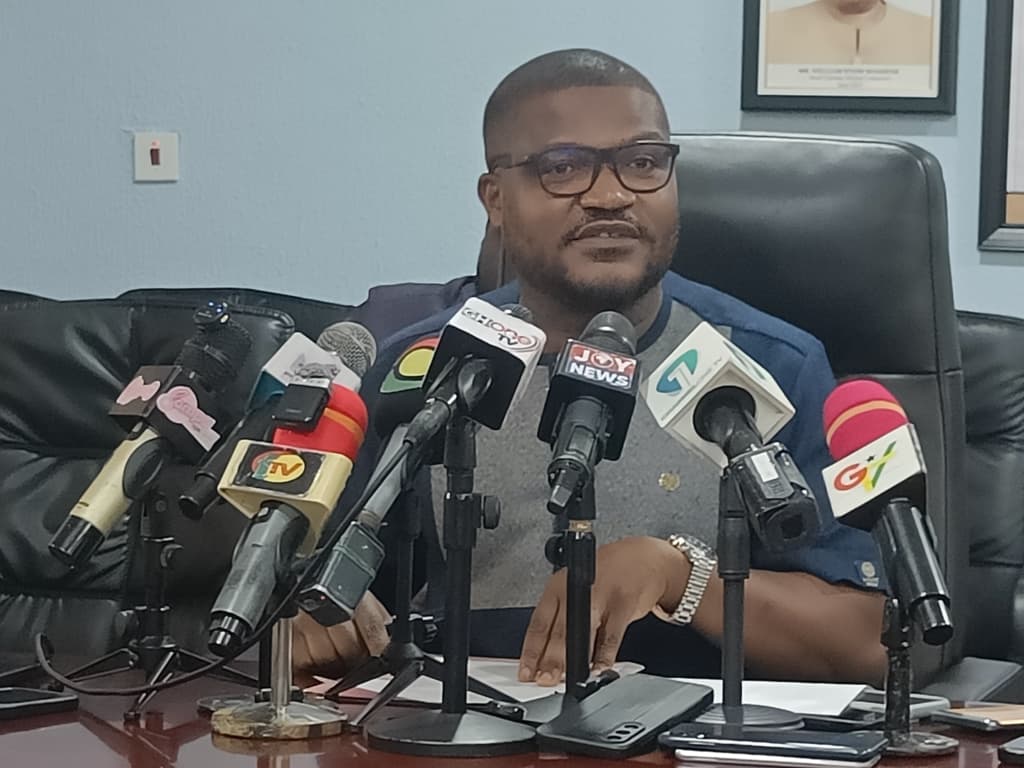
At a press briefing at the Commission’s head office in Accra on Thursday, October 29, 2026, the Chief Executive Officer (CEO) of the Commission, Mr Isaac Andrews Tandoh, said the Commission would place the full sequence of events before the public.
He was responding to the Company’s reaction to an earlier press release, in which it accused the Commission of acting in bad faith and criticised the Minister for Lands and Natural Resources for exercising his statutory authority.
“We want to unequivocally state that we reject these allegations in their entirety,” Mr Tandoh said. “The Minister acted within his lawful jurisdiction, as required by law. The Commission acted within its statutory mandate.”
He stressed that every mining lease and prospecting licence came with statutory obligations. “A mineral right is not a gift, and it is not an inheritance! It is a privilege conferred by the State on terms, and those terms must be honoured!” he said.
Timeline of default
Mr Tandoh said Owere Mines acquired a mining lease covering 595 cadastral blocks in January 2010. Under Section 24 of the Minerals and Mining Act, 2006 (Act 703) and the lease agreement, the Company was required to pay Annual Mineral Right (AMR) fees every year, but did not.
On May 28, 2020, the Commission issued a Notice to Remedy Breach under Section 68(2) of Act 703 and Regulation 200(3) of the Minerals and Mining (Licensing) Regulations, 2012 (L.I. 2176). The Company was then in default of more than US$4 million.
Following the takeover of the Company by BCM Investments, it proposed paying the debt in four tranches.
The Commission accepted the principle of the arrangement in June 2020 but asked for specific dates, since only the year of payment had been given. The Commission said even that proposal was not honoured.
On November 5, 2020, the Commission wrote again, notifying the Company of the breaches. The Company, by then under BCM Investments, responded by requesting a meeting.
By October 13, 2022, when a further notice was served, the debt had risen to US$5,595,238.14. It stood at US$6,188,000 by December 29, 2022.
On April 14, 2025, another notice was served, including fees owed on prospecting licences from 2019 to 2025. The amount owed on the mining leases then stood at US$8,330,000, while prospecting licence arrears were US$49,928. The Company again failed to comply.
On April 7, 2026, the Commission determined that the non-payment was flagrant and deliberate, and asked the Minister to serve a notice of termination on the Company. The Minister approved the notice, after which the Commission terminated the mineral rights.
Figures disputed
The Company has claimed that the US$8 million figure is wrong. Mr Tandoh invited the public to “do the arithmetic”, noting that the debt stood at about US$6 million in December 2022 and continued to accrue through 2025.
He also said the Commission’s records showed that the Company had paid only US$300,000 in AMR, in two tranches, and not the US$1 million it claimed. “For a company that claims to have spent US$200,000,000 on the mine, what prevented it from paying the US$8,000,000 owed to the people of Ghana?” he asked.
Court action
On the Company’s call for dialogue, Mr Tandoh said a company that had sued the Minister, the Commission and the Attorney-General could not credibly claim to be seeking dialogue.
“It is a company seeking to litigate in court and in the media simultaneously. That is improper, and it is contemptuous of the judicial process,” he said, advising the Company to pursue the courts and not the court of public opinion.
He said the mineral rights had reverted to the State, without prejudice to the liabilities the Company assumed before termination. The Commission, he added, would pursue the Company for all sums owed and would protect the assets from encroachers and other illegal actors, as provided under Section 70 of Act 703.
Mr Tandoh said the Company had been given several opportunities to regularise its position and chose not to. “If you flout the laws, there are sanctions, and those sanctions will apply,” he said.
He added that the Commission remained resolute in upholding the laws of the country “without fear or favour” and would not be distracted by media theatrics.
By Kingsley Asiedu