
The New Patriotic Party (NPP) has challenged recent comments by the Minister for Communication, Digital Technology and Innovations regarding Ghana’s Rural Telephony and Digital Inclusion Project, insisting that the record does not support claims of neglect under the previous administration.
The party has consequently called on the government and the Ghana Investment Fund for Electronic Communications (GIFEC) to provide comprehensive information on the status of the project within 30 days.
In a press statement dated September 8, 2026, and signed by Kojo Oppong Nkrumah, Chairman of the NPP Policy Co-ordination Committee, the party’s Policy Committee on Communications and Digitalization responded to comments made by the Minister at the Government Accountability Series press conference on September 7 and during an inspection of project sites in the Eastern Region on September 4.
The NPP welcomed the Minister’s focus on improving rural connectivity and acknowledged his recognition of contributions made by previous administrations during the Eastern Region tour.
However, the party said aspects of the Minister’s characterisation of the project’s history required correction.
“On rural telephony, the record does not support a description of neglect, and the figures are a matter of public documentation rather than opinion,” the statement said.
Project launched in 2020
According to the NPP, the Ghana Rural Telephony and Digital Inclusion Project was launched in 2020, rather than 2022 as suggested in recent comments.
The project was financed through a €155 million facility from the China EXIM Bank and implemented with Huawei and the China National Technical Import and Export Corporation under GIFEC.
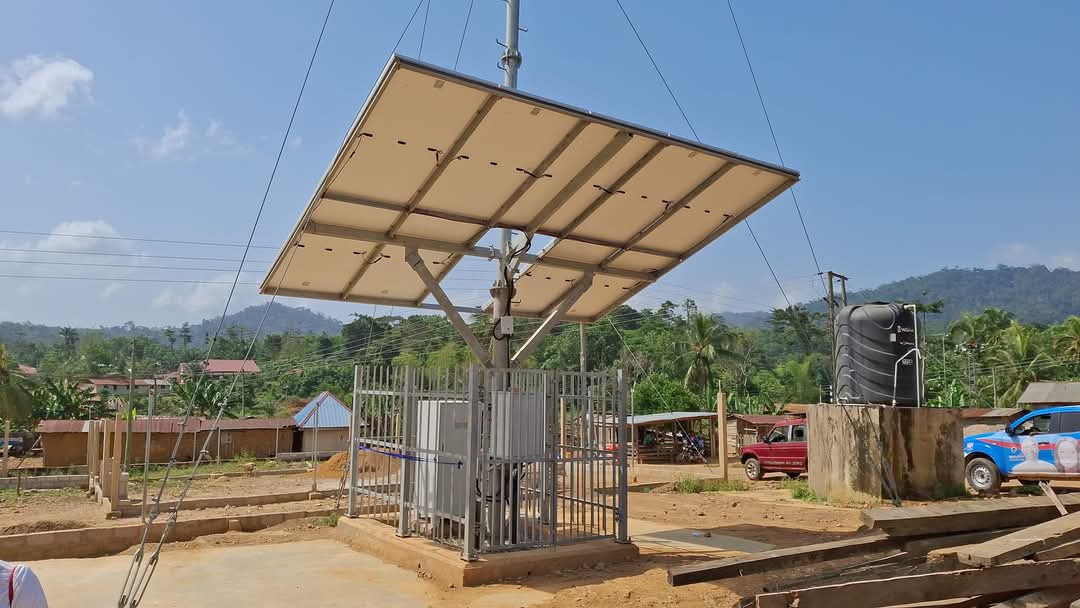
It was designed to establish 2,016 sites across unserved and underserved communities, with the objective of providing connectivity to between three and four million people.
The first project site was commissioned in November 2020.
The NPP also highlighted an earlier phase of the rural connectivity programme implemented between 2017 and 2018, during which 430 rural sites were constructed and activated in collaboration with private-sector operators.
That phase, the party said, connected approximately 700,000 people.
By the January 2025 handover, the NPP said the Akufo-Addo/Bawumia administration had expanded the project’s infrastructure footprint to 1,961 constructed sites, while equipment had been procured and placed in stock for an additional 400 sites.
NPP disputes claims over technically difficult sites
The party also rejected claims that some sites constructed in 2024 were located in areas that were technically impossible to connect.
It cited the satellite hub at the Kofi Annan Centre of Excellence in ICT, which it said had been upgraded, tested and prepared to provide backhaul connectivity to 46 harder-to-reach sites.
According to the NPP, the continued lack of connectivity in those communities is not the result of technical limitations.
Instead, the party said the contracted satellite hub service has not been activated and paid for, describing the situation as a commercial and administrative issue rather than a technical constraint.
Concerns over progress since 2025
The NPP further raised concerns about the pace of deployment since the change of government.
According to information available to the party, no new rural telephony sites were constructed in 2025, despite the handover of equipment for approximately 400 additional sites.
The party said deployment of the remaining sites is progressing too slowly to allow completion within 2026.
It also alleged that a higher proportion of previously activated sites are now non-operational than was the case at the time of the January 2025 handover.
The NPP challenged the Ministry to provide data to correct these claims if they are inaccurate.
NPP backs 4G upgrade but calls for sequencing
The party said it does not oppose the government’s ambition to upgrade rural telephony sites to a minimum of 4G.
It described the proposed upgrade as a legitimate and necessary long-term objective, noting that the original project was designed with equipment capable of being upgraded for a future 4G phase.
However, the NPP urged the government to prioritise connecting communities that currently have no service before focusing extensively on upgrading existing infrastructure.
It argued that communities without connectivity would gain little from debates over whether their eventual service should be 3G or 4G.
The party called for priority to be given to connecting already-built and paid-for sites, deploying equipment currently in stock and restoring services at sites that have become inactive.
It warned that moving too quickly into an upgrade programme without completing the existing network could leave the most poorly served communities waiting even longer for basic connectivity.
NPP demands 30-day disclosure
The NPP is now demanding that the Ministry and GIFEC publish comprehensive information on the project within 30 days.
Among other things, the party wants a full regional and district-level status report identifying sites that have been constructed, connected, are operational, or have been built but remain inactive.
It is also demanding a deployment schedule for the approximately 400 sites for which equipment was handed over, including their locations and expected completion dates.
The party further wants details on the contractual and operational status of the Kofi Annan Centre satellite hub, together with a clear decision and timeline for connecting the 46 designated hard-to-reach sites.
In addition, the NPP is seeking the sequencing, costing and financing plan for the proposed 4G upgrade, with assurances that the programme will not delay outstanding rural telephony work.
The party also wants the Ministry to brief Parliament’s Select Committee on Communications so that the competing claims about the project can be examined using verifiable data.
‘Our interest is a working rural network’
The NPP said its intervention was motivated by the need to improve connectivity for rural communities rather than by a desire to claim political credit.
It stressed that rural telephony constitutes national infrastructure that requires sustained investment and responsible management by successive governments.
The party said it was prepared to make its technical and handover materials available to the Ministry and the Parliamentary Select Committee upon request.
“Our interest is a working rural network, and we will engage constructively with any credible plan to deliver one,” the statement concluded.
“Ghanaians living in the communities concerned are entitled to service, and to a clear account of when they will receive it.”