
The New Patriotic Party (NPP) has called on the governing National Democratic Congress (NDC) to establish a Constituent or Consultative Assembly to deliberate on proposed amendments to the 1992 Constitution before the proposals are taken to Parliament and a referendum.
The party said the proposed changes, which affect 147 of the Constitution’s 299 Articles and introduce about 59 new provisions, amount to a fundamental overhaul of Ghana’s constitutional order rather than a routine amendment exercise.
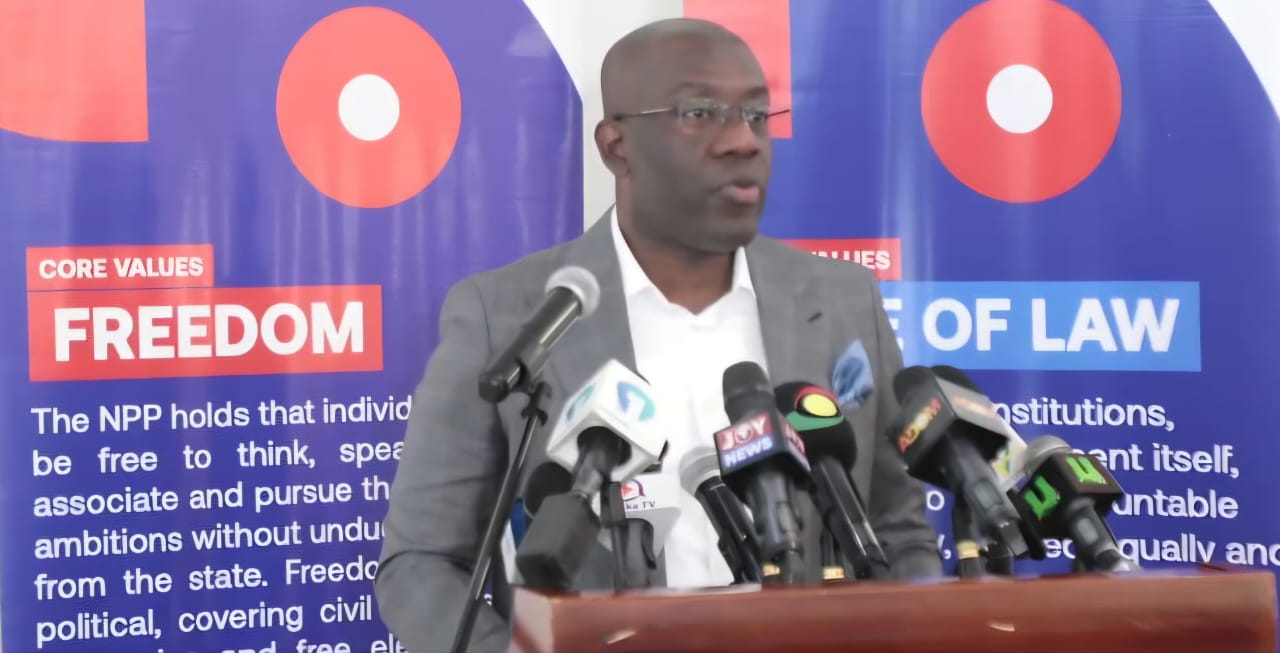
Presenting its position on the proposed amendments at a news conference in Accra on Thursday, September 17, 2026 by the Chairman of the NPP Policy-Coordination Committee and Member of Parliament (MP) for Ofoase-Ayirebi, Mr. Kojo Oppong Nkrumah, the main opposition party said its views were based on a report prepared by an ad-hoc committee chaired by former Speaker of Parliament, Professor Aaron Mike Oquaye, and approved by the party’s National Council.
The party noted that the governing NDC had rejected more than 50% of the recommendations by Prof. H. Kwasi Prempeh-chaired Constitution Review Committee, setting its own agenda for sweeping constitutional amendments.
Consequently, the NPP has reiterated its call on the government to listen to organised labour, civil society, professional bodies, chiefs and other stakeholders and provide a platform for them to participate in the final stages of the review.
“The Constitution is not the property of the NDC or of the NPP. It belongs to the people of Ghana,” the party emphasised.
It further maintained that a Consultative Assembly would help build consensus around the disputed recommendations and give the final constitutional text broader legitimacy.
Reasons for broader consultation
The NPP said the disagreements concern major issues affecting the country’s governance, including the proposed five-year presidential term, the size of Parliament, the appointment of Members of Parliament (MPs) into the Executive arm of Government, the eligibility of MPs to serve as ministers, the selection of District Chief Executives, and the independence and funding of oversight institutions.
It argued that these issues require a platform where political parties and other stakeholders can negotiate and reach agreement.
The party cited concerns raised by the Trades Union Congress (TUC), the Citizens’ Platform on Constitutional Reform and the Ghana Bar Association (GBA) over the process.
The Citizens’ Platform, which brings together more than 100 civil society organisations, unions and professional bodies, has called for a Roadmap Act, a pause in the passage of Bills already before Parliament and broader participation in the reform process.
The Ghana Bar Association has also called for a Constituent Assembly to deliberate on the proposals before they are submitted to the people in a referendum.
According to the NPP, these concerns, together with those raised by Professor Prempeh Committee, demonstrate the need for the government to reconsider its approach.
NPP sets conditions for support
The NPP said it supports the amendment of some provisions of the 1992 Constitution, having previously expressed its views through the 2010 constitutional review process and its Peduase Report.
However, it rejected the government’s current approach of drafting the amendments without further negotiations on the disputed issues.
The party said it would not support the government’s proposed amendments in Parliament or at a referendum in the absence of a Constituent Assembly or a comparable mechanism for negotiated consensus.
It also reminded the government of the requirements under Article 290 of the Constitution for amendments to entrenched provisions.
The party said at least 40 percent of registered voters must participate in a referendum, while at least 75 percent of those voting must vote in favour for the amendment to be approved.
The NPP pointed out that the thresholds underline the importance of broad political and national support for changes to entrenched provisions.
Disagreed recommendations
The party said its review of the government’s Position Paper found that 22 of the 147 recommendations for amendments to existing provisions had been accepted fully, while 25 had been accepted in principle but subject to modifications.
It classified the remaining 100 recommendations as areas of disagreement between the government and the independent Constitution Review Committee.
The NPP said this represented 68 percent of the recommendations for amendments to existing provisions, although it acknowledged that other organisations had arrived at different figures using different methods of counting.
The TUC, for instance, has calculated that the government rejected 54 percent of the committee’s recommendations.
The NPP maintained that, regardless of the method used, more than half of the committee’s recommendations had been set aside or modified by the government.
The party questioned whether the constitutional review was being conducted to reflect the views of the independent committee or the preferences of the governing NDC.
Membership of the Consultative Assembly
The NPP argued that a Consultative Assembly established by law would provide a platform for the political parties, organised labour, professional bodies, the National House of Chiefs, religious organisations, women’s groups, persons with disabilities, students, youth, the private sector, civil society and the regions to participate in the process.
The NPP argued that Ghana’s previous constitutional arrangements had been developed through processes involving expert bodies and representative assemblies.
It cited the Consultative Assemblies associated with the 1969 and 1979 Constitutions, as well as the Consultative Assembly that worked on the 1992 Constitution.
According to the party, the 1992 Constitution was developed through a process in which a Committee of Experts prepared a report that became the working document of a Consultative Assembly.
The Assembly’s draft was subsequently submitted to a referendum on April 28, 1992.
The NPP said the historical examples demonstrate the importance of deliberation and broad representation in establishing a constitutional framework.
NPP questions the government’s approach
According to the NPP, the Constitution Review Committee chaired by Professor Prempeh submitted its full report to the government on February 10, 2026, but the report was not published until July 30, 2026.
The party said the government subsequently issued a Position Paper accepting, modifying or rejecting the committee’s recommendations and handed a zero draft to an eleven-member Constitution Review Implementation Committee chaired by Mrs Marietta Brew Appiah-Opong.
“The Implementation Committee was inaugurated at the end of August and has been tasked with preparing amendment Bills, with the first Bills expected by November 2026.
“The government has also announced plans for a referendum on entrenched constitutional provisions alongside the 2027 District Assembly elections,” the shadow governing party pointed out.
It argued that the timetable leaves insufficient room for meaningful discussions on the recommendations that remain contested.
Constitution Review Committee’s report
The eight-member Constitution Review Committee established by President John Dramani Mahama in January 2025 submitted its final report, outlining far-reaching proposals to address gaps in earlier constitutional reforms and strengthen Ghana’s system of governance.
President Mahama received the report at a ceremony on Monday, December 22, 2025, from the committee’s chair, Professor H. Kwasi Prempeh, and subsequently directed that the document be published and made available to the public.
Among the most significant recommendations is a proposal to extend the presidential term of office from four to five years, while retaining the two-term limit.
The committee argued that the change would enhance governance stability and allow administrations sufficient time to develop and implement long-term policies.
The report also placed strong emphasis on reforming local governance structures with a recommendation to the election of Metropolitan, Municipal and District Chief Executives (MMDCEs) and the formal integration of traditional authorities into local government.