
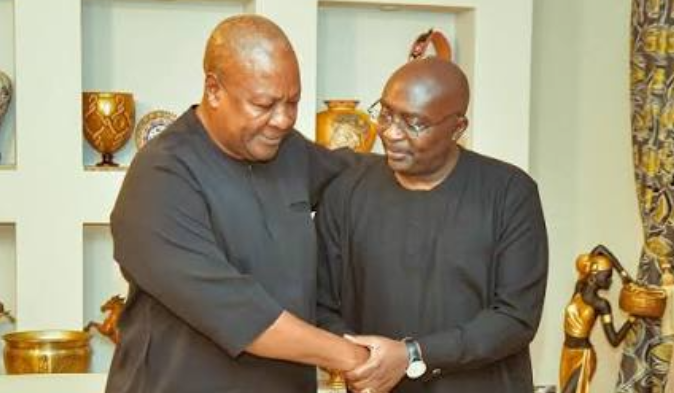
Former Vice President and New Patriotic Party (NPP) flagbearer for the 2028 general election, Dr. Mahamudu Bawumia. has entreated President John Dramani Mahama to pause on his assent to the Tribunals Bill, 2026, which was hurriedly passed in one day by Parliament.
He said the voices of millions of Ghanaian workers among others, who are calling for the withdrawal of the bill, should be heard as the assent to the legislation could reshape Ghana’s justice system and shake confidence in the judiciary.
In a short address to the nation, Dr. Bawumia indicated his call was framed not as opposition politics but as a national appeal in line with an earlier call by the worker unions under the umbrella of the Trades Union Congress (TUC).
“I speak to you on a matter that has the potential to reshape our justice delivery system, confidence in our judiciary and the future of our democracy all together; The attempt to re-introduce tribunals into Ghana’s Judicial System,” the former Vice President stated.
Last week, Parliament passed the Tribunals Bill, 2026 after the mandatory one-day interval between the consideration stage and the third reading was waived, making Ghanaians relive the dark days of the tribunals system during the Provisional National Defence Council (PNDC) in which people were arbitrarily given death penalties, life imprisonment and jail terms ranging from 30 to 100 years.
The Minority’s objections were voted down and organised labour objected loudly and publicly but was ignored.
Bawumia’s plea
Dr Bawumia noted the Bill will soon be transmitted to the President for his assent but said there was the need for caution.
“I have one respectful request of President Mahama. Mr President – Do not sign this Bill. Pause, and let the nation talk. This is not a partisan request. The Trades Union Congress, the voice of millions of Ghanaian workers, has called for the Bill to be withdrawn altogether, warning that in its current form it could become a potent tool for weaponising justice delivery. Those are the words of Ghanaian workers, not of any political party,” Dr Bawumia urged.
He also called on government to consider its own processes after the President established the Constitution Review Committee, and it reported on same last December.
“This Committee recommended removing Regional Tribunals from the Constitution, because the High Court has long carried their caseload. Yet the report has not been published. Before the nation has even read it, Parliament has rushed through and legislated in the opposite direction. Mr. President, publish the report first.
“Consider, finally, history. Under this Bill, panels that include persons who are not lawyers may sit in judgment over criminal matters. Ghanaians remember tribunals, and we remember what was done in their name. Our courts are congested, yes. But the answer to congested courts is to strengthen the courts: more judges, more courtrooms and digitised processes. It is not to build a second system of justice beside the one the Constitution already gives us.
“Mr. President, your government commands one of the largest majorities in the history of the Fourth Republic. With such numbers, Parliament can pass almost any bill it wishes. Not everything that can be passed should be passed. The larger the majority, the greater the duty of restraint. History will not ask how many votes a law received. It will ask whether the law reflected the best desires of a broad section of the Ghanaian society.
“My call is therefore simple and constructive. Withhold your assent. Convene genuine national engagement. Invite the Ghana Bar Association and other lawyers groups, organised labour, civil society, and the political parties, including my own; we will come in good faith. And consult the Judiciary itself, the institution that must live with whatever Parliament creates.
“Justice belongs to no government and no party. It belongs to the Ghanaian people, and a law that reshapes the architecture of justice should rest on national consensus, not on a headcount.
“Mr. President, the pen is in your hand. Use it, not to sign this Bill, but to write an invitation to the nation through the council of state in accordance with Articles 90 and 106 of the 1992 constitution,” Dr Bawumia concluded in his address.
Weaponising Justice Delivery
At a news conference in a Accra last Thursday, the TUC opposed the reintroduction of the public tribunal system in Ghana, calling on the Mahama administration to halt the legislative process in Parliament.
“The TUC is manifestly opposed to the idea of resuscitating tribunals given our collective bitter experiences with tribunals. The Tribunals Bill in its current shape and form strengthens our conviction that tribunals must be abandoned.
“The Bill, when passed into law, can be a potent tool for weaponising justice delivery, and entrench the perception held by many that our justice system is up for grabs by politicians,” the Secretary-General of the TUC, Mr. Joshua Ansah stated. .
According to the TUC, the call followed a Steering Committee meeting of the union to deliberate on the parliamentary debate on the activation of the tribunals as part of the judicial system, as well as the constitutional review process initiated by the government in 2025.
“We call on the President and Parliament to heed the advice of the Constitution Review Committee. Government must halt the current legislative process of enacting the Tribunals Bill, expunge Regional Tribunals from the Constitution and take meaningful steps to properly resource our judiciary.
“If law is properly seen as an embodiment of our collective historical experience, then the recent history of Public Tribunals must lead us away from any attempt to re-establish Regional and District Tribunals,” the TUC recalled.