

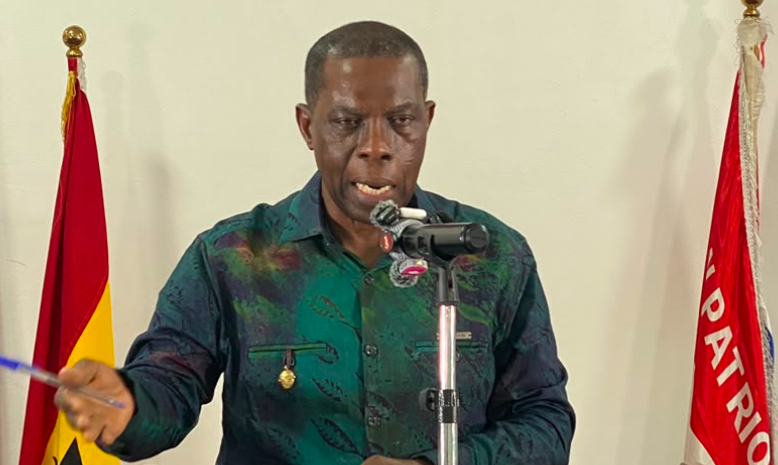
The New Patriotic Party (NPP) has strongly criticised the Ghana Cocoa Board Bill, 2026, describing it as a necessary reform undermined by a flawed and rushed process that risks harming the very farmers it claims to protect.
Addressing a news conference in Accra on August 9, 2026 under NPP Policy Secretariat, Dr. Isaac Yaw Opoku said the party does not oppose the replacement of the outdated PNDCL 81l.
He said the Bill supports key goals such as traceability, value addition, and a guaranteed minimum share of the cocoa price for farmers. However, Dr Isaac Opoku, who is also the ranking member on the Food and Agriculture Committee of Parliament, condemned the manner in which the Bill was passed with several of its provisions having issues.
“A good cause has been undone by a bad process,” he stated.
Why the Bill Matters
The NPP emphasised that no law passed this year affects more Ghanaians.
Dr. Isaac Opoku pointed out that the cocoa sector supports about 800,000 farming families and roughly three million people, generating around two billion dollars each season.
Unfortunately, the industry is already under strain. According to Dr Isaac Opoku, production has dropped from a peak of 1.047 million tonnes to about 650,000 tonnes, with a further 16 per cent decline projected for the next season.
He added that some 90,000 hectares still require rehabilitation due to swollen shoot disease.
“The cost of getting this wrong will not be paid in Accra, but in Sefwi Wiawso, Offinso, Goaso and Enchi,” the NPP warned.
Rushed Process Without Farmers
The Bill was laid on 28 July and passed within the same week under a Certificate of Urgency.
In that short period, Parliament repealed PNDCL 81 entirely, restructured the industry, created a tribunal, and introduced new criminal offences.
While the NPP acknowledged that a Certificate of Urgency is not unconstitutional, it argued that its use must be proportionate. A seasonal pricing window opening every September, the NPP argued, cannot justify rushing such a permanent and far-reaching law.
The party also dismissed claims that extensive consultations took place.
“No engagement report was laid before the joint committee. Neither of the national cocoa farmer associations was consulted. Formal concerns raised by LICOBAG were ignored, and the Cocoa Hauliers Association was not consulted at all.
“Furthermore, the final 2026 Bill differed materially from the 2025 version previously reviewed in committee, meaning Members of Parliament passed a text that stakeholders had never seen.
“A law made for cocoa farmers, without cocoa farmers, is not reform. It is imposition,” the NPP declared.
Key provisions under fire
The NPP highlighted several clauses it believes require urgent review:
Clause 4 – Mandate of COCOBOD
While the restriction of COCOBOD’s core functions in Clause 4(a) is welcomed, Clause 4(b) allows the Board to take on additional responsibilities with only ministerial approval.
The party argued this creates a loophole that undermines the intended restriction.
Any expansion of the mandate, it said, should require an Act of Parliament.
Clause 57 – Producer Price Formula
The statutory floor of not less than 70 per cent of the Gross Free On Board (FOB) price is welcome in principle. However, the NPP raised serious concerns about the shift from “world market price” (used in earlier drafts) to “realised Gross FOB.” The latter is an internal calculation known only to COCOBOD, based on forward contracts fixed months or seasons earlier.
The party demanded that the computation, underlying contracts, and workings of the pricing committee be published and independently audited each season so farmers can verify the figures before the price is announced.
Clause 59 – Licensing of External Marketing
According to the main opposition party, the inclusion of external marketing among licensable activities signals a possible move towards private exporters.
The NPP strongly opposed this, arguing that Ghana’s strength lies in selling as a single seller through the Cocoa Marketing Company (CMC).
Dr Isaac Opoku argued that fragmenting external marketing would weaken the country’s forward sales programme, price stabilisation, quality premium, and ability to negotiate jointly with Côte d’Ivoire on initiatives such as the Living Income Differential.
Clause 81 – Restrictions on Tree Removal
The NPP sais although this is intended to prevent cocoa farms from being converted into galamsey sites, the clause criminalises routine good husbandry practices. “Farmers would need Board approval even to thin overcrowded trees, remove dead trees, or rogue swollen shoot-infected trees — a delay that could accelerate the spread of the disease across the 90,000 hectares already under rehabilitation”, the party noted.
It also observed that requiring approval to convert a cocoa farm to other uses places an unfair encumbrance on private property.
Clause 85 – Farmer and Farm Registration
The Bill makes it illegal for unregistered farmers to produce, buy or sell cocoa commercially. Yet registration is the responsibility of COCOBOD, not individual farmers.
With registration still incomplete (792,954 farmers registered against an estimated 800,000 households), the clause would criminalise farmers for administrative failures beyond their control. The NPP called for the provision to be deferred until the Minister certifies that registration is substantially complete.
Clause 106 – Local Processing Threshold
The main opposition party argued the requirement that at least 50 per cent of beans produced must be processed locally is an ambition without a workable plan. “Ghana has grinding capacity of about 504,780 tonnes but currently processes only 210,000–220,000 tonnes annually. “Achieving the 50 per cent target on a 650,000-tonne crop would require processing volumes far above recent performance. “The critical question of pricing for beans sold to local processors remains unanswered, creating a potential conflict with the 70 per cent farmer price floor,” the party stated.
Credibility and Broken Trust
The NPP pointed to the mid-season price cut in the 2025/2026 season as evidence of why farmers cannot take government promises on trust.
The producer price was announced at GH¢51,660 per tonne in August 2025 but reduced to GH¢41,392 in February 2026 — a 28.6 per cent cut after farmers had already committed resources.
A farmer in Sefwi Wiawso, the statement noted, lost GH¢1,038 on every bag.
The party pledged that the next NPP administration under Dr Mahamudu Bawumia will not cut an announced producer price mid-season and will demand full transparency in the pricing formula every season.
Calls to action
The NPP called on President John Dramani Mahama to withhold assent and return the Bill for broader consultation.
It also urged Parliament, if the Bill is reconsidered, to:
- Restrict any expansion of COCOBOD’s mandate to an Act of Parliament
- Require publication and independent audit of the realised Gross FOB each season
- Confirm that external marketing remains exclusively with the Cocoa Marketing Company
- Exempt routine agronomic practices from the tree-removal restrictions
- Defer the criminalisation of unregistered farmers until registration is complete
- Clarify the pricing basis for beans supplied to local processors
The party further invited LICOBAG, farmer associations, hauliers and processors to place their positions on the public record.
“Ghana’s cocoa industry was built over a century by families who planted trees that would not bear for five years. They are owed better than a law made in haste, in their absence,” the NPP concluded.