
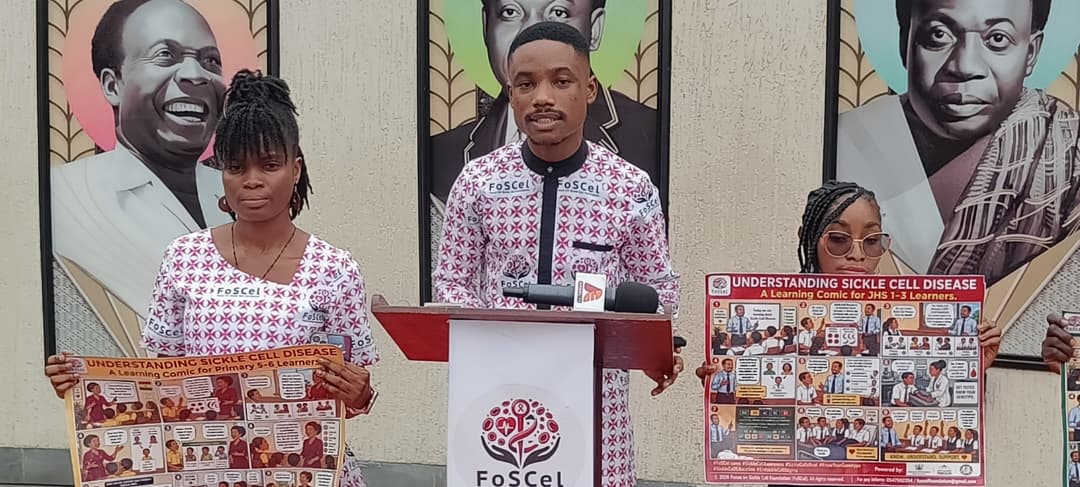
The Focus on Sickle Cell Foundation (FoSCel) has called for the integration of age-appropriate Sickle Cell Disease education into Ghana’s basic school curriculum, warning that waiting until young people are preparing for marriage or relationships is “too late” to prevent the heartbreak and health complications associated with the condition.
Speaking at a media briefing held at the Kwame Nkrumah Memorial Park in Accra on Tuesday, the Founder and Executive Director of FoSCel, Mr Amos Andoh, said awareness alone was no longer sufficient, and urged a fundamental shift in how the nation educates its youth about the disease.
The briefing, held under the theme “Know Your Genotype. Understand Sickle Cell Disease. Support Warriors,” brought together representatives of the National Council for Curriculum and Assessment (NaCCA), members of the media, and advocates within the Sickle Cell community.
A national, educational and generational issue
Mr Andoh disclosed that approximately 18,000 children are born with Sickle Cell Disease in Ghana every year, describing the statistic as one that represents “thousands of Ghanaian families living with the realities of the disease and its complications.”
He noted that despite the existence of the Ministry of Health’s Sickle Cell Disease Screening and Case Management Guidelines, many citizens continue to suffer serious complications including stroke, kidney failure, blindness, bone and joint complications, and acute chest syndrome.
“These are not just numbers. Behind every statistic is a person. Behind every complication is a family. Behind every Warrior is a story,” he stated, stressing that Sickle Cell Disease must no longer be treated as an issue concerning only hospitals or affected families.
“It is a national health issue. It is an education issue. And it is a generational issue,” he declared.
‘Let Our Teachers teach what our doctors treat’
Central to the Foundation’s advocacy is the conviction that healthcare must go hand in hand with education. Mr Andoh argued that knowledge about the disease should not begin only in the hospital or when a young person is preparing for a relationship.
“Let our teachers teach what our doctors treat,” he charged, explaining that when people understand Sickle Cell Disease early, they are better positioned to know their genotype, challenge misinformation, recognise the importance of appropriate care, and make informed decisions throughout their lives.
He lamented that for many years, serious conversations about genotype often begin when young people are already of age to enter relationships or consider marriage, by which time it may be difficult to introduce knowledge that should have been provided much earlier.
He recounted that many parents raising children with the disease had admitted they simply did not know enough about Sickle Cell Disease or genotype compatibility before having their children.
“We cannot wait until the consequences have already occurred before we begin the education. Knowledge should come before the decision,” he emphasised.
Comic-based educational materials submitted to NaCCA
Mr Andoh revealed that earlier this year, FoSCel presented a proposal to the Director-General of NaCCA calling for greater attention to Sickle Cell education within Ghana’s education system. Following that engagement, the Council requested that the Foundation submit its educational materials for review.
“Yesterday, we formally submitted the educational materials to NaCCA,” he announced to the gathering.
At the heart of the submission is FoSCel’s Sickle Cell Comic Strip Educational Model, developed for learners at the Basic School, Junior High School, and Senior High School levels.
Explaining the choice of a comic format, Mr Andoh said children learn through stories, and a well-designed story can make difficult health information simple, relatable and memorable.
The materials introduce Sickle Cell Disease, genotype awareness and compatibility, misconceptions, stigma, healthy practices and informed decision-making in an age-appropriate manner.
“But let me be clear: the comic is the tool. Early Sickle Cell education is the mission. We want to catch them young,” he stressed.
He added that the initiative was not about telling young people whom to marry, but about giving them the knowledge they need before they are faced with important decisions in adulthood.
The Foundation’s advocacy is not entirely new. Last year, FoSCel piloted an early version of the comic model within the Effutu Municipality in Winneba, an experience Mr Andoh said offered practical insight into how Sickle Cell information could be presented to young learners.
Commendation for NHIS Inclusion of Hydroxyurea
FoSCel commended the Ministry of Health, the Ghana Health Service and the National Health Insurance Authority for efforts to improve healthcare access for persons living with Sickle Cell Disease.
The Foundation particularly welcomed the inclusion of hydroxyurea and other essential Sickle Cell medicines in the NHIS benefits package, describing it as an important step toward reducing the financial burden on Warriors and their caregivers.
Mr Andoh encouraged Warriors and their caregivers to ensure their NHIS membership remains active to access eligible medicines and services.
A call to action
In a passionate closing appeal, the FoSCel Founder urged Ghanaians to embrace a new approach to the disease: “Educate early. Know your genotype. Understand Sickle Cell Disease. Challenge misinformation. End stigma. Support Sickle Cell Warriors.”
He noted that while it may be impossible to change the fact that Sickle Cell Disease exists, society can change how children understand it, how society responds to it, and how those living with it are supported.
Standing at the historic Kwame Nkrumah Memorial Park, Mr Andoh drew a parallel between the nation’s forebears and the present generation’s duty, saying: “Our generation also has a responsibility to make history not simply by talking about the problem, but by taking meaningful steps to change the future.”
He concluded with a powerful trio of appeals: “Let us educate before the crisis. Let us know before the decision. Let us support before the pain. Knowledge should come before the decision. And above all: Education is the first medicine.”
By Kingsley Asiedu