

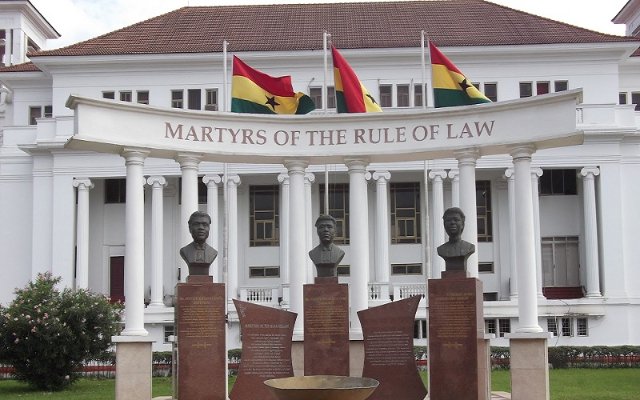
Justice Gabriel Pwamang of the Supreme Court, sitting as a single judge, has dismissed an application for interlocutory injunction filed by Kojo Oppong Nkrumah, Member of Parliament, seeking to halt the hearing of criminal cases in specialised High Courts during the legal vacation.
The application arose from a writ filed on 14 August 2026 challenging warrants issued by the Chief Justice authorising certain judges of specialised courts to sit during the legal vacation.
The plaintiff sought declarations that the warrants were unconstitutional, amounting to selective justice, violating equality before the law (Article 17), administrative justice and discretionary power requirements (Articles 23 and 296), and the right to satisfactory working conditions and health (Articles 24 and 36(10)). He also challenged Order 79 of the High Court (Civil Procedure) Rules, 2004 (C.I. 47).
In support of the injunction, the applicant argued that allowing the trials to proceed would cause irreversible harm if the warrants were later declared unconstitutional, and that the balance of convenience favoured suspension of the sittings.
The Attorney-General opposed the application, disputing the claim that the warrants targeted only “selected cases.”
The warrants, it was argued, authorised hearings in all cases pending before the relevant courts. The Attorney-General further contended that the suit was frivolous and that the plaintiff stood to suffer no personal inconvenience.
Justice Pwamang first addressed a preliminary objection concerning the Attorney-General’s representation of the Chief Justice. Relying on Tastsu Tsikata v Chief Justice [2001-2002] SCGLR 437, he held that the Attorney-General is the proper party to defend official acts of the Chief Justice under Article 88(5) of the Constitution.
On the merits, the Court restated the well-established principles governing interlocutory injunctions in public law matters, drawing on Welford Quarcoo v Attorney-General [2012] 1 SCGLR 259, Michael Ankomah-Nimfah v James Gyekye Quayson & Ors (unreported, 2022), and Republic v High Court (Fast Track Division); Ex parte Ghana Lotto Operators Association [2009] SCGLR 372.
An applicant must demonstrate a serious question to be tried with high prospects of success, irreparable harm, and that the balance of convenience favours the injunction. Particular caution is required before restraining actions taken in the public interest.
Examining the constitutional claims, the Court found no serious question under Article 17.
Priority of hearing during vacation does not constitute inequality before the law, and no allegation had been made that the selection of courts was based on any of the prohibited grounds of discrimination (gender, race, ethnic origin, religion, etc.).
Judicial notice was taken of the specialised nature of the courts (handling narcotics, cybercrime, galamsey, corruption, and related matters), making targeted discrimination improbable.
Claims under Articles 24 and 36(10) were also rejected. Judges who sit during vacation ordinarily take leave when normal sittings resume; court staff leave entitlements are unaffected; and lawyers, as independent practitioners, control their own schedules.
Regarding Order 79 of C.I. 47, the Court noted that the rule applies to civil proceedings. No statutory provision in the Courts Act, 1993 (Act 459) or the Criminal and Other Offences (Procedure) Act, 1960 (Act 30) prohibits the Chief Justice from authorising criminal hearings during vacation. The plaintiff himself conceded the existence of the Chief Justice’s authority.
Finally, the Court emphasised Article 19(1), which guarantees a fair hearing within a reasonable time to persons charged with criminal offences. The warrants, the Court held, advanced the public interest by facilitating the expeditious trial of serious cases. Halting the sittings would not serve the administration of justice.
Accordingly, Justice Pwamang concluded that it was neither right, just, nor convenient to grant the interlocutory injunction. The application was dismissed.
The substantive constitutional suit remains pending.