

The Earth could be doomed to breach the symbolic 1.5C warming limit in as little as three years at current levels of carbon dioxide emissions.
That’s the stark warning from more than 60 of the world’s leading climate scientists in the most up-to-date assessment of the state of global warming.
Nearly 200 countries agreed to try to limit global temperature rises to 1.5C above levels of the late 1800s in a landmark agreement in 2015, with the aim of avoiding some of the worst impacts of climate change.
But countries have continued to burn record amounts of coal, oil and gas and chop down carbon-rich forests – leaving that international goal in peril.
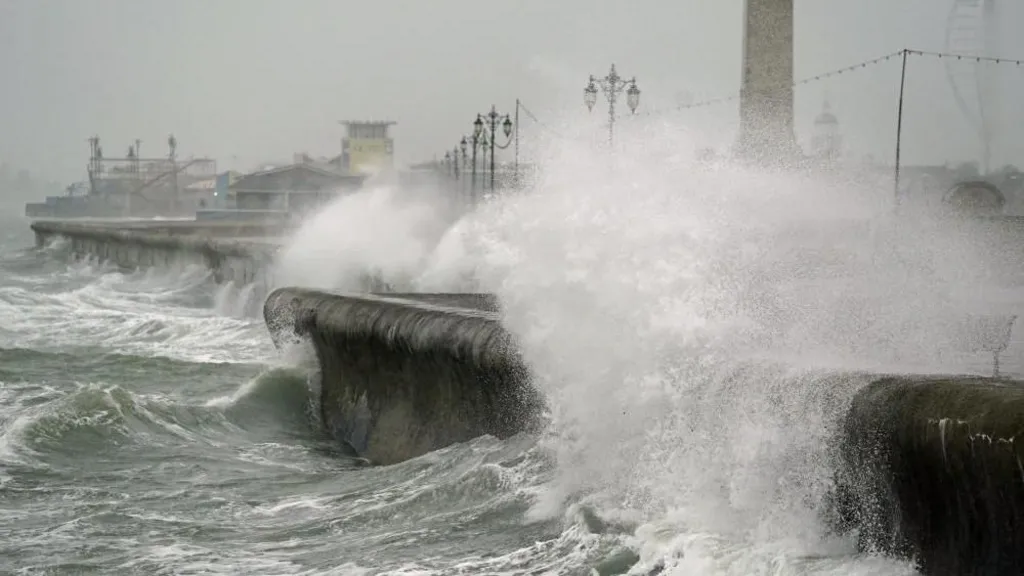
Climate change has already worsened many weather extremes – such as the UK’s 40C heat in July 2022 – and has rapidly raised global sea levels, threatening coastal communities.
“Things are all moving in the wrong direction,” said lead author Prof Piers Forster, director of the Priestley Centre for Climate Futures at the University of Leeds.
“We’re seeing some unprecedented changes and we’re also seeing the heating of the Earth and sea-level rise accelerating as well.”
These changes “have been predicted for some time and we can directly place them back to the very high level of emissions”, he added.
At the beginning of 2020, scientists estimated that humanity could only emit 500 billion more tonnes of carbon dioxide (CO2) – the most important planet-warming gas – for a 50% chance of keeping warming to 1.5C.
But by the start of 2025 this so-called “carbon budget” had shrunk to 130 billion tonnes, according to the new study.
That reduction is largely due to continued record emissions of CO2 and other planet-warming greenhouse gases like methane, but also improvements in the scientific estimates.
If global CO2 emissions stay at their current highs of about 40 billion tonnes a year, 130 billion tonnes gives the world roughly three years until that carbon budget is exhausted.
This could commit the world to breaching the target set by the Paris agreement, the researchers say, though the planet would probably not pass 1.5C of human-caused warming until a few years later.
Last year was the first on record when global average air temperatures were more than 1.5C above those of the late 1800s.
A single 12-month period isn’t considered a breach of the Paris agreement, however, with the record heat of 2024 given an extra boost by natural weather patterns.
But human-caused warming was by far the main reason for last year’s high temperatures, reaching 1.36C above pre-industrial levels, the researchers estimate.
This current rate of warming is about 0.27C per decade – much faster than anything in the geological record.
And if emissions stay high, the planet is on track to reach 1.5C of warming on that metric around the year 2030.
After this point, long-term warming could, in theory, be brought back down by sucking large quantities of CO2 back out of the atmosphere.
But the authors urge caution on relying on these ambitious technologies serving as a get-out-of-jail card.
“For larger exceedance [of 1.5C], it becomes less likely that removals [of CO2] will perfectly reverse the warming caused by today’s emissions,” warned Joeri Rogelj, professor of climate science and policy at Imperial College London.
‘Every fraction of warming’ matters
The study is filled with striking statistics highlighting the magnitude of the climate change that has already happened.
Perhaps the most notable is the rate at which extra heat is accumulating in the Earth’s climate system, known as “Earth’s energy imbalance” in scientific jargon.
Over the past decade or so, this rate of heating has been more than double that of the 1970s and 1980s and an estimated 25% higher than the late 2000s and 2010s.
“That’s a really large number, a very worrying number” over such a short period, said Dr Matthew Palmer of the UK Met Office, and associate professor at the University of Bristol.
The recent uptick is fundamentally due to greenhouse gas emissions, but a reduction in the cooling effect from small particles called aerosols has also played a role.
This extra energy has to go somewhere. Some goes into warming the land, raising air temperatures, and melting the world’s ice.
But about 90% of the excess heat is taken up by the oceans.
That not only means disruption to marine life but also higher sea levels: warmer ocean waters take up more space, in addition to the extra water that melting glaciers are adding to our seas.
The rate of global sea-level rise has doubled since the 1990s, raising the risks of flooding for millions of people living in coastal areas worldwide.
While this all paints a bleak picture, the authors note that the rate of emissions increases appears to be slowing as clean technologies are rolled out.
They argue that “rapid and stringent” emissions cuts are more important than ever.
The Paris target is based on very strong scientific evidence that the impacts of climate change would be far greater at 2C of warming than at 1.5C.
That has often been oversimplified as meaning below 1.5C of warming is “safe” and above 1.5C “dangerous”.
In reality, every extra bit of warming increases the severity of many weather extremes, ice melt and sea-level rise.
“Reductions in emissions over the next decade can critically change the rate of warming,” said Prof Rogelj.
“Every fraction of warming that we can avoid will result in less harm and less suffering of particularly poor and vulnerable populations and less challenges for our societies to live the lives that we desire,” he added.