
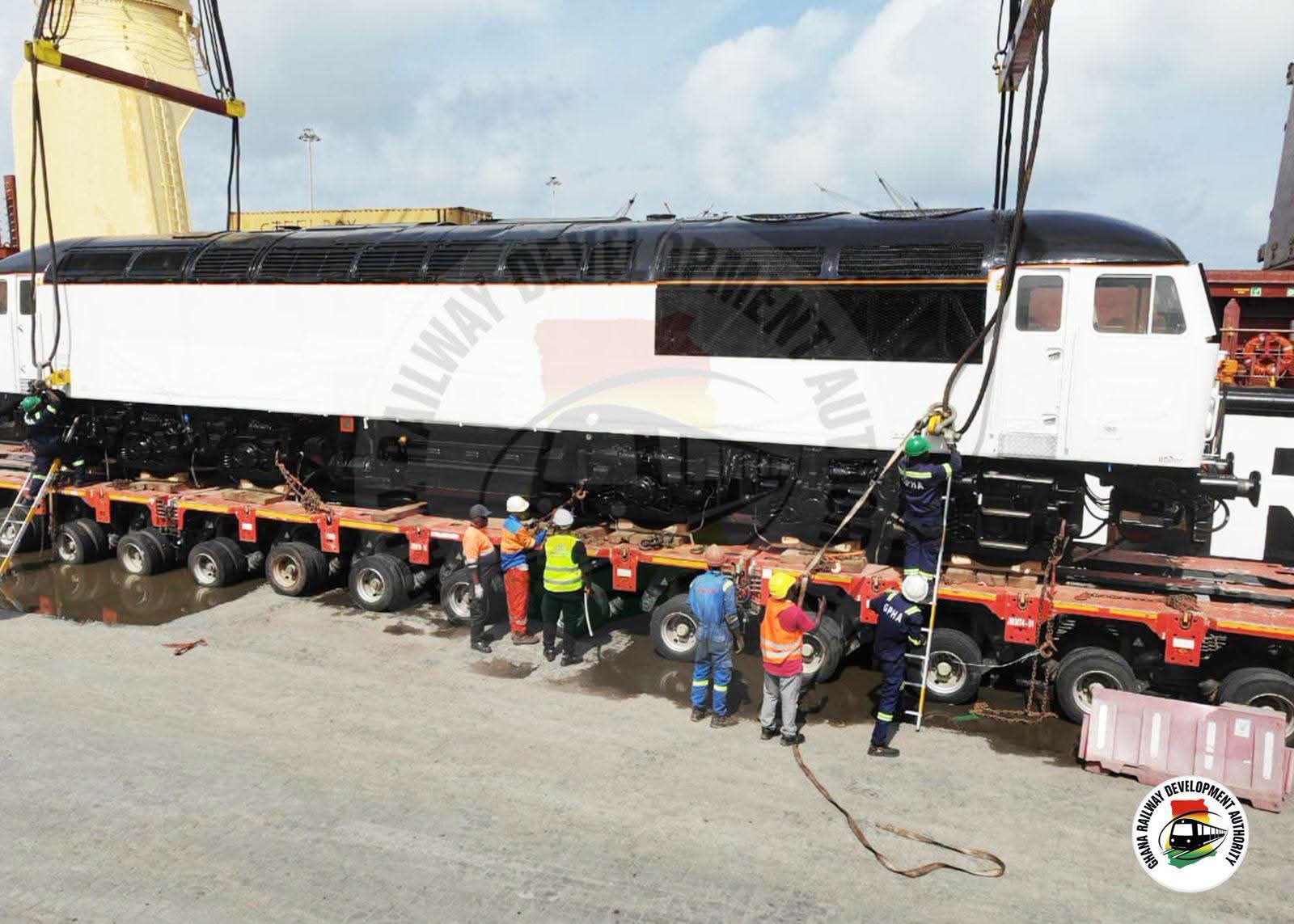
The Ministry of Transport has issued a strongly worded press release defending the government’s decision to acquire two Class 56 diesel locomotives and 20 freight wagons, dismissing criticisms from the New Patriotic Party (NPP) Minority Transport Committee as factually inaccurate and politically motivated.
In the statement released on July 2, 2026, the Ministry described the NPP’s characterisation of the Class 56 locomotives as “toys fit for the museum” as a fundamental misunderstanding of railway engineering.
The Ministry emphasised that the true value of rolling stock is determined not merely by age, but by factors including structural integrity, refurbishment quality, reliability, maintainability, and commercial viability.
According to the Ministry, the two locomotives underwent extensive heavy maintenance and upgrades in the United Kingdom prior to shipment. These included complete overhauls of diesel engines, electrical systems, traction motors, bogies, and brake systems, as well as the installation of modern safety equipment such as GSM-R digital railway radio. The locomotives also come with a five-year warranty, and the government has secured five years of spare parts.
The Ministry highlighted that Class 56 locomotives remain actively in commercial service in the United Kingdom with operators such as Colas Rail, DCRail, and GB Railfreight and are also operating in Hungary. Colas Rail alone holds a £58 million contract for their use until 2030.
Cost comparison and value for money
A significant portion of the release contrasts the current acquisition with the previous NPP administration’s purchase of two PESA Diesel Multiple Units (DMUs) for passenger service. The Ministry noted that the NPP government spent approximately US$14.67 million (GH¢164.7 million) on the two DMUs — one of which was already refurbished — while the current NDC government acquired the two heavy freight locomotives and 20 container wagons for roughly GH¢37.6 million (US$3.18 million).
The Ministry argued that the new assets are revenue-generating freight equipment designed to operate between Tema Port and Mpakadan, supporting industrialisation, reducing road congestion, and easing pressure on Ghana’s roads. Officials project that the investment will be recovered within two years through commercial offtake agreements, with one expected to generate about US$3.5 million annually.
Addressing operational readiness
Responding to claims that the Ghana Railway Development Authority (GRDA) lacks necessary equipment, the Ministry confirmed the availability of two Reach Stackers and five Heavy Duty Forklifts for container handling, while noting plans to procure two Gantry Cranes. It also revealed that engineers from the supplier have arrived in Ghana to provide hands-on training and technology transfer to local technicians.
Broader rail revival narrative
The statement painted a picture of significant progress under the current administration led by President John Dramani Mahama. It contrasts this with alleged neglect during the NPP’s tenure, including the prolonged idling of the Kojokrom–Sekondi line and unresolved technical issues on the Tema–Mpakadan corridor. The government claims to have revived passenger services, rehabilitated infrastructure, and secured a €21 million European Union grant to address signalling deficiencies.
The Ministry concluded that the railway sector is being repositioned as a key driver of Ghana’s 24-hour economy, emphasising that the locomotives and wagons represent “practical railway economics” rather than waste or propaganda.