
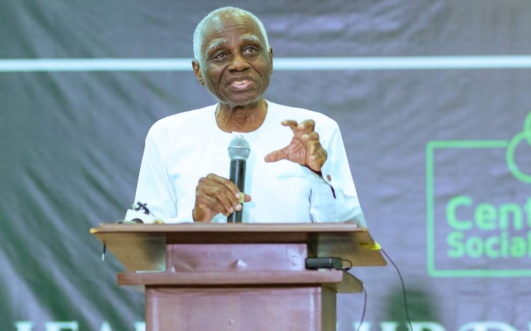
The Chairman of the West Africa Gas Summit, Tsatsu Tsikata, has reaffirmed that the West African Gas Pipeline (WAGP) remains one of the clearest and most successful examples of regional energy integration in Africa.
He described the project as a “proud example” of cooperation among West African states and a model that should be strengthened to support the region’s growing energy needs and long-term sustainability.
However, Mr Tsikata cautioned that despite the success of the pipeline and its strategic importance, West African countries must urgently confront persistent challenges relating to payment security and gas supply reliability.
He stressed that unless these issues are addressed “brutally,” the long-term viability of regional energy cooperation could be undermined.
“There’s no reason why payment for gas from Nigeria should not be as secure as payment for gas supplied by ENI under a partial risk guarantee arrangement with the World Bank. There’s absolutely no reason why the same security of payment should not be used when it comes to gas from Nigeria,” he said.
His remarks were delivered during the opening session of the three-day West Africa Gas Summit held in Accra on Tuesday, June 9, where key stakeholders from across the energy sector gathered to discuss the future of gas development and regional integration.
Mr Tsikata, who played a central role in the early conceptualisation of the West African Gas Pipeline project, said the original logic behind the initiative remains valid today.
He explained that Ghana’s decision to participate in the pipeline was driven by the practical recognition of Nigeria’s abundant gas reserves and the opportunity this presented for secure, cost-effective energy access.
“There was just no question about Nigeria’s vast reserves, and therefore the availability of those reserves created an opportunity for Ghana. By creating, or by getting involved in the creation of the pipeline, it was clear to us that access would give Ghana security of energy supply,” he said.
He added that regional cooperation in the gas sector is no longer optional but essential, especially as West African economies continue to experience rising demand for energy.
According to him, the expansion of mineral processing activities such as gold, lithium, aluminium, and bauxite refining, along with rapid growth in digitisation, artificial intelligence systems, and data centres, has significantly increased pressure on national power systems.
Mr Tsikata emphasised that addressing structural weaknesses in the system requires honesty, commitment, and a willingness to confront difficult operational realities. Without this, he warned, regional collaboration may fail to reach its full potential.
He said, “it takes a lot of honesty about addressing those problems to make sure that we make regional cooperation effective” and build on it to do more.
Reflecting on the early development of Ghana’s gas strategy, Mr Tsikata recalled that when the Ghana National Petroleum Corporation (GNPC) first advocated for gas as a complement to hydroelectric power, there was significant scepticism from international institutions and development partners.
At the time, organisations such as the World Bank and other advisers argued that Ghana’s energy demand was too limited to justify investment in gas infrastructure. They believed hydropower from the Volta River system would be sufficient for decades and that gas would only become necessary occasionally when water levels dropped.
He noted that these projections ultimately proved inaccurate as Ghana’s energy demand grew rapidly, driven by population growth, industrial expansion, and urbanisation.
“They argued Ghana’s energy demand did not justify gas, and that hydropower would be sufficient into the distant future, with gas needed only one year in seven when the water level of the Volta Lake comes down.
“Now, obviously, they were wrong in those perspectives. And what GNPC began to champion from those days in terms of gas has shown itself to be clearly the way forward,” he said.
Mr Tsikata also reiterated that the West African Gas Pipeline continues to demonstrate the value of regional cooperation, particularly in ensuring energy security and reducing dependence on fragmented national systems.
He argued that strengthening such cross-border infrastructure is essential for the future stability of the region’s energy markets.
Speaking at the same event, the Deputy Minister of Energy and Green Transition, Richard Gyan-Mensah, underscored the importance of using natural gas as a catalyst for industrial development rather than viewing it as a final objective in itself.
He said gas must be strategically deployed to support broader socio-economic transformation across West Africa.
Mr Gyan-Mensah acknowledged that while significant progress has been made in developing gas infrastructure and supply systems, the full transformative benefits expected in areas such as economic growth, infrastructure development, energy access, employment creation, and improved living standards have not yet been fully realised.
“Just to remind sponsors, rapid gas expansion is not the end goal, but a way to drive socio-economic transformation. The key question is how we turn our gas resources into lasting values for our people,” he said.
He further highlighted ongoing challenges facing West African economies, including high energy costs, limited industrial competitiveness, infrastructure deficits, and the need for more sustainable development pathways.
Despite the region’s abundant natural gas resources, he noted that many countries still struggle to translate these resources into broad-based economic benefits.
Mr Gyan-Mensah also pointed to global geopolitical tensions and energy market disruptions, warning that countries without resilient and diversified energy systems remain vulnerable to external shocks.
He emphasised that natural resources alone do not guarantee prosperity unless supported by effective governance and institutional frameworks.
“Prosperity happens when resources are backed by sound policy, good infrastructure, strong institutions, and effective partnerships. Governments need to create an environment that builds investment confidence and ensures benefits reach our people”.
He added that in Ghana, the West African Gas Pipeline has already played a critical role in stabilising power supply and supporting economic activity over the years, serving as a strong example of the benefits of regional integration.
He also highlighted the contributions of international and local energy partners such as Tullow Oil, Kosmos Energy, ENI, and the GNPC in advancing domestic gas discoveries that have reshaped Ghana’s energy landscape.
According to him, one of the biggest challenges facing Africa is not the lack of ideas or resources but the difficulty of transforming viable concepts into bankable projects that attract financing and investment.
He suggested that improving project preparation and institutional readiness could significantly accelerate energy development across the continent.
“The opportunity in West Africa is huge. We have the resources. We have the talents. We have the institutions and the partnerships to try. What’s needed now is ongoing commitment, coordinated efforts, and a shared drive to turn our potentials into real progress,” he said.
Closing the summit, the Executive Secretary of the Gas Consortium, Senam Kodzo Gbeho, emphasised the need for West Africa to establish its own dedicated platform for frank and practical discussions on regional gas development.
He said the West Africa Gas Summit has been created precisely to fill that gap by providing a space for open engagement among stakeholders, rather than relying on external forums that may not fully reflect regional priorities.
“What matters is that West Africa needs its own platform for candid, practical conversations about regional gas development, and you have helped make that platform a reality,” he told delegates.
The summit brought together policymakers, regulators, investors, financiers, industry leaders, and representatives of regional institutions to discuss strategies for strengthening energy cooperation and accelerating gas-driven development across West Africa.