
A total of 2,331 victims of human trafficking were rescued in Ghana in 2025, the highest figure recorded in the past five years, signalling both the escalating nature of the crime and the enhanced capacity of state institutions to combat it, the Minister for Gender, Children and Social Protection, Dr Agnes Naa Momo Lartey, has disclosed.
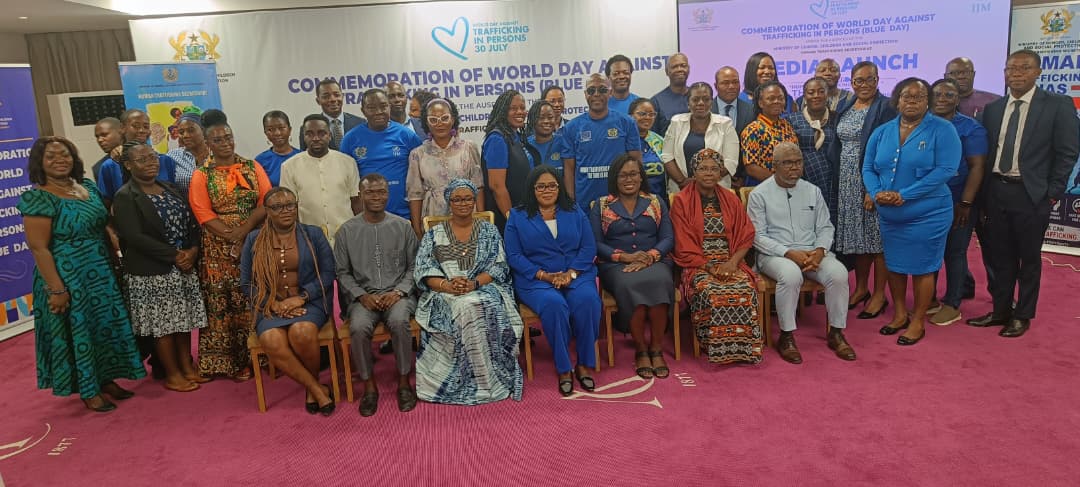
Out of the number, 1,544 were men, 789 were women, while 425 were children, the Minister revealed in a keynote address at the official media launch of the Commemoration of the World Day Against Trafficking in Persons, also known as Blue Day, held at the Accra City Hotel on Tuesday.
The event, organised by the Human Trafficking Secretariat of the Ministry of Gender, Children and Social Protection, was on the theme: “Human Trafficking Can End: The Time is Now – Blow The Whistle On Sports Trafficking.”
Sharp rebound in rescues
Dr Lartey noted that the number of victims rescued increased from 821 in 2021 to 846 in 2022, and rose significantly to 2,089 in 2023. Although the figure declined to 794 in 2024, it rebounded sharply in 2025 with an unprecedented 2,331 victims rescued.
“These figures tell an important story. They are not just numbers – they demonstrate improved collaboration among institutions, increased public awareness, strengthened enforcement operations, enhanced detection systems, and greater institutional capacity to identify and rescue victims,” she stated.
The Minister explained that the sharp increase also reflected intensified action against emerging forms of trafficking, particularly cyber-related trafficking, online exploitation, and romance scam networks.
Prosecutions yielding results
Dr Lartey further disclosed that following investigations and rescue operations, about 106 offenders were prosecuted and convicted for cybercrime trafficking and exploitation-related offences, including defrauding by false pretense.
Additionally, 54 offenders were convicted for human trafficking and child labour-related offences after 2,022 cases were investigated in 2025.
“These outcomes send a strong message that Ghana will not treat the exploitation of its people, especially women and children, for criminal gains lightly,” she asserted.
Sports trafficking under spotlight
With the world preparing for major international sporting events, including the upcoming FIFA World Cup, the Minister warned that traffickers are increasingly exploiting the dreams of young athletes.
“Sports is meant to inspire hope, discipline, opportunity, and national pride. Across the world, millions of young people see sports as a pathway to education, professional success, economic advancement, and a better future,” she said.
“Unfortunately, traffickers and exploiters are increasingly taking advantage of these dreams. Criminal networks and unscrupulous individuals use false promises of contracts, scholarships, overseas trials, and recruitment opportunities to lure vulnerable young people into situations of exploitation, abuse, forced labour, irregular migration, and trafficking.”
‘Can end’ versus ‘should end’
Speaking on behalf of the Chairperson of the Parliamentary Select Committee on Gender, Children and Social Welfare, Reverend Helen Adjoa Ntoso, the Member of Parliament for Salaga South Constituency, Hajia Zuwera Mohammed Ibrahimah, drew a critical distinction between the words “can” and “should” in the theme.
“‘Can end’ connotes ability. We can end it if we put our shoulders to the wall, but ‘should end’ indicates obligation. I think we have an obligation, all of us gathered here, to endeavour to work together to stop human trafficking in any form,” she stated.
The MP, who is also Vice Chairperson of the committee, disclosed that Parliament had joined the Ministry in advocating for a dedicated fund through the District Assembly Common Fund for child protection at the metropolitan, municipal, and district assembly levels.
“Such a fund will go a long way to facilitate the effective work of social welfare officers, who are the frontline officials charged with the responsibility of ensuring the protection and social well-being of our children,” she added.
IOM reveals alarming statistics
The Chief of Mission for the International Organization for Migration (IOM) in Ghana, also accredited to Togo and Benin, Fatou Diallo Ndiaye, revealed that research conducted by IOM Ghana showed that more than 95 per cent of young people are interested in sports careers abroad, yet many encounter deceptive offers.
She identified the high migration aspirations, weak regulation of intermediaries, limited use of formal contracts, and low awareness of trafficking as key drivers of these risks, affecting both male and female athletes.
“Ending trafficking in sport requires trusted information, stronger systems, and accountable institutions. It also requires communities, families, coaches, and the media to act as a first line of protection,” Ms Ndiaye stated.
She commended the Minister for centring the lens on sports trafficking for this year’s commemoration and called for ethical recruitment practices.
“We see many agencies, many companies coming and recruiting our young people without passing through the normal channels, and this is creating a kind of deep trafficking. How can we turn those policies we have developed into action? It is about ethics,” she emphasised.
Call to action
The Gender Minister announced that Ghana would join the rest of the world on 30th July to commemorate the 2026 World Day Against Human Trafficking and urged all citizens to play an active role in the fight.
“Human trafficking thrives when communities remain silent, when suspicious activities are ignored, and when vulnerable persons are left unprotected. Every citizen therefore has responsibility to remain vigilant, report suspicious recruitment and movement of persons, protect children and vulnerable young people, and support efforts aimed at preventing exploitation in our communities,” she said.
Dr Lartey made a special appeal to the media, describing journalists as “one of our strongest partners in shaping public awareness and national action.”
“Your platforms have the power to educate, influence behaviour, expose criminal networks, amplify survivor voices, and sustain national attention on this important issue,” she added.
Vigilance urged as World Cup approaches
As excitement builds towards the FIFA World Cup 2026, Hajia Zuwera urged parents, coaches, communities, and sports institutions to remain vigilant.
“Human trafficking thrives in silence. It requires awareness, cooperation, and action. As we celebrate sports and look forward to the World Cup, let us also commit ourselves to ensuring that sports remain a platform for talent, opportunity, and dignity, and not exploitation,” she said.
The Ministry has called on all citizens to become “ambassadors against trafficking” and report suspicious activities through the Social Welfare and Community Support Call Centre (SWESC), which continues to serve as an important reporting and response mechanism for vulnerable persons.
Dr Lartey concluded with a powerful declaration: “Human trafficking can end, and it should end. This is the time to blow the whistle.
This is the time to protect young people, and this is the time to stand together against exploitation in all its forms.”
By Kingsley Asiedu