
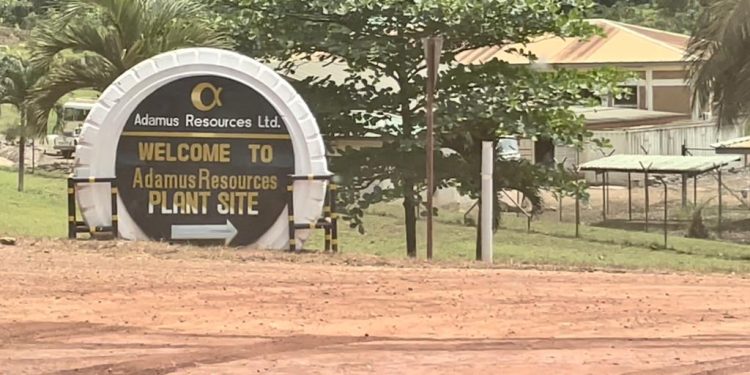
Findings by a Ministerial Committee have disclosed that the revocation of Adamus Resources Limited’s mining leases has exposed deep financial and regulatory failures that cost Ghana hundreds of millions of cedis and dollars in unpaid obligations.
While illegal mining and weak control of mining activities featured in the findings, financial obligations or unpaid taxes and royalties emerged as some of the most damaging concerns.
The committee, established by Lands and Natural Resources Minister Mr. Emmanuel Armah-Kofi Buah and chaired by Professor Jerry Samuel Yaw Kuma, reviewed Adamus Resources’ petition against the revocation of its Nkroful, Akango and Salman leases.
After investigations, the committee found Adamus Resources to be in arrears of GH¢86.78 million in royalties owed to the Minerals Income Investment Fund (MIIF) dating from 2020.
It also owed GH¢119.04 million in taxes to the Ghana Revenue Authority (GRA) from 2023, plus US$2.56 million in annual payments to the Minerals Commission.
Total statutory arrears stand at approximately GH¢205.83 million plus US$2.56 million, money the committee noted, should have been paid to the state for the extraction of Ghana’s mineral resources.
These unpaid obligations sit alongside the company’s transfer of more than US$224.61 million to related parties between 2020 and 2024.
Of that sum, about US$123.14 million went to Segala Mining Corporation SA, Semico 1 and Semico 2 in Mali.
The committee rejected any suggestion that cash-flow problems explained the non-payment of the statutory arrears.
It concluded the pattern pointed to deliberate non-compliance: money was available for large intra-group transfers while statutory debts to Ghana remained outstanding.
Gold production and export inconsistencies
The Committee also found that Adamus failed to produce its statutory Gold Production Book.
It therefore relied on Form 16A monthly returns and GRA royalty returns, and those records revealed serious discrepancies.
Between 2020 and January–March 2026, differences between Form 16A and GRA royalty returns totaled 6,580.04 ounces of gold, valued at approximately US$27.13 million (using the Bank of Ghana rate of 12 July 2026).
Further mismatches appeared in the figures reported to different state institutions for 2024 to January–March 2026:
Reporting Source Gold Reported (oz)
Ghana Revenue Authority (GRA) -72,194.94
Minerals Commission – 71,553.00
Adamus own shipment records -74,375.14
According to the Committee, additional variances were valued at roughly US$12.02 million and US$21.30 million.
It described the records as “suspicious” and concluded they had been prepared to evade statutory liabilities.
The Committee raised questions about possible gold smuggling or deliberate under-declaration of production and exports.
Community and other debts
The Eastern Nzema Traditional Area, the Committee indicated, alleged an outstanding US$2.5 million balance from a US$10 million Community Development Fund and claimed mineral royalties due to it had not been paid for eight years.
Concerns were also raised about infrastructure, roads, flooding, and the Salman Resettlement Project.
Outstanding debts to GOIL and GRIDCo were also noted, with further details expected later.
Over US$1 billion in Gold production
The Committee uncovered that from GRA records between 2020 and January–March 2026, Adamus produced approximately 8.8 tonnes of gold valued at more than US$1 billion.
Despite this, the company defaulted on its 10 percent contribution to MIIF and other statutory payments.
Late and disorderly EPA permits
According to the Committee, two Environmental Protection Agency permits revealed further irregularities.
“Permit EPA/EMP/313 (Salman operations, 20 July 2017 – 19 July 2020) was officially issued only on 19 December 2024 — more than four years after it had expired.
“Permit EPA/EMP/316 (Nzema operations, 21 December 2023 – 20 December 2026) was issued on 16 December 2024, nearly a year after the authorisation period had already begun.
“Both certificates were released in the same week in December 2024 and in reverse chronological order.
“The documents establish that Adamus operated for extended periods without valid environmental permits, constituting illegal operations under Ghanaian law,” the Committee noted.
Committee recommendation
The Ministerial Review Committee assessed the breaches as serious and fundamental to the integrity of the mining leases.
It recommended that the revocation be upheld and called for additional regulatory, environmental, and financial enforcement measures, including a comprehensive audit of the company’s activities.
The logic of the findings rejected arguments that Adamus is Ghanaian-owned and should therefore retain its leases: ownership does not exempt any company from complying with the country’s laws, paying statutory obligations, or accurately accounting for gold produced and exported.