

The Minerals Commission has detailed the reasons behind the government’s decision to revoke three mining leases held by Adamus Resources Limited, citing what it described as “systematic and flagrant violations” of Ghana’s mining laws.
The Commission indicated that the recent lease revocations Adamus Resources do not preclude further legal action.
It said criminal charges may be pursued against Adamus Resources Limited and its directors under Act 995.
The Commission also noted that steps will be taken to protect legitimate jobs affected by the decision, with transitional measures expected to be announced.
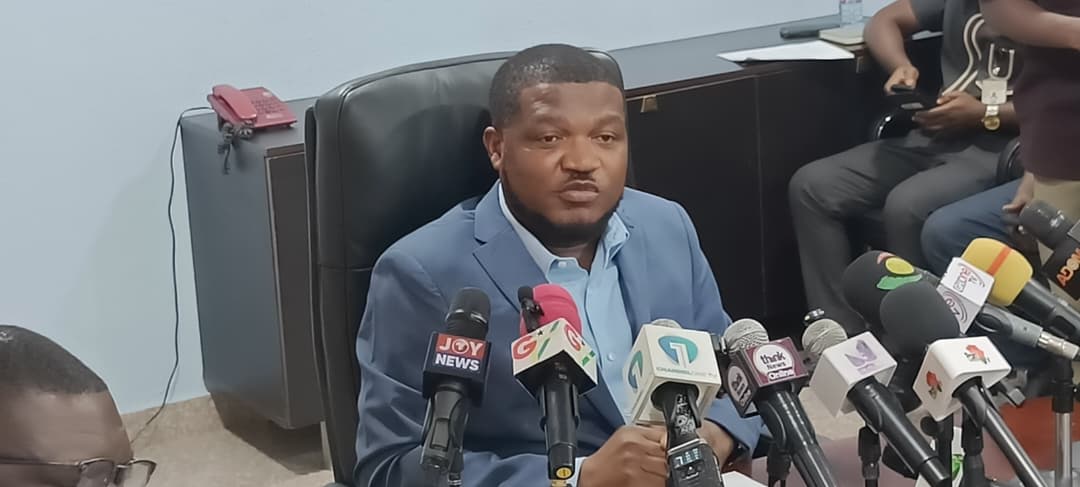
At a news briefing in Accra, the Chief Executive of the Commission, Mr Isaac Tandoh said findings from routine inspections revealed multiple breaches, including the assignment of mineral rights, unauthorised mining beyond approved zones, and the involvement of foreign nationals in illegal mining activities—commonly referred to as galamsey.
The revoked leases cover the Akango, Salman, and Nkroful concessions.
The decision was formally announced last week by the Minister for Lands and Natural Resources, Emmanuel Armah-Kofi Buah.
Evidence of breaches
According to the Commission’s Inspectorate Division, Adamus Resources Limited reassigned portions of its mineral rights to third parties without obtaining the required ministerial approval, in direct violation of Section 14 of the Minerals and Mining Act, 2006 (Act 703).
Investigations further revealed that three out of the company’s four concession areas—Nkroful, Akango, and Salman—had been opened up for mining outside approved operational zones and without access to the company’s processing infrastructure.
“No mineral resources or reserves were defined in the released areas to justify any legally sanctioned contract mining operations,” Mr Tandoh said.
Foreign nationals and illegal mining
The Commission described as particularly troubling the discovery of foreign nationals actively engaged in illegal mining on two of the concessions.
At the Akango site, inspectors observed Chinese nationals operating heavy equipment, including excavators and a bulldozer, on land that had been cleared for mining.
The site, located several kilometres from Adamus’ main processing facility, lacked a proper access route—contravening provisions of the Minerals and Mining (Amendment) Act, 2019 (Act 995).
A similar situation was found at the Salman concession, where multiple excavators were engaged in preparatory works.
Again, foreign nationals without permits were operating at a location far removed from the company’s established infrastructure.
Environmental concerns
The Minerals Commission described the operations as environmentally harmful and inconsistent with industry standards.
It warned that such activities have led to land degradation and pose risks to nearby water bodies.
Mr Tandoh added that beyond environmental damage, the illegal operations deny the state legitimate mining revenue and expose communities to health risks due to the use of unregulated chemicals.
Legal basis for revocation
Addressing concerns about due process, the CEO explained that although the law typically allows time for companies to remedy breaches, immediate revocation is justified in cases involving serious violations and threats to public interest or the environment.
“The Commission is of the considered view that the serious and deliberate violations of statutory and regulatory obligations by the company… provide compelling and lawful grounds for the Honourable Minister to terminate the mining leases,” he stated.
Strong warning to industry
The Commission stressed that the action sets a clear precedent for the mining sector.
“This decision was neither arbitrary nor politically motivated,” Mr Tandoh said. “It was a lawful, evidence-based action taken to protect Ghana’s natural resources, environment, and public interest.”
He added that companies operating outside the law will face strict consequences.
“Companies that act with impunity, disregard regulatory authority, and endanger our land, water, and communities will face the full rigours of these same laws… illegality will not be disguised as investment.”
Policy clarification
Mr Tandoh used the briefing to reiterate government policy on contract mining, noting that prioritising indigenous Ghanaian companies—or requiring partnerships with them—is already embedded in existing regulations.
He explained that the policy was formally incorporated into the 6th Edition of the Local Procurement List in January 2025 under the Minerals and Mining (Local Content and Local Participation) Regulations, 2020 (LI 2431), and that many multinational firms have already complied.
Continued enforcement
The Minerals Commission pledged to intensify oversight through unannounced inspections and stricter enforcement actions.
“Ghana welcomes responsible investment,” Mr Tandoh concluded. “But the era of impunity—where leases are used to facilitate galamsey and foreign nationals operate without authorisation—is over.”
By Kingsley Asiedu