
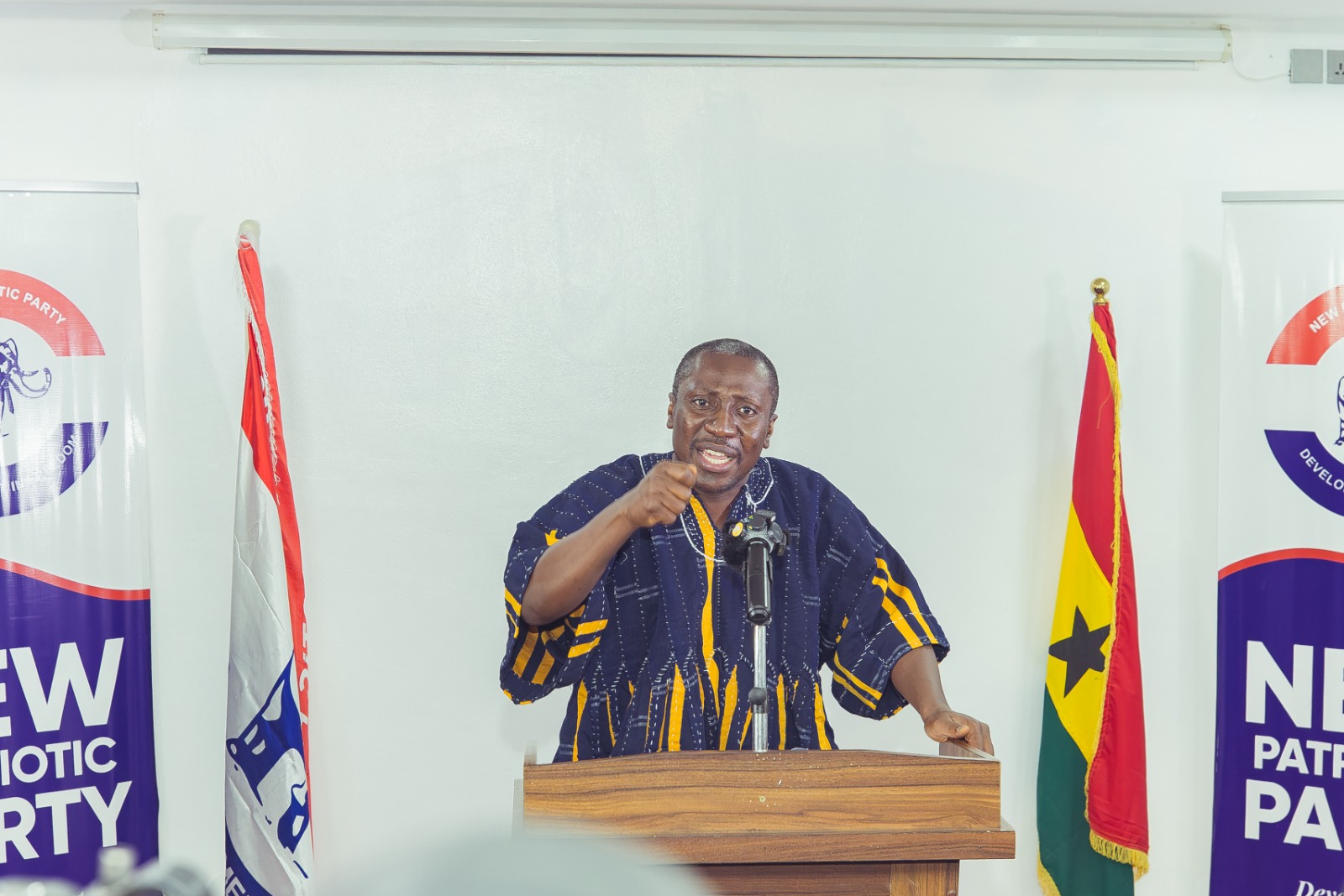
Minority Leader Alexander Afenyo-Markin has launched a scathing attack on the governing National Democratic Congress (NDC), accusing the party of abandoning its principles and engaging in political double standards over amendments made to the controversial anti-LGBTQ legislation currently before Parliament.
Speaking on the floor of Parliament during debate on the bill, Afenyo-Markin argued that the NDC, which previously resisted any attempts to amend the original legislation while in opposition, has now diluted key provisions after assuming power.
According to the Minority Leader, the amendments introduced by the Majority expose what he described as a glaring contradiction between the NDC’s previous position and its current actions in government.
“Clearly, this evening, this country has witnessed an unprincipled political act by our friends in the Majority. They may try and act smart, but smartness does not last. Integrity lasts,” he declared.
Afenyo-Markin maintained that when the bill was first introduced in the Eighth Parliament, proponents within the NDC strongly opposed any suggestions for amendments despite concerns raised by members of the then Majority caucus.
He recalled that during consultations on the bill, the New Patriotic Party (NPP) drew attention to what it considered problematic clauses and potential legal challenges. However, he claimed those concerns were ignored by the bill’s sponsors.
“Today, as they take responsibility for governance, they realise that indeed the issues we raised are still critical,” he said.
The Minority Leader argued that the very legislation the NDC had insisted former President Nana Akufo-Addo should assent to has now been altered by the same party.
“The very law that they wanted Nana Akufo-Addo to sign, when they were faced with the same law, they amended and diluted that same law. Such a double standard does not pass for a man with principles,” he stated.
Procedural concerns raised
Beyond the substance of the bill, Afenyo-Markin also questioned aspects of the parliamentary process leading to the amendments.
He alleged that some of the bill’s sponsors were absent during critical stages of proceedings and claimed that motions related to the legislation were moved without the direct participation of the principal sponsors.
The Minority Leader specifically named several lawmakers associated with the bill, including Emmanuel Kweisi Bedzrah, Sam Nartey George, Naana Adole and Ellen Adjoa Ntoso, stating that they were not present in the chamber at key moments.
According to him, the absence of the sponsors raised questions about the handling of motions connected to the legislation.
“It is important to let Ghanaians know that at this critical stage, none of the NDC sponsors of this bill was in this chamber,” he told the House.
He further suggested that the developments demonstrated a lack of commitment to the original principles the sponsors had championed when the legislation was first introduced.
Challenge to the NDC’s position
Afenyo-Markin repeatedly questioned why the NDC had changed its stance after winning power.
He argued that political parties should maintain consistency between the positions they take in opposition and those they adopt in government.
“It is not enough to say one thing in opposition and, when you get power, change your stand thinking that nobody can read through it,” he said.
The Minority Leader challenged the NDC to explain the differences between the earlier version of the bill and the revised version currently under consideration.
He called on religious groups, traditional leaders and civil society organisations to compare the two versions and determine whether the amendments had weakened the original intent of the legislation.
“Who in this country is the NDC trying to deceive? The religious leaders? Our chiefs? Our civil society?” he asked.
According to Afenyo-Markin, the amendments suggest that the government itself recognises that the original bill contained provisions that would have made presidential assent difficult.
“I know that indeed President Mahama could not have signed that bill, and the NDC knows that they cannot present the same bill,” he argued.
Wider criticism of government policies
The Minority Leader used the opportunity to broaden his criticism beyond the anti-LGBTQ bill, accusing the NDC administration of failing to honour several campaign promises.
He cited issues including taxation, utility tariffs, employment creation and compensation for customers who lost investments in failed financial institutions.
Afenyo-Markin accused the government of taking positions in opposition that it later abandoned after assuming office.
He pointed to the controversy surrounding the Electronic Transfer Levy (E-Levy), claiming the NDC had campaigned vigorously against the tax but later sought alternative revenue measures that placed similar burdens on citizens.
“You came and said you were repealing the E-Levy, yet you imposed the Dumsor Levy on Ghanaians,” he said.
He also referenced increases in electricity and water tariffs, arguing that ordinary Ghanaians were facing mounting economic pressures despite promises of relief.
The Minority Leader further criticised the government’s job creation agenda, claiming little progress had been made on pledges to expand employment opportunities.
“You said you were going to create one job, three shifts. Nothing,” he stated.
Call for principle in politics
Throughout his speech, Afenyo-Markin returned to the theme of political consistency and integrity.
He argued that democratic governance requires leaders to uphold the same principles regardless of whether they are in opposition or in power.
“Whether you are in opposition or in government, let us have some values,” he said.
The Minority Leader maintained that the NPP’s objections to the amendments were based on principle rather than political convenience.
“We may be few, but we are armed with principle. We may not have the numbers to undo your actions, but we are principled,” he declared.
Afenyo-Markin warned that political expediency could have long-term consequences and suggested that voters would eventually judge the government’s actions.
Looking ahead to 2028
In a pointed conclusion, the Minority Leader predicted that the electorate would ultimately assess the NDC’s record and determine whether the party had remained faithful to its promises.
He suggested that the political consequences of the government’s decisions would become evident in future elections.
“2028 is not far away,” he said, warning that political fortunes can change rapidly.
Drawing on literature to conclude his remarks, Afenyo-Markin quoted Kenyan author Ngũgĩ wa Thiong’o’s novel Weep Not, Child, saying, “The ravening clouds shall not long be victorious. They shall not long possess the sky.”
The quotation served as a metaphor for his belief that what he views as political inconsistency and opportunism would eventually be exposed.
With that, the Minority Leader ended his address, insisting that history and posterity would ultimately judge the actions of the government and the decisions surrounding the amended anti-LGBTQ legislation.