
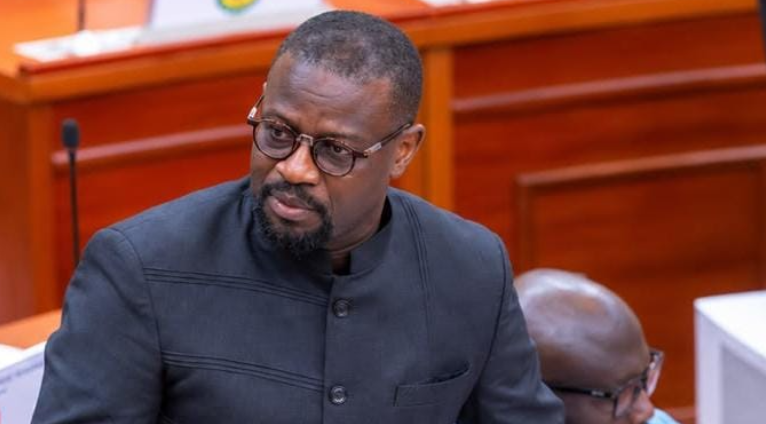
Minority Chief Whip and Member of Parliament for Nsawam-Adoagyiri, Hon. Frank Annoh-Dompreh, has challenged the government over what he considers a lack of urgency in responding to parliamentary business, insisting that the Attorney-General or his deputy must be present in the House to discharge the responsibilities of the office.
Speaking on the floor of Parliament on Thursday, Annoh-Dompreh objected to an arrangement that would allow a paper requiring the Attorney-General’s attention to be laid in his absence without ensuring that his deputy was available to perform the duty. He maintained that where the Attorney-General could not attend parliamentary proceedings, the Deputy Attorney-General should be summoned to represent the office and ensure that the business of the House was not delayed.
“Mr. Speaker, this application doesn’t find favour with us. If the Attorney-General is not here, his deputy must be here,” he argued, urging the leadership of the House to insist on the proper procedure. He further appealed to the relevant parliamentary leadership to take immediate steps to get the Deputy Attorney-General to the chamber to lay the paper.
Annoh-Dompreh’s intervention, however, went beyond the immediate issue of the Attorney-General’s absence. He used the opportunity to raise concerns about delays in scheduling motions arising from committee reports, arguing that the problem could not simply be attributed to committees failing to complete their assignments.
He explained that several parliamentary committees, including the Local Government Committee and the Health Committee, had completed work on various referrals and submitted their reports to the appropriate authorities. According to him, despite the completion and submission of these reports, the corresponding motions had yet to be scheduled for consideration on the floor of Parliament.
The Minority Chief Whip said the situation required closer communication between the Table Office and the parliamentary whips, particularly the Majority Whip, to establish why completed committee reports were not translating into parliamentary business.
“I am aware of committees that have completed their works. I’ll give you two examples: the Local Government Committee and the Health Committee. On various referrals directed at them, they have completed their works. Reports have been submitted, but motions are not being scheduled to be taken on the floor,” he told the House.
He acknowledged the position and observations made by the parliamentary leadership but insisted that there was another side to the matter which needed attention. In his view, the House needed to establish whether the delays were caused by communication gaps or other issues surrounding the scheduling of parliamentary business.
Annoh-Dompreh specifically referred to the Collins-Dalda matter, maintaining that the committee report in question was already ready before Parliament adjourned. He explained that the former Majority Leader had requested further consultations before the matter proceeded, stressing that the delay should not be presented as a failure by the committee to complete its work.
“In the case of Collins-Dalda’s matter, Leader, with greatest respect to you, that report is ready. Before we rose, the report was ready, and then the former Majority Leader said that we should do some consultation. So it is not a question of the report not being ready. The reports are ready. We need to find out why we are not scheduling the motions to be taken,” he stated.
His comments brought attention to a broader parliamentary concern: the need to ensure that committee work, once completed and submitted, receives the necessary attention through the scheduling of motions for debate and consideration by the House.
Returning to the issue of the Attorney-General’s representation, Annoh-Dompreh urged the parliamentary leadership not to allow the matter to drag on. He called on the relevant leader to step out of the chamber and contact the Deputy Attorney-General so that the official could appear and lay the required paper.
“Let’s do things properly. Just step out and call the Deputy Attorney-General to come and lay his paper,” he appealed.
He emphasised that Parliament must be accorded the importance it deserves and that government officials must demonstrate respect for the institution by ensuring that their responsibilities to the House are fulfilled.
“This is Parliament. They cannot treat Parliament anyhow,” Annoh-Dompreh declared, reiterating his demand for the Deputy Attorney-General to be brought before the House.
The Minority Chief Whip said he did not intend to turn the matter into an unnecessary dispute or prolong the proceedings, but insisted that the House must protect its procedures and ensure that government business is handled with the seriousness required.