
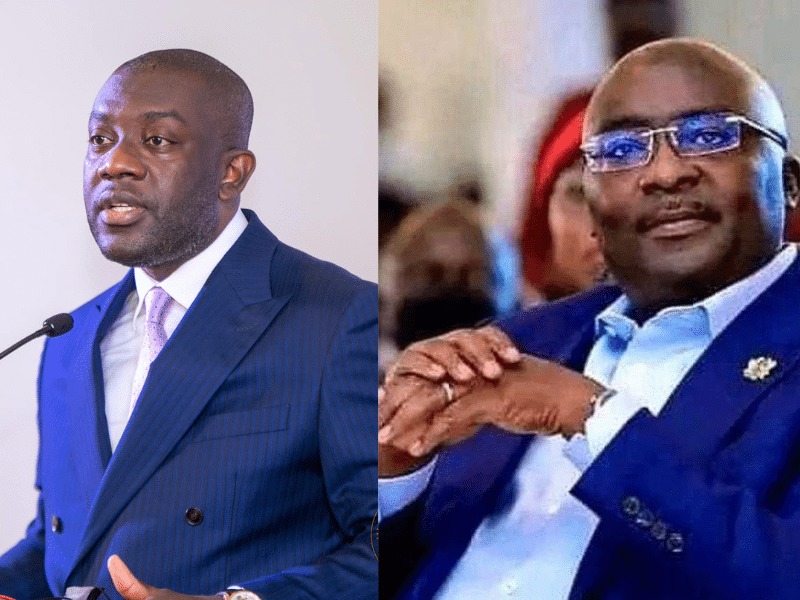
The Governor of the Bank of Ghana (BoG), Dr. Johnson Asiama has confirmed that the central bank has relied on the Domestic Gold Purchase Programme, spearheaded by former Vice President Dr Mahamudu Bawumia under the New Patriotic Party (NPP) administration, to intermediate foreign exchange flow, which has ensured the stability of the local currency, the cedi.
He explained that under the arrangement, Ghana cedis generated through foreign exchange forward auctions are converted into foreign currency through gold purchases before being channelled back into the market.
Answering questions from Mr. Kojo Oppong Nkrumah, the Member of Parliament for Ofoase Ayirebi and Ranking Member of Economy and Development Committee of Parliament, the Governor stated that the mechanism effectively replaces foreign exchange flows that were previously supplied by independent gold exporters before those transactions became centralised under GoldBod operations.
A fresh political storm has erupted in Parliament after the Minority accused the National Democratic Congress (NDC) Majority of deliberately preventing Ghanaians from hearing what it described as the Bank of Ghana’s admission that the stability of the cedi has been sustained through the Domestic Gold Purchase Programme.
The controversy followed the Majority’s decision to hold the Bank of Ghana Governor’s appearance before Parliament behind closed doors, a move the Minority argued, was intended to conceal key disclosures contained in the Governor’s written responses to parliamentary questions.
Parliamentary controversy
The confrontation began when the First Deputy Speaker, Bernard Ahiafor, granted a request by the NDC Majority for the Governor of the Bank of Ghana, Dr. Johnson Asiama, to brief Parliament’s Committee of the Whole in camera.
Journalists were ordered to leave the public gallery before proceedings commenced, triggering a walkout by the Minority Caucus, which insisted that the engagement involved issues of significant public interest, including the foreign exchange management, the Bank’s financial position and the source of the cedi’s recent stability.
Leading the Minority’s protest was the Ranking Member on Parliament’s Economy and Development Committee, Mr Oppong Nkrumah, who argued that there was no justification for excluding the media because the Governor had already submitted written responses to Parliament, which had been published on the Order Paper.
According to him, the answers contained no classified information and should have been openly discussed before the Ghanaian public.
“These are the answers that the Majority seeks to deny the press an opportunity to report to the people of Ghana. What is there to hide, for which reason the media is being denied access to follow these proceedings?” Mr. Oppong Nkrumah questioned while addressing journalists after the Minority suspended its participation in the sitting.
At the centre of the controversy are three parliamentary questions filed by Mr. Oppong Nkrumah seeking clarification on the source of the foreign exchange used by the Bank of Ghana for market interventions, the framework governing those interventions, and the total amount of foreign exchange injected into the market since January 7, 2025.
Responding, the BoG Governor disclosed that it has not undertaken any direct foreign exchange market intervention using the country’s official reserves since August 2024.
The Governor further disclosed that the current Foreign Exchange Operations Framework was formally introduced on November 11, 2025, and is built around a rule-based system that allows exchange rates to be determined by market forces while limiting excessive short-term volatility.
According to the Bank, foreign exchange transactions are now conducted through transparent spot auctions without exchange-rate guidance or transaction fees.
Notably, the Governor also announced that between January 7 and December 31, 2025, the Bank of Ghana facilitated approximately US$10.36 billion in foreign exchange through the Domestic Gold Purchase Programme.
He stressed that these transactions did not involve direct intervention financed from the international reserves but were supported by foreign exchange generated from gold purchases.
Impact Domestic Gold Purchase Programme
Mr. Oppong Nkrumah argued that these disclosures effectively confirm that the Domestic Gold Purchase Programme—widely associated with the economic policies championed by former Vice President Dr. Bawumia under the previous NPP administration—has become the principal source of foreign exchange supporting the cedi.
According to him, this was precisely the information the Ghanaian public deserved to hear directly from the Governor, and deciding to exclude journalists even more difficult to justify.
He questioned why the Majority would prevent the Governor from publicly explaining a policy framework that, according to the Bank’s own responses, now underpins the foreign exchange operations.
“The Bank of Ghana is here to admit that its ability to intervene on the market is as a result of the Domestic Gold Purchase Programme. Why is it that the Majority is preventing the Governor from saying this to the entire country?” he asked.
The former Information Minister also disclosed that beyond the foreign exchange questions, the Minority had intended to interrogate the Governor on the Bank’s recent audited financial statements, including concerns over its reported operating losses and the credibility of certain figures contained in the accounts.
However, the Minority suspended its participation after the media were ordered out of the chamber, insisting that Parliament could not promote accountability while simultaneously denying the public access to proceedings involving one of the country’s most important public institutions.
Parliament as people’s House
Mr. Oppong Nkrumah maintained that Parliament is the “people’s House” and that proceedings concerning the management of the economy should not be shielded from public scrutiny.
He argued that discussions relating to the cedi, inflation, foreign exchange interventions and the financial health of the Bank of Ghana affect every Ghanaian and should therefore be conducted openly.
Majority’s defence
The Majority, however, defended the decision. Majority Leader Mahama Ayariga insisted that the Committee of the Whole acted within Parliament’s Standing Orders, arguing that committees may decide whether to sit in public or not.
He rejected suggestions that the Governor was being shielded from scrutiny and maintained that the Governor had come prepared to answer all questions submitted by Members of Parliament.
According to him, the Minority chose to walk out instead of participating in the proceedings after failing to convince the Committee to open the sitting to the media.
Despite the Majority’s explanation, the Minority insists the controversy goes beyond parliamentary procedure.
It argued that the Governor’s own written responses acknowledge the central role of the Domestic Gold Purchase Programme in foreign exchange management and that Ghanaians deserved to hear those explanations—and the follow-up questions from the Governor himself in an open parliamentary session rather than behind closed doors.
By Kyei Boateng