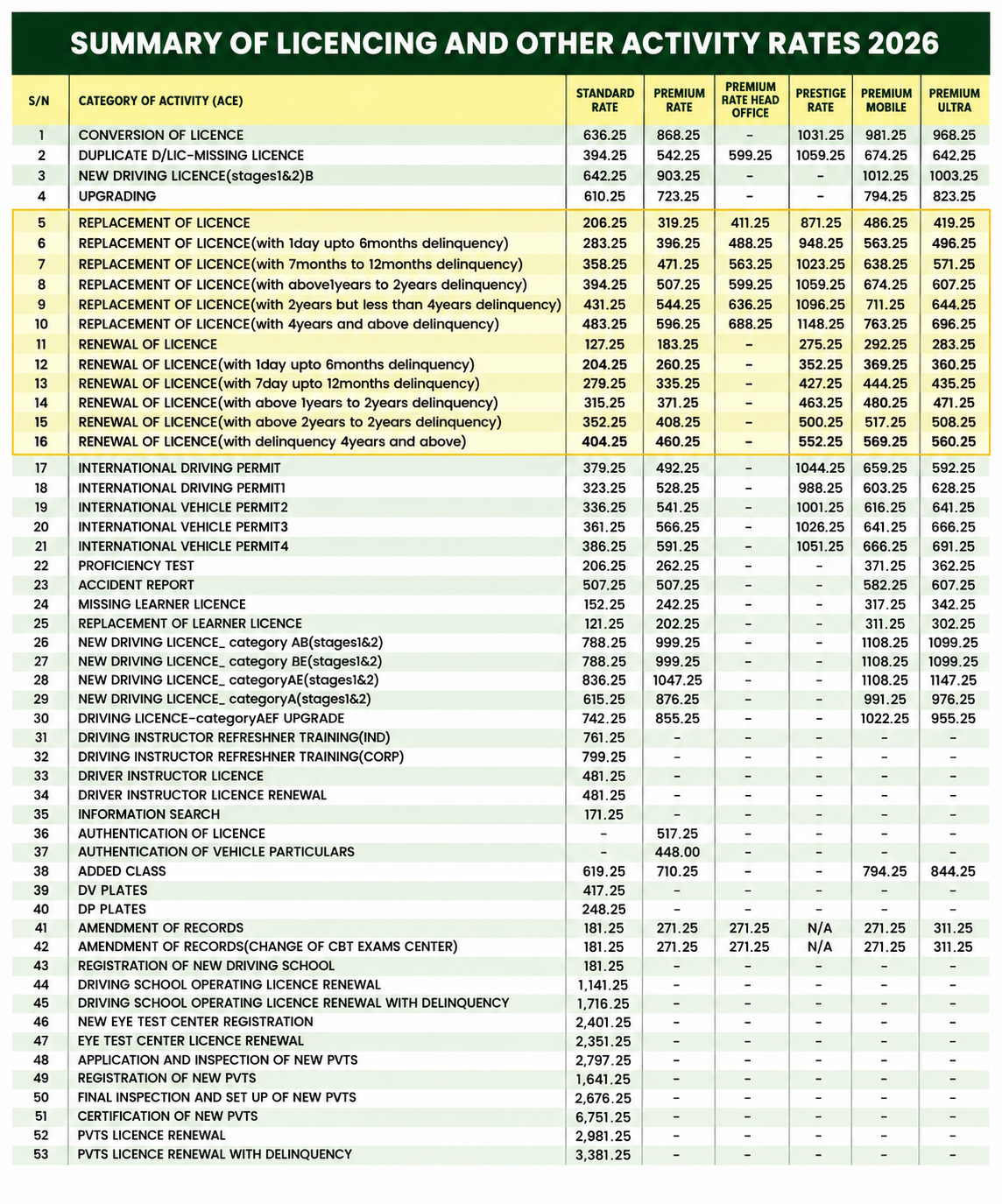


CUTS International, Accra, a leading public policy think tank, is calling on the Driver and Vehicle Licensing Authority (DVLA) to suspend the escalating “delinquency” charges imposed on people who renew or replace a driver’s licence after its expiry date, pending full public disclosure of the precise legal basis, approval process and calculation of the charges.
Under the DVLA’s Summary of Licensing and Other Activity Rates for 2026, the standard charge for renewal before expiry is GH¢127.00. The amount rises to GH¢204.25 where the licence has expired by between one day and six months. It rises further to GH¢279.25 for seven to twelve months, GH¢315.25 for up to two years, GH¢352.25 for up to four years and GH¢404.25 beyond four years. The schedule applies similar escalating charges to the replacement of an expired licence.
CUTS considers the automatic and escalating charges unfair, opaque and open to abuse unless the DVLA identifies the exact statutory instrument and approved fee item authorising each amount.
“The DVLA must show Ghanaians the law, the approved fee schedule and the formula behind every cedi it collects as a delinquency charge. Public power must rest on law. If the Authority cannot point to a clear legal basis for each charge, it must stop collecting the money and refund affected licence holders,” said Appiah Kusi Adomako, Esq., Director, West Africa Regional Centre of CUTS International.
The Law Requires a Clearer and Fairer Approach
Regulation 46(1) of the Road Traffic Regulations, 2026 (L.I. 2519) provides that a driver’s licence “may” be renewed within one month before it expires. Regulation 46(2) then deals expressly with renewal after expiry. It states that a late renewal takes effect from the earlier expiry date unless the Authority for a good cause shown, permits that the renewal should take effect from the date of the renewal.
Both revoked L.I. 2180 and the current framework (LI 2519) recognises that renewal after expiry will occur. Regulation 46(8) also creates an offence for failure to renew as prescribed and makes a person liable on summary conviction. The law says “a person who fails to renew a driver’s licence as prescribed commits an offence and is liable, on summary conviction, to a fine not less than five penalty units and not more than twenty-five penalty units or a term of imprisonment of not more than thirty days or to both.” The law gives the Ghana Police to enforce this and the court to convict offenders. These provisions raise important questions about the source, scope and administration of a separate automatic “delinquency” charge at the DVLA counter.
The use of the word “may” and not “shall” is a clear reflection of the intention of the lawmakers. Failure to renew your license becomes punitive only when driving without a valid license and not when your license is expired and are caught driving. The imposition of any fine by DVLA for late renewal of a license is therefore unlawful, ultra vires and contrary to the intention of the legislator. Imposing a fine on late renewal will amount to the DVLA interpreting the LI by 2519 replacing the word “may” to mean “shall,” which is not permissible in a constitutional democracy. Unless there is no evidence that someone with an expired license was caught driving, the regulator cannot charge anyone fee for delinquency. The Ninth Schedule to the LI provides for an automated road traffic offenses. Once the law says it is an “offence” then there can be no presumption except an evidential proof that license holder continued to drive beyond the expiry date of the license.
CUTS therefore asks the DVLA to state whether the escalating charges are renewal fees duly approved under the applicable Fees and Charges legislation, administrative penalties, or some other charge. The distinction matters. If the amounts are penalties, the DVLA must explain the legal process that permits an administrative system to impose them without proof of driving during the period of expiry, without a hearing and without a finding by a court.
“CUTS is not encouraging anyone to drive with an expired licence. Driving without a valid licence must attract lawful enforcement. Our concern is different: the DVLA should not presume that every person with an expired licence continued to drive, then impose an automatic escalating charge without first establishing the legal and factual basis,” Mr. Adomako said.
Since there is no legal basis for the escalated charges, the DVLA must desist from charging people who come to their counter to replace or renew their licenses. Whilst the charges may have found it is way into the Fees and Charges Act, it does not legitimatize it since there is no legal basis for it. Accordingly, DVLA must initiate the processes to refund to everyone who paid these charges.
Expiry Does Not Prove That a Person Was Driving
A person may hold a Ghanaian driver’s licence without owning a vehicle or driving regularly. The person may be ill, studying, living abroad or otherwise unable to drive for a prolonged period. Expiry of the document alone does not prove that the holder drove on a public road while the licence was invalid.
Consider a Ghanaian who leaves the country for a five-year PhD programme or a work assignment. His Ghanaian licence expires while he is abroad. He does not drive on Ghanaian roads during that period. When he returns and seeks to resume driving lawfully, the DVLA’s schedule places him in the highest delinquency bracket. He is charged more because time passed, although he did not expose any Ghanaian road user to risk during his absence.
“That citizen should be encouraged to regularise his licence before returning to the road. He should not be branded delinquent and punished as though expiry itself proves unlawful driving. The system must distinguish an expired document from the separate act of driving without a valid licence,” Mr. Adomako said.
The same practical logic applies to other public documents. Many Ghanaians renew an expired passport when they next intend to travel. The state does not infer from the expiry of a passport that the holder travelled unlawfully. The DVLA should adopt a similarly evidence-based and proportionate approach, while maintaining strict enforcement against anyone found driving without a valid licence.
The Label “Delinquent” Is Misplaced
CUTS objects to the use of the term “delinquency” for every late renewal or replacement. The label suggests wrongdoing before the person’s circumstances are considered. Public institutions should use neutral language such as “renewal after expiry” and provide clear criteria for waiver, exemption or proof of non-use.
The present system also creates a risk of repeated punishment. A driver who has already been prosecuted and fined by a court for driving with an expired licence may face an additional escalating charge at renewal. The DVLA counter does not even accept a court receipt if a court has convicted one for driving with an expired license as the DVLA says the charges are system-generated.
CUTS further asks the DVLA and the Ghana Police Service to clarify their respective enforcement roles. The public must know which institution investigates driving without a valid licence, which institution initiates prosecution, and the limited circumstances in which the DVLA may impose or collect an administrative charge.
Public Institutions Must Raise Revenue Lawfully
The DVLA needs internally generated funds to deliver licensing services. That need does not remove the duty to charge only fees authorised by law, disclose them clearly and treat the public fairly. The Authority is a public regulator and service provider. Revenue generation must remain secondary to legality, road safety and public service.
CUTS is also concerned about the GH¢181.00 charge for amending a licence holder’s electronic records. Charging people to update an address or telephone number discourages accurate records. Current contact and residential information support road safety, identity verification, criminal investigations and emergency communication. The DVLA should make basic updates to contact details free or charge only a small, cost-based amount where a new physical card is required.
“The DVLA should design fees to support compliance, not discourage it. When a citizen wants to correct an address or telephone number, the Authority gains better data. Charging GH¢181.00 for a basic update risks leaving the database outdated and weakens the public interest the database is meant to serve,” Mr. Adomako said.
CUTS calls on Parliament to conduct an urgent inquiry into the legality, approval, and administration of the DVLA’s escalating “delinquency” charges and operations.