
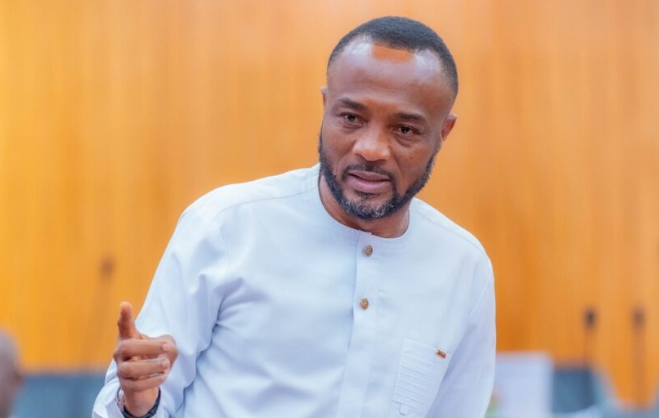
The Member of Parliament for Weija-Gbawe and Second Deputy Minority Whip, Mr. Jerry Ahmed Shaib, has called for a fundamental shift in Ghana’s approach to flood management, urging policymakers to move beyond emergency responses and embrace long-term climate-resilient urban development strategies.
Delivering a statement on the floor of Parliament on the theme, “Rethinking Flood Management in Ghana: From Disaster Response to Climate-Resilient Urban Development, with Lessons from Weija-Gbawe and the Greater Accra Region,” the legislator argued that the country’s recurring flood disasters require more than routine relief efforts and drainage maintenance.
According to him, the recent floods that affected several parts of Accra highlight the growing vulnerability of Ghana’s urban centres to changing rainfall patterns and the broader impacts of climate change.
“I rise today not only as the Member of Parliament for Weija-Gbawe, a constituency that has repeatedly suffered the painful consequences of flooding, but also as a representative concerned about the future of how we design, build and protect our communities across Ghana,” he said.
Breaking the cycle of flood disasters
Mr Jerry Ahmed noted that Ghana’s response to flooding has for years followed a predictable cycle: heavy rains cause devastation, emergency assistance is provided, drains are desilted, and attention fades until the next disaster strikes.
He questioned how long the nation would continue rebuilding the same communities after experiencing the same disasters without addressing the root causes.
“How many more times will we rebuild the same communities after the same disaster before we change the way we build our cities? Before we change our habits? Before we enforce accountability?” he asked.
The MP stressed that the country’s flood challenges are not solely the result of excessive rainfall but are largely linked to development practices that prevent water from flowing naturally through urban environments.
Weija-Gbawe among hardest hit
The Weija-Gbawe lawmaker highlighted the repeated flooding experienced by communities within his constituency, including Wiaboman, SCC and surrounding areas, White Cross, Away, Tetegu, Oblogo, Kokroko, Borla Road, Weija, Gonse and Glefe.
According to him, countless families have lost homes and possessions while businesses and schools have suffered extensive damage due to recurring floods.
“Our responsibility is not only to stand with these affected citizens in their moment of distress. Our responsibility is to ensure that we break this cycle,” he stated.
Immediate interventions needed
While advocating long-term reforms, Mr. Jerry Ahmed emphasised the need for immediate support for affected communities.
He called on government, through the National Disaster Management Organisation (NADMO) and other relevant agencies, to continue providing emergency shelter, healthcare, sanitation support, relief items and recovery assistance to flood victims.
The Deputy Minority Whip also urged authorities to undertake immediate desilting and dredging of critical drainage systems and waterways across vulnerable communities in Weija-Gbawe.
Areas identified for urgent intervention include New Weija East, White Cross, High Tension, Kokordjor, Tetegu, Oblogo, Weija Away, Djanman, Gbawe East, New Gbawe, Mallam West, Mallam East, McCarthy South, Wiaboman and Gonse.
Moving beyond bigger drains
Mr Jerry Ahmed reiterated that emergency interventions and expanded drainage systems alone will not provide lasting solutions.
He argued that no drainage infrastructure, regardless of its size, can effectively evacuate all water during extreme rainfall events that are becoming more frequent due to climate change.
Instead, he called for a shift towards modern flood management principles that focus on slowing water movement, storing excess water, spreading it safely and allowing natural absorption into the ground.
“Floods of the future cannot be managed only by building larger drains,” he cautioned.
Call for accountability
Mr. Jerry Ahmed urged Parliament to exercise its oversight responsibilities by demanding measurable action from relevant institutions.
He called on the Minister responsible for Works, Housing and Water Resources, together with other relevant ministers, to appear before Parliament and provide a comprehensive update on government’s immediate, medium-term and long-term flood mitigation strategies.
He also questioned the status of the Flood Task Force established by President John Dramani Mahama, urging the government to present its findings and recommendations to Parliament for consideration.
Additionally, he called on the Works and Housing Committee and the Local Government Committee of Parliament to invite Metropolitan and Municipal Chief Executives from affected areas to present their local flood prevention and preparedness plans.
“Flood resilience requires accountability at every level — national government, local authorities, technical agencies and communities themselves,” he noted.
Reforming Building and Planning Systems
A major aspect of the MP’s proposal focuses on strengthening development regulations to prevent the creation of new flood risks.
He argued that building approval systems must evolve beyond simply assessing whether structures are safe to occupy.
Authorities, he said, must also evaluate how proposed developments affect water flow and drainage patterns.
To achieve this, he proposed the introduction of mandatory water impact assessments for major developments, rainwater harvesting systems for residential and commercial properties, limits on excessive paving, and the creation of green infiltration areas designed to absorb stormwater.
He also called for strict enforcement against illegal developments on waterways, wetlands and environmentally sensitive lands.
According to him, these measures are not necessarily expensive but require strong political will and consistent enforcement.
Building With Nature
The MP further advocated a greater reliance on nature-based solutions as part of Ghana’s flood management strategy.
He described wetlands, floodplains, green corridors and natural drainage channels as essential components of the country’s flood protection infrastructure rather than vacant lands available for development.
“Wetlands store excess water, filter pollution, recharge groundwater and reduce the intensity of flood flows during storms,” he explained.
He warned that every wetland destroyed and every natural waterway blocked increases flood risks for surrounding communities.
Mr. Jerry Ahmed therefore called for stronger protection of wetlands and floodplains while encouraging efforts to restore vegetation and natural water absorption systems within urban areas.
He also raised concerns about the increasing use of concrete and asphalt across cities, which reduces the land’s ability to absorb rainfall.
To address this, he proposed a deliberate process of “de-hardening” urban spaces through tree planting, green corridors, permeable surfaces and the restoration of natural ecosystems.
“The future of our cities depends not on conquering nature, but on working with it,” he said.
Proposal for a Greater Accra Flood Resilience Plan
As part of a broader national response, Jerry Ahmed called for the development of a comprehensive Greater Accra Flood Resilience Plan.
The proposed framework would bring together engineers, hydrologists, environmental scientists, urban planners, local assemblies, traditional authorities and community groups to address flooding in a coordinated manner.
He outlined five key pillars for the plan:
Engineering and Emergency Preparedness, including drainage modernisation, continuous desilting and improved flood forecasting systems.
Nature-Based Solutions, focusing on the protection and restoration of wetlands, preservation of floodplains and creation of green corridors.
Smart Urban Development, incorporating climate-sensitive building regulations, water impact assessments and rainwater retention systems.
Community Stewardship and Behavioural Change, promoting responsible waste disposal, public education and citizen participation in protecting drainage systems.
Governance, Coordination and Accountability, ensuring clear institutional responsibilities, sustainable funding and regular reporting to Parliament.