
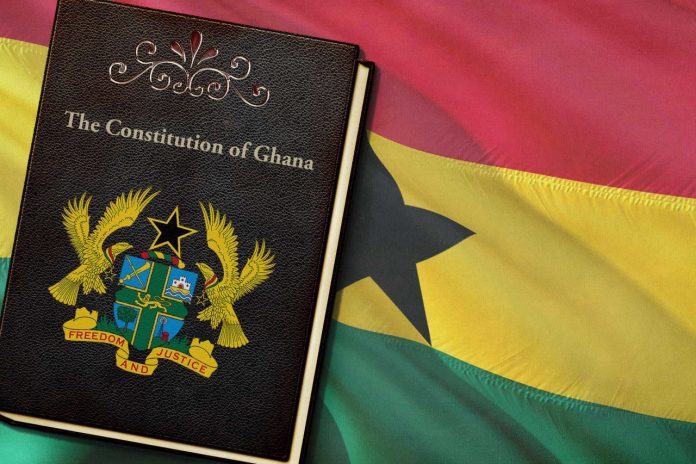
The government of Ghana has formally accepted one of the most consequential recommendations put forward by the Constitutional Review Committee (CRC), agreeing to extend the tenure of both the President and Parliament from the current four years to five years.
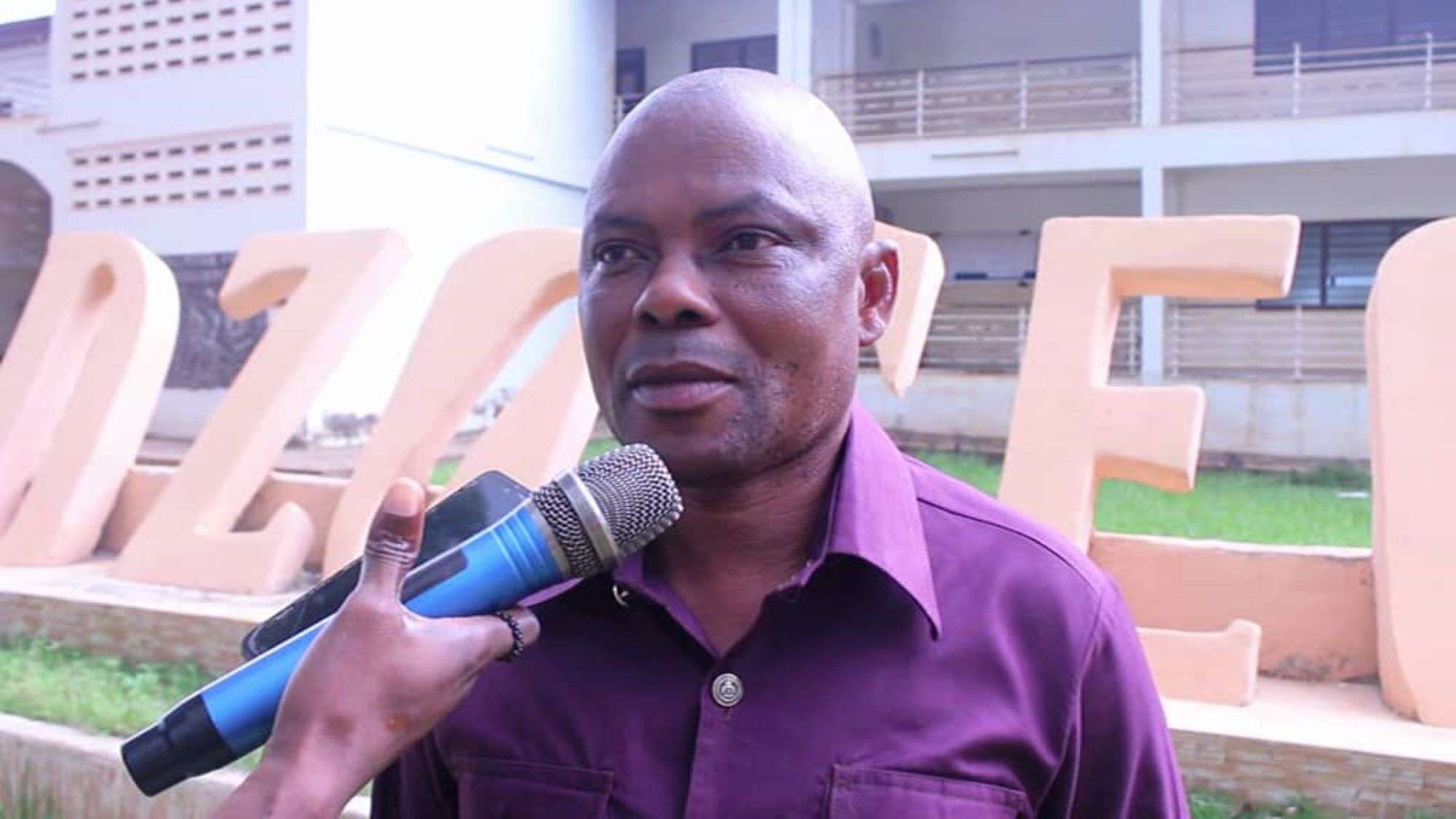
The announcement was made by Attorney General and Minister for Justice Dr Dominic Akuritinga Ayine as he presented the government’s White Paper responding to the CRC’s wide-ranging proposals for constitutional reform.
The Constitutional Review Committee in its report also called for an amendment to Article 62(b) of the 1992 Constitution to “lower the minimum age a person must attain to qualify for election as President from forty years to thirty years.”
Members argued that the change would open up the country’s highest office to a younger generation of leaders, in line with broader efforts to make Ghana’s democracy more inclusive and responsive to the aspirations of its youthful population.
Speaking at the presentation of the White Paper, Dr Ayine explained that the decision rests on a clear-eyed assessment of the practical realities of governance under the existing electoral timetable.
“The government has accepted a recommendation to extend the term of office of the president from four years to five years, with the term of Parliament extended to correspond with this,” he said.
The proposal, he emphasised, is designed to give successive administrations a more workable window in which to design, execute and evaluate their programmes before they must once again seek the mandate of the electorate.
Under the present four-year cycle, Dr Ayine observed, the effective period available for substantive governance is severely compressed. The early months of every new administration are dominated by the logistical and political demands of transition—handing over power, reconstituting the machinery of government, and settling into office.
At the opposite end of the cycle, the final year is largely consumed by the intense activities of campaigning, party primaries and the general election itself. The result is that the middle stretch of an administration’s life, the period during which genuine policy delivery should occur, is squeezed into a far narrower band of time than the constitutional text might suggest.
“Our thinking is practical. Under the current four-year cycle, the early months of every administration are consumed by transition matters, and the final year is largely consumed by elections,” the Attorney General stated.
In his view, a five-year term would restore a more realistic balance between the democratic requirement of periodic accountability and the practical necessity of giving elected leaders sufficient time to govern. “A five-year term provides a more realistic time frame for the formulation, implementation and assessment of government policy,” he added.
The extension is not intended to weaken democratic oversight. Rather, it is framed as an adjustment that recognises the complexity of modern public administration. Large infrastructure projects, multi-year social programmes, institutional reforms and the careful evaluation of policy outcomes all require sustained attention that a truncated electoral calendar makes difficult to sustain.
By aligning the terms of the President and Parliament, the government also seeks to preserve the synchronisation of the executive and legislative cycles, avoiding the potential complications that could arise if the two institutions operated on mismatched schedules.
Alongside the tenure proposal, the government has also addressed the CRC’s recommendation concerning the minimum age of eligibility for the presidency. The committee had proposed lowering the threshold from the current forty years to thirty years, arguing that the existing age limit excludes a significant cohort of otherwise qualified citizens from seeking the highest office. The government has accepted the principle of reducing the age requirement, but has chosen a more measured adjustment.
“Still under the presidency, the committee recommended that the minimum age of eligibility for election as president be reduced from 40 years, currently in the Constitution, to 30 years. The government has accepted this recommendation in principle, subject to one modification,” Dr Ayine announced. “The minimum age will be 35 years, not 30 years. And of course, the details of this will be fashioned out by the Constitutional Review.”
The decision to settle on thirty-five years rather than thirty reflects a judgment that a modest reduction still opens the door to younger leadership while retaining an expectation of substantial life and professional experience.
At thirty-five, a candidate would ordinarily have completed higher education, accumulated meaningful work experience and, in many cases, held positions of public or private responsibility. The government appears to regard this as a balanced compromise between the desire for generational renewal and the need to ensure that those who seek the presidency possess a depth of maturity commensurate with the office.
Taken together, the two accepted recommendations signal an intention to recalibrate aspects of the 1992 Constitution that the government believes have become misaligned with the practical demands of contemporary governance.
The four-year term, inherited from earlier constitutional arrangements, is now viewed as insufficient for the scale and complexity of the policy challenges facing the state. Likewise, the rigid age barrier of forty is seen as unnecessarily restrictive in a country whose demographic profile is increasingly youthful and whose political culture has matured since the early years of the Fourth Republic.
The White Paper presented by Dr Ayine forms part of a broader process of constitutional reflection. Once the details of the accepted recommendations are further refined through the constitutional review mechanisms, the proposals will proceed through the formal amendment processes required by the Constitution itself. Public debate, parliamentary scrutiny and, ultimately, the consent of the Ghanaian people will determine whether these adjustments become part of the supreme law of the land.
For now, the government’s position is clear. A five-year presidential and parliamentary term is judged necessary to give administrations the breathing space required for effective governance, while a reduction of the presidential age limit to thirty-five years is accepted as a measured step toward greater inclusivity.
Both changes, the Attorney General indicated, are grounded in practical considerations rather than abstract theory, and both are offered as contributions to a more functional and responsive constitutional order.