
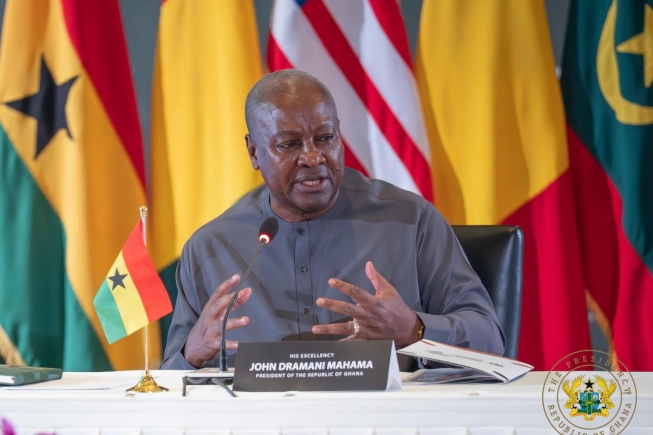
President John Dramani Mahama has been ranked fifth on Devex’s Power 50 list of the most influential people in global development, earning recognition for his leadership and advocacy of the Accra Reset.
Compiled by the respected global development publication, the Power 50 list highlights 50 individuals shaping the sector amid what Devex describes as “tectonic shifts” in the international development landscape.
Mahama’s placement in the top five positions him at the forefront of a new generation of leaders responding to the retreat of traditional foreign aid and the rise of private-sector-driven development.
His inclusion reflects a broader shift in how power and influence are exercised within global development.
At the heart of Mahama’s recognition is the Accra Reset, a bold framework aimed at redefining the relationship between African nations and the global North.
As major donors, including the United States, reduce foreign aid commitments, Mahama has emerged as a leading advocate for a “post-aid” Africa.
The Accra Reset emphasises domestic resource mobilisation, expanded regional trade through the African Continental Free Trade Area (AfCFTA), and strategic use of technology to tackle persistent development challenges.
According to Devex, Mahama has moved beyond the rhetoric of “Africa Beyond Aid” by implementing practical, market-driven policies that attract development finance while preserving national sovereignty.
Devex notes that Mahama’s influence spans multiple critical areas, highlighting his role in reshaping global development thinking.
The Power 50 list also features changemakers in philanthropy, finance, technology, and health. Figures such as Alexander Berger of Open Philanthropy and Nidhi Sahni of the Bridgespan Group are recognised for steering major private capital flows.
Innovators like Keller Rinaudo Cliffton, CEO of Zipline, are acknowledged for using AI and robotics to improve healthcare delivery across Africa.
In global health, reformers like Muhammad Ali Pate are noted for strengthening health systems to withstand future pandemics. Influential “behind-the-scenes” leaders, such as Avinash Persaud, are also highlighted for shaping policy and global climate finance.
By ranking Mahama among the top five, Devex signals a shift in the geography of global influence, recognising that the future of development is increasingly being shaped from cities like Accra.
His leadership through the Accra Reset exemplifies a broader rebalancing of power, as developing nations assert greater agency and demand a stronger voice in global decision-making.