
By Kwadwo Afari
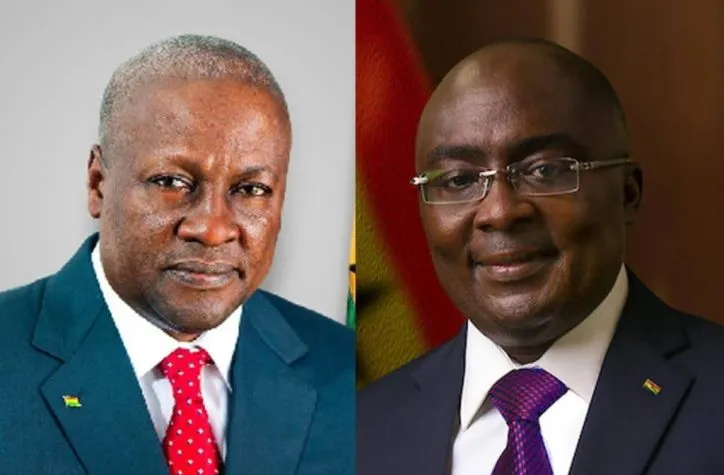
The two front runners in the December Presidential polls, Former President and NDC Candidate John Mahama and Vice President and NPP’s Candidate Dr Bawumia
While waiting for the written manifestoes of our presidential aspirants, their utterances as they go around the country reveal one painful fact: Ghanaian politicians still believe they have the magic wand to create prosperity, plan the entire economic life of individuals and groups, and by using the coercive power of the state determine beneficiaries in the economy. This gives grit to the argument that most of our aspiring presidents are out of touch with ordinary families’ lives.
Unfortunately, we are still battling to answer who plans what, by whom, and who gets what in the economy. The 1992 Ghana Constitution, in the Directive Principles of State Policy, says the state must eliminate poverty by re-distribution of wealth. This perspective automatically divides Ghanaian society into two — rich and poor — forgetting that prosperity depends on an environment that ensures that individuals retain clear titles to their properties, enforce contracts, have a stable currency, lower taxes, and tariffs, and reduce corruption and indiscipline.
In this economic crisis, the government or politicians are not the solution to our problems; the government and politicians are the problem. The belief that our current economic problems can be solved by enacting laws or creating a government agency with aid money and illegally printed money from the Central Bank is a simplistic and hypocritical stance.
Indeed, in this economic crisis, we rather need to reduce the size of the government, not use large government to solve economic problems. In an economy characterized by a large informal sector, it is nonsensical to maintain certain regulatory and entitlement structures. Our large governments have failed to be accountable to the citizens of Ghana, doubled the national debt and overregulated the free market economy, despite not having a good understanding of it. They have neglected to address corruption while attempting to control schools, businesses, and personal lives.
We are made to choose among political parties, yet the trajectory of our democracy has been to largely ignore such communities of small property owners and the effects that entitlement policies have had on the economy. Unfortunately, in our mixed-economy democracy, the actions of our politicians always reflect not the will of the majority, but interest groups, cronies and partisans.
It is time for change!
It is time for a change. We repudiate the absurd idea our poverty is the result of external shocks. This requires thought, not emotion to understand. Change does not require ringing phrases, high-flowered sentiment, and promises to the ‘so-called’ poor. This is the time to repudiate the false gospel of Ghana’s victimhood and retreat. We suggest an opportunity society based on the principles of sustainability, competitiveness, and fairness. These principles would enable individuals to use their wits and abilities to determine how best to put a roof over their families, food on their tables, and shoes on their children’s feet. It is time to create a country that works. And works for everyone, not just partisans and cronies.
It is up to you and it is up to me
When politicians say they will create wealth, they lie. Ghanaians should worry about the rising deficits, growing government spending, and their tendency to create social instability. The rising deficit usurp the earnings of every productive citizen of Ghana. Central planning of our financial sector has not created jobs, it has killed them. It has not limited risks, it has created more. It has not encouraged economic growth; it has shackled it. It is time to renew our faith, and shun communal and tribal politics and insist the debate is focused on real issues of the individual. We should abhor injustice, unfairness, and inequality and insist on ideals and values like inclusiveness, property rights, the rule of law, and equal respect and opportunities for all individual citizens.
What can we do?
It has always been the economy, stupid. Economic models driven by politics and vote-bank appeasement policies have relegated wealth creation to the backburner. To create wealth and reduce poverty, we have to confront the invisible philosophy of government underlying current policies of government trying to create wealth and not the environment for individuals to do so perfectly.
The government is just a tax-collecting, printing money, and borrowing machine, which means the source of wealth lies outside the government. Wealth creation simply lies with individuals and not the state or government. The preferred policy of transferring income from the poor to the state to be shared equally and from the state, in a Kwaku Ananse form of distribution, back to the so-called poor, the aged, and the unemployed, keeps the poor majority always trapped in poverty.
Rebuilding the Economy and Creating Jobs
-Role of Government: Reduce the role of government in the economy, business, industries, and individuals and stop politicians from enriching special interests.
-Regulations: Compete to attract businesses, investors and citizens. Excessive regulations and bureaucratic hurdles drive investors away.
-Tax Reform: Reduce the corporate tax from 25% to 15%, and reduce the tax burden on individuals and businesses. This will encourage work and production.
-Rule of Law: Restore the dignity of the Judiciary. Corruption must be punished, and deterred, irrespective of position or political affiliation.
-Property rights: Recognise the rights of land owners to enable poor individuals to use their physical assets to generate capital easily.
-Fiscal Responsibility: Introduce a balanced budget/tax limitation amendment that would enforce fiscal responsibility in government, forcing politicians to adhere to the same budget constraints as families and businesses.
-Inflation: It is the quality of money that matters, not quantity. ‘Haircuts’ or devaluation or depreciation is not a good policy for wealth creation
-Free Trade: Encourage policies that promote free trade, open markets, and economic cooperation with ECOWAS.
-Education Reform: Scrape the SHS boarding system, and allow parents who choose boarding to pay the full cost without any subsidy. Reduce government involvement in tertiary education.
-Healthcare: Reform the NHIS and reduce government intervention in private healthcare decisions.
Agriculture is the primary source of employment in Ghana, providing over half of all jobs. In rural areas, more than 80% of people work on farms. These small-scale farmers are responsible for producing almost 85% of the food that households consume. Unfortunately, small-scale farmers face problems with credit and labour. The objective is to enhance the economic prosperity, progress, and quality of life of small-scale rural farmers who cultivate between 1 and 30 acres annually.
-Access to Credit: Connect farmers to guaranteed lines of credit, using their lands for collateral, and expand financial packages. Rural banks are vital for small-scale farming and small business funding.
-Biodiversity: Decrease the use of fertilizer, and encourage organic farming in certain areas. This will reduce pollution in the country’s rivers and streams.
Encourage planting of medicinal plants and their processing for exports.
SMALL-SCALE MINING
-Decentralise licensing, monitoring, and supervision to the Assemblies.
-Communities do not own land, individuals and families do. Treat small-scale mining as a vehicle for wealth creation at the local level. Involve individual property owners and promote a 1-5% royalty payment to landowners, including individuals and families.
-Small-scale miners should bear the cost of pollution and reclamation, not the taxpayer.
We hope that manifesto writers will adopt all or some of our suggestions. Together, we can restore economic growth in Ghana and renew our faith in the future.